

New York State
Exit Interview: Syracuse Mayor Ben Walsh did it his way
The independent elected official bucked the family’s Republican legacy, and that was OK.
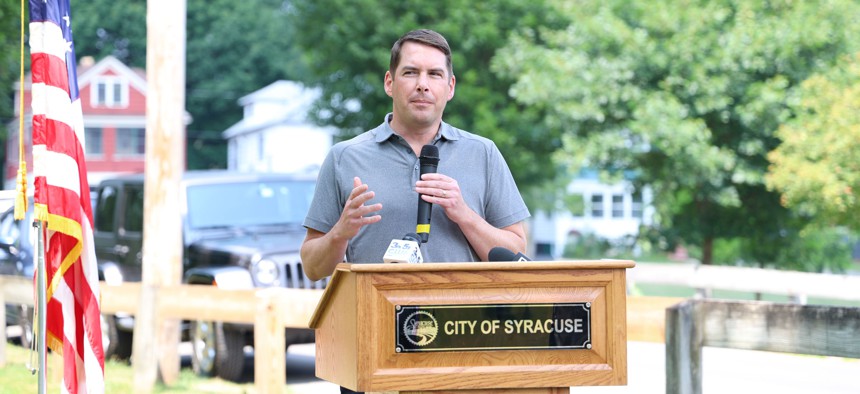
Syracuse Mayor Ben Walsh hopes to work in Syracuse after he leaves office. Mayor’s Office of Syracuse


Syracuse Mayor Ben Walsh’s term ends on Dec. 31, and it has been a ride. From crime scene tragedies to major economic development wins, a lot has happened during his eight years in office. The job itself hasn’t worn thin, but it seems he’s had his fill of politics, even if he still plans to be involved in the community.
Walsh made his history as an independent mayor, running and remaining in office with a last name associated with Republicans while governing a city comfortably controlled by Democrats. His successor, Democratic Deputy Mayor Sharon Owens, may change the party leading City Hall, but Walsh is confident that public service will trump all.
Walsh spoke with City & State on Election Day to discuss his transition out of elected office, the highs and lows of his administration and the pressing issues facing Syracuse. This interview has been edited for length and clarity.
It’s Election Day, so I think if there’s ever a perfect time to reflect, it’s probably today. Does this have you thinking back to your first run at all?
It certainly makes the transition real, and I’ve been saying to people that I know the end is coming, but I just keep showing up to work every morning and doing the job because that’s what I’ve loved to do for the past almost eight years now. But this morning was different, starting with me putting on my lucky socks that I wore when I won in 2017 and again in 2021 and I’m wearing them to bring some good luck to Deputy Mayor Sharon Owens, but yeah, today feels different, and I’m sure tomorrow is going to feel even more so.
What is it like to play out those last few months of your final term?
I mean, it’s bittersweet. I’m ready, but as I said, I have absolutely loved this job, and it’s hard to imagine doing another one, but assuming Deputy Mayor (Sharon) Owens is victorious tonight, I couldn’t think of a better scenario for a transition. I mean, I’ve been talking a lot to our team about just the inherent kind of awkward nature of transitions, understanding that some people will be staying, some people will be going. It is hard, and there is a certain kind of tension that flows throughout City Hall because of it. But I think looking at other potential scenarios and previous transitions, this is, again, assuming Sharon wins, this is about as good as it can get. I’ve been showing up to work every day, doing the work, pushing to get as much done as we can before the end of this year, and so that isn’t going to stop even after today.
Do you feel like your career has been unique at all, since you have that lineage of public service dating back to your grandfather?
It’s not a coincidence that my family is full of public servants, and I happen to be in public service. The way I describe it to people is I’ve spent my life surrounded by people that help other people and that do good, and that’s infectious, and that’s not limited to my father and grandfather. That’s my mom’s work as a teacher, my aunts and uncles as social workers and judges and hospital administrators. It’s part of growing up in this family. So I always aspire to find my own niche within the public service arena. I didn’t expect it to be an elected office until more recently, probably about 10 years ago or so. But again, there’s a reason why I ended up in this line of work, and I’ve got some great role models who have helped shape the way I go about the job.
Did you ever have any doubts or start second-guessing others?
Well, I have not made a secret of the fact that the campaigning part, and more specifically, that just the politics of the job is my least favorite part. I actually enjoy the door to door. I enjoy the kind of retail politics, but the party politics and what goes into that is not something that I enjoy, and it’s not only because of how it affects other people, it’s how it affects me. I like to assume that people are doing the right things for the right reasons, and I certainly felt that when I was running for reelection. But when you begin to see people you’re used to previously acting one way start to act differently, and being pretty sure that it’s largely based on politics, I don’t like second-guessing people’s motivations and what it does to me. I’ve said for the position of mayor, I felt that it was worth it to deal with the downside of politics in order to have the upside of serving the city that I love and that I grew up in. At this point in my career, I have a hard time seeing another elected office where I would feel the same way. But I’m 46 years old. I’ve still got plenty of gas locked in the tank, so still trying to figure that part out.
With being an independent when other members of your family have been elected officials as Republicans, did that ever cause any friction within your family, or was it understood what you were trying to achieve?
Yeah, I think they understood what I was trying to achieve. My parents wrote a letter to registered Republicans in my 2017 campaign, and it said, “You raise your kids to be independent thinkers, and darned if that’s what they turned out to be.” I think they meant that, with all sincerity. They raised me to think for myself, and I think they’re really proud of me for that and for the way I went about it. As I explored my first run, I had a lot of people saying, “Look, it’s a heavily Democratic city. The only way you’re going to get elected is as a Democrat, and your last name is Walsh in Syracuse, and so that’s just never going to fly.” But ultimately, I decided that if I was going to put myself and my family through the downside of politics, I needed to do it in a way that stayed true to myself, and for me, that was maintaining my independence, which I’ve had ever since I registered to vote. Ultimately, I think it was staying true to myself and connecting with people on issues and shared love for the city that ultimately helped me be victorious. Going back to the family, while you know that my last name has been associated with the Republican Party, I think even more so it’s been associated with good, honest public servants. I think it helped me more than it hurt me, even in a heavily Democratic city.
Can you take me through the highest and lowest points of your time in office?
The lowest is, unfortunately, easy. It was when Officer Michael Jensen and Lt. (Michael) Hoosock were killed, that was just a brutal night. I’ve spent a lot of nights out on crime scenes and up at the emergency room, but the scene that I encountered at Upstate (University Hospital) emergency room that night was something that I’ll never forget. The pain that I saw in the officers’ eyes and the emotion was overwhelming, and obviously that did not end that night – that’s something that’s stuck with me and stuck with this community ever since. By far, that was the worst night on the job.
In terms of the highs, that’s a little bit harder for me, because, as my team knows, I don’t tend to dwell on the wins, on the victories, probably to a fault. But when I look over the past eight years, I think that the moments for me that have been the most enjoyable have been time spent with my team, my colleagues, my department heads, whether it was at a department head meeting or an off-site retreat. One of my most significant accomplishments was pulling together just an incredible team of public servants. The time that I’ve spent with them is time that I really have relished. Moments where we’ve cut ribbons on projects that have a real impact on people’s lives. When I’ve welcomed families into new homes and they’re the first people in their family ever to own a home. Those are the moments that get me a little teary-eyed and really proud of the work that we do.
Do you have any concerns about the Micron project?
Well, so I wouldn’t say concerns. I see it as a challenge and an opportunity. So I believe strongly that it’s going to happen. It’s moving forward. We’re seeing the tangible investments that Micron has made in the community, from their new downtown office space and their sign hanging on the top of the building for all to see across the skyline, to the investments they’ve made in different projects and programs throughout the city, including our new STEAM High School, which I’m incredibly proud of. It’s all very real. I think what tempers my enthusiasm and excitement for the project is ensuring that the city of Syracuse and residents within the city of Syracuse truly benefit from the project. I think under any scenario, it’s going to be successful and it’s going to have a positive impact on the community. But if we want it to have a truly transformational impact, we need to ensure that city residents are being connected to those opportunities, and we are changing the trajectory of people’s lives, helping families overcome generational poverty. Those are the things that will truly move the needle, and I’m cautiously optimistic. We’ve been investing in programs for the past eight years that I think have helped us be able to sell Micron on our ability to deliver for them, and that have positioned the city as well as we can to maximize the community benefit of the project.
With the Trump administration’s tenor toward a variety of projects in blue states, but specifically I-81 in your case, do you have worries that your successor will have a big challenge on their hands making sure that the redesign goes ahead as planned?
I mean, the I-81 project is well underway, and there’s nothing that’s going to stop it now. We worked really hard to get the community prepared for that project, to get everyone generally on the community grid option, which is what we’re moving forward with. If you drive through Syracuse today, you will be painfully aware of the project being underway, because there is a lot of construction. Unfortunately, because of the Trump administration, we lost the majority of a $30 million Reconnecting Communities grant that was set to really help us maximize the benefit of the project for the people in the city, and we’ve talked a lot about the the history of I-81 and cutting a scar through the heart of the city and reknitting the fabric of our community. When you look at the federal Reconnecting Communities program, it was developed with I-81 in mind, and other projects like it. Similar to my point about Micron, under any circumstance, the I-81 project is going to be successful and is going to have a positive impact on the community. But I think that it’s all the things that we do around it, whether it’s improvements to infrastructure, pedestrian and bicycle infrastructure, enhancing access east and west across the city. Those are the kind of extra things that Reconnecting Communities was going to help us with. Now the good news is the state was able to retain its part of that grant, which was the much larger part, about $150 million, but it hurt, and I do worry about additional actions coming out of Washington that may set us back. I have consistently said, and I had the opportunity to say it directly to President (Joe) Biden on a couple occasions, but most recently as he was finishing up his term, that when you look at the projects and the programs that were developed in his administration, along with the support of Congress, the bipartisan infrastructure law, I-81 would not be happening without that.
While you’ve been in office, have you felt like Syracuse and Central New York have received equal attention compared to other regions of New York?
We mentioned some of the big-ticket projects, from I-81 to Micron, we’ve been very successful over the history of the Regional Economic Development Council programs and the Consolidated Funding Applications. We consistently are among the most-awarded regions and, most recently, received significant support from Gov. (Kathy) Hochul for Upstate hospitals. When we’ve come together as a region and made big asks to Albany, and specifically Gov. Hochul, she’s delivered. I try not to look at it as a competition between Syracuse and other cities, and it really isn’t, but if it were, I think we fared very well.
Is there anything you really hope gets taken care of by the next mayor of Syracuse?
I felt like the first year, I was chasing the finish line. I was trying to get to a point where I would complete everything that I wanted to complete. It dawned on me again, probably about a year in, that there is no finish line, especially in Syracuse, where there are term limits for mayor; it’s about moving the community forward, advancing your priorities as far as you can, and then positioning your successor to pick the ball up and continue moving it forward. I think we’re really well-positioned to do that. So when I think about what some of my major priorities were, I’ve largely accomplished everything that I set out to. It doesn’t mean that everything’s done. We have some large housing projects that are closing on their financing at the end of this year that won’t be completed for a couple of years. There’s always going to be unfinished business, but the goal is, in the spirit of the Athenian Oath, leaving the city better than you found it, and I feel very confident that I’m doing that. I think we’re in a unique opportunity, if Deputy Mayor Owens is successful, to really just carry our work forward, and not to say she isn’t going to have her own priorities and her own approach, we’re very different people in many ways, but I think what we share is, generally speaking, our priorities and our approach to governance, which is rooted in public service and people.
Would you recommend electoral politics as an avenue for people who want to make change in the world?
Absolutely. Now more than ever, we need good, honest people in government that bring subject matter expertise and skills to the table, that bring optimism and hope to the table. But I’m very honest and I talk to aspiring politicians, elected officials, public servants … all the time. Most recently, I spoke to a group of veterans who are taking a course up at the Maxwell School at Syracuse University, where I earned my master’s in public administration, and I did encourage them to get in the ring, but warned them that it is really hard. It’s taxing, personally, emotionally, spiritually. It takes a toll on your family, and so when you make the decision to do it, it can’t just be your decision. It has to be made in conjunction with your loved ones. So it’s really hard, but it’s really worth it. That’s the only way that our democracy survives is if we continue to have good people that are willing to raise their hand and step up and serve.
Do you have an idea of what you want to do next?
Still figuring it out. So I have a couple of key criteria. One is, stay in Syracuse. This is my hometown, and I’m excited to be a part of the continued momentum and change that’s coming to this community. My wife and I have been in our home for 19 years. Our daughters are in 10th and seventh grade in the Syracuse City School District and are really thriving, and so we have no reason to leave, and so we don’t intend to. Beyond that, find a different way to do good and to support the community, but I’ve received a couple of unsolicited offers and or expressions of interest from prospective employers. I have a few other irons in the fire, and I’m just trying not to rush it. I’m trying to make sure that it’s the right next move for me. My one piece of advice I always give to people who are at a moment of transition in their professional lives: It’s what my dad would always say to me is “you don’t have to know what you want to do for the rest of your life. You just have to know what you want to do next.” So that’s really what I’m focused on. I anticipate that I’ll do numerous things before I retire. So I’m not resting all my hopes on that.
Do you have a parting message for Syracuse residents who might want some reassurance for the future?
It has been an honor to serve and I have truly loved every minute of it, even the really hard parts. There’s nothing else that I would have wanted to do for the past eight years. I am very bullish about the future of the city, and I think that our residents should be as well.