

Budget
Does a late state budget really mean a less productive legislative session?
An analysis by City & State suggests it doesn’t.
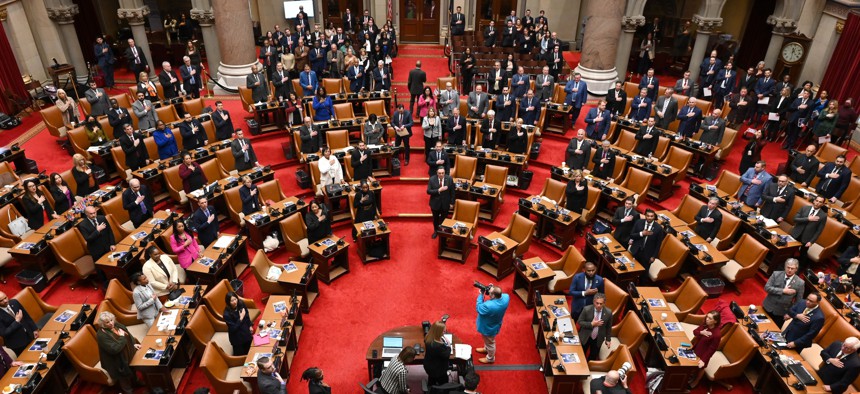
The Assembly gets sworn into the 2024 legislative session, one of Democrats’ less productive years with a more timely budget. Lori Van Buren/Albany Times Union via Getty Images



With the exception of 2020, when the onset of the COVID-19 pandemic interfered with legislating, the 2026 state legislative session was Democrats’ least productive since they gained control of both chambers in 2019. Though lawmakers cast blame for that on the tardy budget – the most delayed since Hochul took office – the timing of the budget hasn’t had a clear correlation on how many bills lawmakers managed to approve, according to an analysis by City & State.
Legislators approved 759 bills in both chambers this year after Gov. Kathy Hochul ushered in the most delayed spending plan in 16 years. But a more on-time budget hasn’t always meant a more productive session. In 2024, when the budget passed on April 20, 805 bills passed through both chambers. Democrats also benefited from the leverage offered by veto-proof majorities in both the state Senate and Assembly. That year’s budget was one of only two spending plans under Hochul that actually got approved in the month of April, and was the governor’s second-most timely budget.
But in 2023, when the budget was approved May 2, lawmakers managed to pass 896 bills through the Legislature, despite taking more time to complete the budget compared to 2024. That’s the third-most bills legislators have approved in a single session since 2019. Democrats even passed 856 bills in 2025, when the budget passed on May 9 and they had lost their supermajority – and therefore negotiating leverage – in the state Senate.
Coincidentally, legislators had the same number of scheduled post-budget session days for each of those three years – 18 total shaded boxes on the legislative calendar. In nonelection years, legislators tend to stretch their session time slightly longer, even if all sessions typically have between 60 and 62 days scheduled in total.
Yet Democratic legislators’ most productive year since taking back control was in 2022, an election year with an earlier conclusion, when lawmakers passed 1,007 bills through both chambers. The scheduled session concluded on June 2, a particularly early end of the legislative session. It’s comparable to the June 4 scheduled end date of the 2026 legislative session.
Many differences exist between the 2022 and 2026 legislative sessions, perhaps most notably the amount of time it took to finish the budget. In 2022, Hochul’s first spending plan as governor, the budget was relatively timely, and was done just over a week past the April 1 deadline and leaving legislators roughly the usual two months for other business. This year, lawmakers didn’t wrap up the budget until May 27 after prolonged negotiation with the governor. It left lawmakers just six session days for everything else.
But that’s not the only difference. Democrats in 2022 were freshly empowered under a new governor who promised a new era of cooperation after a tense working relationship between Democratic leaders and former Gov. Andrew Cuomo. Additionally, the state Senate was in its second year of its most powerful supermajority in recent history with 43 members.