

New York City
Joe Crowley talks about how Queens has changed over the past 20 years
In an interview for City & State’s 20th anniversary, the former member of Congress also looks ahead to the borough’s next two decades.
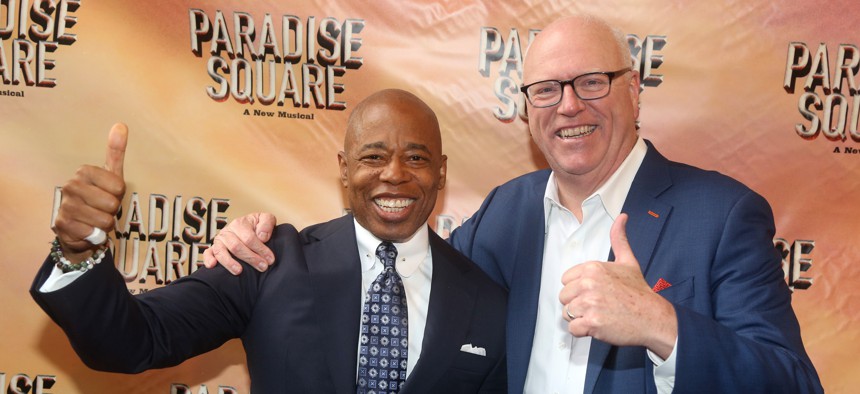
Then-New York City Mayor Eric Adams and former Rep. Joe Crowley at an opening night on Broadway in 2022. Bruce Glikas/Getty Images



No single moment in the past 20 years better represented the changing face of Queens political power than former Rep. Joe Crowley’s 2018 Democratic primary defeat at the hands of a then-unknown bartender named Alexandria Ocasio-Cortez.
Before that, Crowley was a longtime power broker in Queens, as both a member of Congress and the leader of the Queens Democratic Party. He also wielded influence nationally as the chair of the House Democratic Caucus. So as City & State New York celebrates our 20th anniversary, we caught up with Crowley, now a senior policy director at Dentons, to discuss how the “World’s Borough” has changed since 2006. This interview has been edited for length and clarity.
How would you characterize the changing face of Queens politics over the past 20 years?
Obviously, there are a lot of changes in the past 20 years, and I was part of much of that change as well. And I was speaking about my own final primary before recognizing the influx of new immigrants, the influx and influence of minority communities that before that had the level again, of that influence talking specifically about the Chinese American, the Korean community, the Latino community, the multiple ethnic groups within them that emerged. But I think it’s a tribute to Queens County, in many respects, as a welcoming place where there is opportunity politically. But beyond politics, there’s opportunities as well. I think Queens is in a good place, I think overall, and I think I played a role in securing that to some degree.
One of the biggest changes in Queens politics has been the growth of the Democratic Socialists of America in the electorate, how do you see that having an impact?
I haven’t yet seen it happen on the boroughwide basis, whether it’s (district attorney) or for borough president, for countywide office, so to speak. You know, really not in other congressional districts, for instance, that isn’t really reflective, I think, in a bigger picture. Looking at what happened in the mayoral election, and I don’t know what happened in Queens, I don’t have it in front of me, just looking, generally speaking, the first time that a mayoral candidate got a million votes in Mamdani at the same time really people voted against him, which is really interesting too. Here’s a city, it’s 4-to-1 Democratic enrollment advantage over Republicans, and he gets 50.4%. I still think that, and all the power to him, I think he’s a very good politician. He’s good on his feet. He comes across very well, a very attractive candidate. I think that sometimes lost in terms of, the first Muslim American, the first DSA or all these other things, that it really wasn’t a landslide election in terms of (the) general election.
And just looking back on your own career in Congress and in the state Legislature, what are some of your proudest accomplishments?
When I was in the state Legislature, I required the teaching of the Great Hunger in the New York state curriculum. And then it’s a law (requiring the teaching of how) the tool of hunger is a tool of suppression in countries, whether it be in Ireland at that time, but around the world, China, where they’ve done it, and they’ve done it in Russia, did it elsewhere. They do it in Africa and that needs to be taught and understood as to why that happened. But the effect that that event had on the development of New York state. New York City was a majority Irish-born city at that point in time. I think in terms of my work on female genital mutilation and trying to end that practice (was) something that I was very passionate about and had some success in terms of legislation in the Congress. The work that I did on the Affordable Care Act is something that I was very, very much a part of working with then Speaker (Nancy) Pelosi in in a leadership capacity as the head of the New Democrat Coalition to make that come to fruition.
There is ongoing speculation that Rep. Alexandria Ocasio-Cortez could run for president or the U.S. Senate in 2028, what are your thoughts?
As objectively as I can, and I have no ill will toward her at all. All is fair in politics, love and war in politics, right? I lived by the sword. I died by the sword. I did everything I could to have a win, because I wanted to win. I reflect on it. Certainly back then, I thought I was pretty reflective, considering what had happened. When I look at what’s happening right now, whether or not you can really transpose what happened in the congressional district to statewide or nationally, is a big if. If you look at Queens itself, is it ready to elect a borough president as a democratic socialist? I don’t know. They rejected it at the district attorney level. I think Mamdani, interestingly, got 50.4% of the vote in the general election citywide. New York City is the bastion of liberalism, so to speak, in the state. You run statewide, it’s a big state. It’s a lot different in terms of the Democratic primary vote as well. So I don’t think any of that is a slam dunk for anyone running statewide or or nationally at this point. I think there’s a place for it within the Democratic Party itself, certainly part of the coalition.
Where do you see Queens politics going in the next 20 years?
I think it’s an exciting question to see what happens to Queens overall. I think Queens is developing. It’s changing. I think the need for more affordable housing is still going to be there. I think the future is bright overall for Queens, because I think we have great assets. We have the two airports, we have access via subway and Long Island Rail Road and bus system into Manhattan. I think one of the things I’m disappointed in Queens is my hope that western Queens would be the corridor for the tech community. I think the Amazon decision was foolhardy. I don’t think that was a good thing to have happened. I think my vision was in accordance with what was happening with Bloomberg on Roosevelt Island. The cost of real estate was $30 on a square foot, as opposed to $100 in Manhattan at the time. And it was a good opportunity for the development of incubators and (the) tech community within the western Queens corridor. I still think there’s opportunity there for that, given its proximity to the city and yet not being directly in Manhattan and the costs that are incurred there, my hope is that someone will pick up that challenge, and especially as we enter into the world of AI.