

Nonprofits
How a clothing partnership supports threatened refugees
New Neighbors Partnership’s long-term community-based model continues to build trust among vulnerable newcomers.
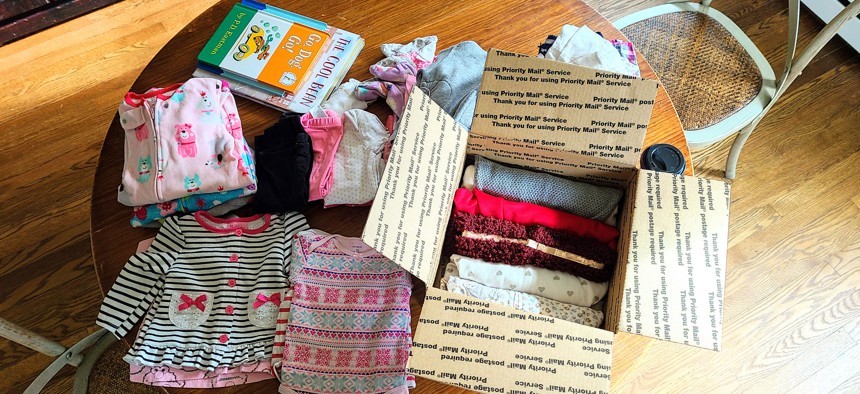
A clothing package for a family involved with New Neighbors Partnership. New Neighbors Partnership


Since the Trump administration suspended the U.S. Refugee Admissions Program a year ago, many asylum-seekers have been relying on their communities for support. With their list of eligible benefits dwindling, many newcomers (refugees, asylum-seekers and humanitarian entrants) now face severe restrictions to SNAP benefits, Medicaid and children’s health insurance, according to the National Immigration Law Center.
With deportation threats continuing to increase in recent weeks, community-based organizations like New Neighbors Partnership have become increasingly vital resources – acting as trusted messengers to help families navigate through unpredictable circumstances.
In 2017, founder Shoshana Barzel took on volunteer tutoring with refugees, where she first came in contact with an Afghan mother in need of baby clothes. Barzel, who at the time taught translation at Columbia University and Barnard College, then connected the Afghan mother with a friend willing to share her daughter’s hand-me-downs – thus starting the basis of New Neighbors Partnership. By 2020, Barzel juggled a spreadsheet of 100 kids and soon decided to start her own nonprofit. Six years later, the Partnership serves 600 individuals from 42 countries, and its staffers have a variety of lived resettlement experience and speak up to 20 languages.
As threats to refugees and asylum-seekers persist, with 10% of New Neighbors Partnership’s families living in shelters, New York Nonprofit Media spoke to Barzel about the nonprofit’s long-term integrative model and how the community she built is bracing for major policy changes. This interview has been edited for length and clarity.
I’m curious to learn more about the early days of New Neighbors Partnership. How did you meet these mothers, and how did your spreadsheet grow from one person to 100 within months?
So I started New Neighbors really by accident. I was teaching at Columbia University, which was my dream job, and I thought I was there forever. On the side, I was doing some volunteer tutoring with refugees, specifically with a mom from Afghanistan who was pregnant. She didn’t have a community here and I happened to have a friend who had just had a baby and had so many extra supplies, so she shared a round of hand-me-downs with that Afghan mom. Then six months later, she came back to me and said, my daughter’s grown, I have more clothes, should I give them to the same person? And that seemed like such a good idea to me, that I just started making more of those family to family connections between a newcomer family and a local family, who had a slightly older child. I think a lot of successful nonprofits start when someone realizes a problem and fixes it, without even realizing they’re starting a nonprofit. It’s much more of an organic solution that comes from actually being in touch with the problem every day.
I want to get a better understanding of the asylum-seeker families you serve. Could you share what their statuses look like right now?
We have had a fair number of families lose status because of the administration’s new policies. Families from countries where things are not resolved, where there’s still incredible ongoing violence. They fear for their lives to return, and their status has been revoked because the reason given is that the “crisis has been resolved.” I can tell you the crisis has not been resolved. But even the families who haven’t lost their status are really living in fear. I’ve heard rumors of this happening – we haven’t had it happen to any of our families yet, of reinterviewing families who came in under the last administration as refugees. So now we’re talking about permanent legal residents who are going to go through the whole interview process again. They have every right to be nervous. They’re going to have to tell their stories again, which are often traumatic, and it’s going to have to line up exactly to what they said five years ago about something that happened maybe eight years ago or 10 years ago, and it’s going to be picked apart for continuity with every single detail.
Are you mobilizing any additional resources to help them?
We’re trying to make sure that everybody is connected to legal support. We don’t do any social services in-house. We sort of see ourselves as fitting a totally different niche of longer-term community resettlement support. But families come to us with questions about absolutely everything, and for 84% of families in our program, we’re their only or primary source of support. So we try to support the volunteers with accurate information about trusted immigration resources – and then, of course, providing emotional and community support. A lot of the families feel really unwelcome and really scared. So we’re sending the message that they are welcome here, we do want them and we do think they enrich our community.
In 2022, there was a lot of coverage surrounding the migrant influx in New York City. How has that changed? What’s different about being an asylum-seeker or refugee now?
There’s a lot of eligibility for support that’s been stripped. Refugees are not eligible for SNAP anymore, along with special immigrant visa holders. The refugee resettlement organizations that often provided a lot of the support to asylum-seekers or people with other humanitarian statuses are operating at a very reduced budget. I think that’s why we’ve had to sort of ramp up our operations, because families are relying much more on the community-based work than on the official (sources). Also, people are really scared of registering for benefits. So they’re really not getting a fraction of the institutional, structural support that they’re used to.
Community organizations like yours have a trusted status among vulnerable groups. Do they feel more comfortable, to a certain degree, interacting with you and asking questions?
I think there’s a few reasons for that. So we actually survey our families about a lot of things, and one of the things we ask is to rate how much they trust the information that comes on the WhatsApp threads that we send out. We also ask whether they’ve shared any information they’ve gotten from our organization with someone outside of our organization, which is sort of a proxy for trust. And those numbers are extremely high. We have a 97% rate for “strongly trust,” among a pretty difficult to reach and difficult to trust population. We have families who were targeted by their governments and are really hesitant to share anything. I think the reason for that is the nontime-bound aspect; we’ve known families for years. We’re sort of the continuity and the through line, which is why the community-based aspect is so important. And then I think also, the language capacity that we offer on staff is a huge aspect.
Your model is really trying to pair families together. Is this relationship consistent throughout the entire time they’re with New Neighbors Partnership?
Yeah. We have amazing retention of volunteers and partnerships. I say amazing because I think families with young kids are a really hard group to engage as volunteers. We have managed to match volunteer families in our program for six to eight years, and that continuity is really important. I think most nonprofits measure success by how quickly someone doesn’t need their program anymore. We are not that way. We’re not a time-bound program. Families can stay in our community as long as their kids are growing and as long as they want to.
I’m curious to get a better understanding of your volunteers. What’s their background?
I think it’s a very big mix. I think most of the volunteers have some kind of connection to a refugee or immigration story, but it’s not necessarily their generation. So, it could be that their grandparents or great-grandparents were refugees who fled, or some who came here as families, as kids. I remember one partner family, the dad came from Vietnam after the Vietnam War with his family as refugees when he was, like, 5 or 6 years old. I was with them in the home of the family that they were partnered with. They were visiting for tea, it was a family from Afghanistan, and they had just arrived. They also had a boy who was 5 years old, and the father had this moment of like, wow, that was me, you know, 40 years ago. So I do think there’s a lot of identification.
I'm also curious to know a little bit more about the Ramadan initiative, what was the inspiration behind it?
I can’t take credit for it. It started with Khadija Kakar, our program manager, who fled Afghanistan after the Taliban takeover in 2021. She brought to a staff meeting that there are a lot of folks from Afghanistan who are celebrating Ramadan for the first time away from home, having trouble finding the supplies and foods. I mean, I’m Jewish, but it would be like celebrating Christmas here and then going to a country where most people haven’t heard of Christmas. So we very quickly stood up a program in 2022 and have continued every year to grow. Basically, we take our clothing partnership model, and a lot of the volunteers are partner families, and they get a personalized profile, and then create a personalized package with all the food, supplies and gifts they could want. We do everything really personalized to keep the humanity and dignity of folks at the center of it.
Amid the remaining refugee resettlement programs and nonprofits in New York City, what distinguishes your organization?
We work in partnership with 30 or so nonprofits, so I think everyone plays a very vital piece of that network. I think the role that we play that others don’t is the sort of long-term dignified community support that we’re not time-bound. Like most organizations, we center dignity with every stage. We don’t call them clothing donations. We say you’re sharing hand-me-down clothes with your partner family. You’ll notice that I don’t just use the word refugee, we say newcomer or newly arrived family to not pigeonhole families into one life experience.