

Interviews & Profiles
Procurement reform is Lincoln Restler’s problem now.
A Q&A with the new City Council contracts committee chair on “one of the most intractable and problematic components of city government.”
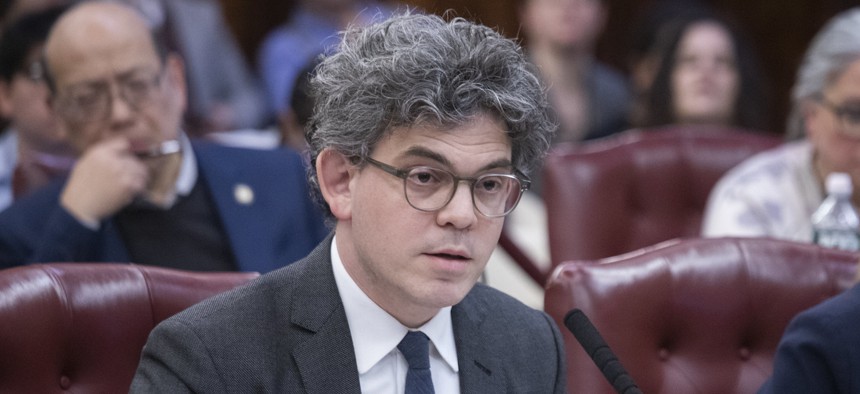
City Council Member Lincoln Restler was named chair of the contracts committee last month. John McCarten/NYC Council Media Unit



New York City is infamously bad at paying contractors on time. The backlog of payments to nonprofits contracted with city government reached a high of $11 billion in 2022, but has since been reduced to under $3 billion by efforts from the mayor’s office, city agencies and the City Council. When the council announced its committee assignments for the new term last month, Lincoln Restler was named the chair of the Committee on Contracts.
In an interview with City & State, the North Brooklyn Democrat said he plans to guide the council in improving the contract payment system. This interview has been edited for length and clarity.
In general, what would you like to accomplish during your time as the chair of the Committee on Contracts? What are your goals for the committee?
My two primary priorities for the contracts committee are to speed up the procurement life cycle so that we can make it much faster for vendors, especially nonprofit organizations, to navigate the city’s procurement process and get their contracts registered.
Secondly, we need to pay our vendors – again, especially our nonprofit partners – much more expeditiously. The failures of the Adams administration are shameful; our nonprofit partners who perform essential work every single minute of every single hour of every single day across the five boroughs deserve to be paid in a timely fashion for the work that they do.
The Discretionary Grant Pilot kicked off in November to treat some small contracts as grants, streamlining payment. The pilot is still in its early stages, but do you have any thoughts on how it’s going so far?
We are monitoring this pilot very closely. The City Council discretionary funding process is far too slow and laborious for nonprofit organizations to access the funds that they have been allocated. I’m hopeful that this shift to a more grant-like model will be effective. We still need to develop clear terms for how the city can claw back funding if nonprofits are misusing it or misallocating it, but I’m generally very hopeful about this approach.
Late last year, the Mayor’s Office of Nonprofit Services announced that the contract payment backlog had been reduced by 52%. What have you been hearing from nonprofits about city contracting lately? Do they seem happy with the trajectory?
I think that evolving from a terrible situation to a bad situation may be progress, but it’s not nearly good enough, and so we have a lot more work to do to expedite our procurement life cycle and get contracts registered in a timely fashion. I’m committed to working with the Mamdani administration to speed this process up so that organizations can get their contracts registered much more promptly.
One bill that we did pass last year that is going to have a major beneficial impact when it’s fully implemented is expanding advanced payments for nonprofits upon registration of their contract. Under the de Blasio administration, we created a policy where 25% of the payment for a contract could be available at registration. Thanks to the leadership of Speaker Adrienne Adams, that figure is shifting to 50%, so next fiscal year when that is taking effect, we will see further stabilization of the nonprofit sector, as it is able to pay their staff and pay for the services they provide in a more timely way.
What more do you think needs to be done to improve the contract payment system?
We’re in the process of conducting a comprehensive review of the city’s procurement process. I’ve set up calls with four former directors of the Mayor’s Office of Contract Services who I’ve had the privilege of working with over the years. We’re looking at legislative reforms that could speed up timelines, technological enhancements that can streamline the procurement process, improvements to PASSPort in particular and strategies to build the political will and capital within the Mamdani administration to shift agency practice and priority to speed up procurement and vendor payment.
What drew your interest to the contracts committee?
I’ve spent most of my career working in city government — at the Department of Small Business Services, at the Department of Consumer Affairs, in the mayor’s office and, of course, as a council member — and one of the most intractable and problematic components of city government is procurement. If we can make it easier for agencies to swiftly secure the goods and services that they need, we can make enormous differences in the lives of New Yorkers. City bureaucracy and our painfully slow and rigid procurement process fails New Yorkers and fails our nonprofit partners that contract. Every single day, we have to do better. And as somebody who’s served as the executive director of the New York City Employment and Training Coalition and at Phoenix Alliance, I understand well the impacts of failing to pay our nonprofits. We can do better, and we will do better under the leadership of Speaker Julie Menin and Mayor Zohran Mamdani to streamline procurement and vendor payment in the City of New York.