

Interviews & Profiles
Full disclosure
Bill de Blasio, George Soros and the war on Citizens United
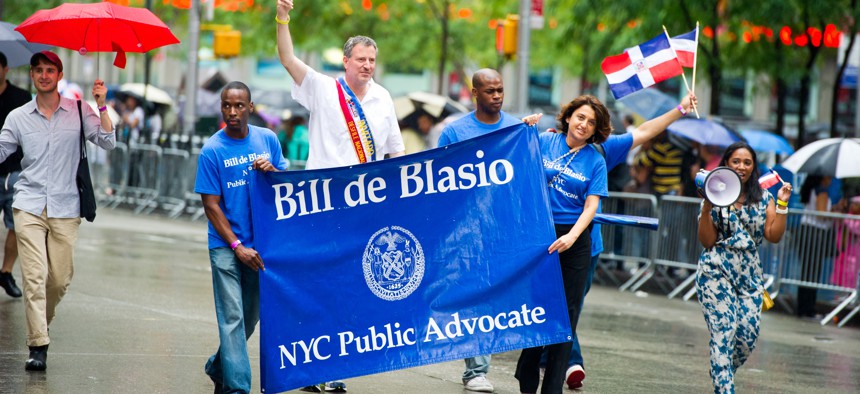
New York City Public Advocate Bill de Blasio attends the 2011 Dominican Day Parade. Michael Stewart/Getty Images

One autumn night last year, about 50 people gathered in the sprawling Fifth Avenue apartment of billionaire financier George Soros for a panel discussion on a topic that was roiling the liberal political establishment.
The U.S. Supreme Court had issued its Citizens United v. Federal Election Commission decision in January, allowing individuals, unions and corporations to engage in unlimited spending on political campaigns. Secret corporate cash funneled through shadowy nonprofits had immediately flooded the country’s political system, helping Republicans win a record number of seats in Congress.
Soros and his cadre were looking for a way to fight back.
One of the three panelists was Public Advocate Bill de Blasio, who after less than a year in the city’s second-highest-ranking office was already considered a leading Democratic candidate for mayor. He had become one of the Left’s leading voices on the impact of Citizens United, and had a compelling story to tell of how he was using his poorly funded, little-known office to fight back.
Over the previous year, de Blasio had used his seat on the board of New York City’s pension funds and the bully pulpit of his office to cow Goldman Sachs, Morgan Stanley, Citigroup and J.P. Morgan into disclosing their political contributions – and in some cases, to agree to not make such donations altogether.
“I really didn’t know Soros before this,” de Blasio recalled. “At the end of it, I talked to him a bit, and he expressed some appreciation for the notion of finding a constructive way to address this. He said, ‘Stay in touch,’ and we did.”
He added, “Then we went to his staff and said, ‘Look, we’re trying to build this out nationally, and here’s an idea how to do it.’”
The resulting arrangement has given de Blasio an unprecedented platform to try to stem a flood of corporate money that he contends will corrode American democracy. It has also given him some strange allies to do so: He works in a taxpayer-funded office; his effort is funded through a related nonprofit that benefits from a close connection to government; and his main benefactor, Soros, funnels millions of dollars to his favorite causes through some of the same campaign-finance loopholes he aims to close.
De Blasio is walking a tightrope, pushing an ambitious national campaign to restrict money in politics while perhaps becoming a cog in a larger effort funded by a single-minded billionaire. But the public advocate strenuously disputes the idea that Soros’ backing has made him a proxy in the long-running war between the Left and Right.
“We had been doing this for a year before the funding ever existed,” de Blasio said. “This is work that’s been going on, in one form or another, since Watergate.”
“Did you hear the big news?” de Blasio said, immediately after sitting down for a late lunch at a downtown boulangerie he favors because the menu has calorie counts.
“We got a Republican state rep from North Carolina,” he said, beaming like a kid at Christmas. “And quite Republican, I’m told.”
It was the first concrete step toward making his national crusade truly bipartisan: Until recently, it consisted only of seven Democrats from five states, including New York State Comptroller Thomas DiNapoli.
De Blasio launched the Coalition for Accountability in Political Spending, or CAPS, this spring, but the effort really took shape in July with a $400,000 contribution from Soros’ nonprofit, the Open Society Institute. The entire budget for de Blasio’s office, by contrast, is $2.2 million.
The money went to the Fund for Public Advocacy – a nonprofit founded in 2002 by then Public Advocate Betsy Gotbaum to supplement the public advocate’s shrinking budget with private support – though it had never accepted a grant this size before.
CAPS is the vehicle de Blasio hopes to use to combat Citizens United across the country – franchising it to the offices of politicians, union leaders and other leaders who sit on state pension-fund boards. Those pension funds are major stockholders in corporate America, de Blasio explained, and when they vote their shares against large corporate spending in politics, their voices matter.
To lend credibility to the Democrat-heavy initiative, Kate Coyne-McCoy, the recently hired executive director of CAPS, has been trying frantically to get a Republican elected official – any Republican – to jump on board.
Coyne-McCoy first tried to get a big-name Washington, D.C., Republican lawmaker to commit, with no luck. Then she mined state legislatures until she found a Republican state representative in North Carolina named William Current, who had sponsored a bill to limit the influence of money in politics.
Before signing on, Current asked for Coyne-McCoy’s résumé, and was not exactly impressed. He is against same-sex marriage and abortion; Coyne-McCoy had spent the prior 12 years training candidates backed by EMILY’s List, the abortion-rights group with one of the country’s biggest 527s, a lightly regulated type of political spending group that can take unlimited donations. A former congressional candidate, she is also known as something of a liberal firebrand in her home state of Rhode Island.
“We had some tense conversations,” Coyne-McCoy said of Current. “We both like cooking collard greens, we both like oysters, and we both believe in the principle that corporations are not people – and that’s probably all we have to talk about.”
De Blasio insists his cause is above partisan politics. The grant proposal he submitted to Soros’ Open Society Institute said CAPS would have bipartisan makeup and leadership; with its ties to his taxpayer-funded office, it must be apolitical to be legal. Yet in the months since Citizens United opened the floodgates, most unregulated donations have come from corporations and gone to Republican candidates – so curbing it would essentially help Democrats, who have seen less help from newly unlimited union spending.
De Blasio argues that regardless of politics, it makes sense to focus on political money spent by corporations, since their donations far outstrip those from unions and individuals.
“The individual money is bad enough and counts for a lot of the change we’ve already seen,” de Blasio said. “Corporate money is the much bigger sum that must be kept out of the system. And that was what animated this effort from Day One.”
He does not deny that CAPS is staffed with longtime liberals, or that most of the money he is likely to raise from the project will come from left-leaning donors. Yet he insists he is committed to goring anyone’s ox, from Left or Right, if they insist on keeping unregulated, anonymous donations in politics.
Before last year’s congressional elections, for example, he sent letters to 16 issue-oriented nonprofits asking them to disclose their anonymous electioneering efforts – most of them leaning right, but some to the left.
De Blasio has lofty goals for CAPS in next year’s elections: Introducing campaign-finance-reform bills in at least a dozen states; getting at least a quarter of the S&P 100 companies to commit to altering their campaign-spending policies; lining up one trillion dollars’ worth of government pension-fund investors who will prod corporations to reform their political giving policies; and securing the backing at least two elected officials from every state, including as many Republicans as possible.
Those goals also play into the larger partisan dynamic. In a post-Citizens United world, even a billionaire like Soros or cash-flush public-sector unions cannot compete with vast corporate treasuries that are disproportionately helping Republicans. And there are relatively few ways for Soros and others on the Left to fight back. The decision was so broadly written that there is little chance for appeal. Congress could act, but the chances of that happening are practically nonexistent.
That has left statehouses and local pension-fund boards as the battlefield for the Left’s burgeoning movement to shift the political calculus back – and de Blasio, by choice or by circumstance, is on the frontlines.
“Wealthy individuals have always spent their billions on politics, whether it be the Koch brothers or George Soros,” said Baruch College political science professor Doug Muzzio. “But Citizens United fundamentally alters the playing field. Even George Soros can’t compete.”
De Blasio is a big man in a small office. At a lanky 6’6”, de Blasio towers over other elected officials at press conferences. His aides often have to rush to raise microphone stands before he speaks. At one event this spring in Brooklyn, City Council Speaker Christine Quinn tried to speak after him, but her face was completely obscured by a huge “Public Advocate of New York” sign on the podium.
“You have to wear your platforms when you’re with Bill,” Quinn joked.
But Quinn, who may face off against de Blasio in the 2013 Democratic mayoral primary, has often had the last laugh: She and Mayor Michael Bloomberg, who has repeatedly called for eliminating the public advocate’s office, have continually slashed de Blasio’s budget.
During de Blasio’s nearly two years in office, his efforts to combat Citizens United have brought the only shred of national attention to his otherwise obscure post. On a local level, he is best-known for creating a watch list of deadbeat landlords and for weighing in on virtually every issue imaginable, one of the few real powers he possesses. His press aide briefs him on the news every day at 6 a.m. He subsequently has opined on everything from Palestinian statehood to reports of a decades-old bar brawl involving Republican Congressman Michael Grimm to whether a bike lane should be installed in Bay Ridge.
“Just the other day, I had a press release about potholes,” de Blasio noted when asked whether Citizens United was outside the scope of his office.
When the Supreme Court issued the Citizens United decision in January 2010, de Blasio had been in office less than a month, already under threat. Bloomberg would soon appoint a charter-revision commission that could recommend eliminating the office; Comptroller John Liu, the other citywide officeholder, suggested usurping de Blasio’s position to become second in line for succession to the mayor.
De Blasio could have established his place in the political firmament by focusing on meat-and-potatoes local issues instead of a complicated topic with questionable political value for 2013. But the cause seemed an emotional one for de Blasio.
He found out about Citizens United when he was live on Brian Lehrer’s WNYC radio show discussing Bloomberg’s State of the City address. With no advance preparation, he immediately dissected and denounced its implications, showing an insight few others seemed to possess at the time.
“I was stunned,” de Blasio recalled. "When lawyers I knew started to tell me just how total it was, I literally felt like this was one of the breaking points in my time as an American citizen.”
De Blasio says he first became alarmed about the pervasive role of big money in politics while managing Hillary Clinton’s 2000 campaign for Senate. Nearly $70 million was raised and spent on the race.
He has also long been involved in causes favorable to unions, helping found the labor-backed Working Families Party in 1998. After his election to the City Council in 2001, de Blasio sponsored a bill allowing unions to give more money from their treasuries to political candidates. They can give $2,750 each, while corporations cannot give any money directly to New York City campaigns.
In 2009, de Blasio won a hard-fought citywide election for the public advocate’s office with the strong backing of the WFP. He relied on Data and Field Services, a for-profit campaign operation run from the WFP’s office, leading to a federal probe into whether the party significantly undercharged for campaign services. The WFP later agreed to sever its relationship with the company, and was cleared of any wrongdoing.
And as de Blasio eyes a 2013 run, most pundits believe his best and only shot at Gracie Mansion lies in running to the left and affixing himself to the muscle and money of his union allies.
But in his efforts to combat Citizens United, he has affixed himself to one of the biggest political spenders of all.
Soros has given away an estimated $7 billion for a range of causes, according to his official website, but he may draw the most attention for his largesse to progressive political causes in America.
The reclusive Hungarian billionaire, who did not respond to requests for comment, has given heavily through his Open Society Institute since the 1990s in support of campaign-finance reform, including to a dozen groups that spurred the 2002 McCain-Feingold law. In fact, it is difficult to find a campaign-finance group without at least some Soros backing.
At the same time, Soros has donated millions to Democratic partisan efforts. In 2004, he poured $23 million into generically named 527 groups – groups that were once seen as a major loophole in the campaign-finance system – that attempted to unseat President George W. Bush.
Four months after Citizens United invalidated parts of the McCain-Feingold law, Soros made his first donation to one of the so-called “Super PAC”s that can now receive unlimited corporate, individual and union contributions, giving $75,000 to a pro-Democratic group.
In a New Yorker article last year, Soros’ spokesman said his boss’ heavy spending to influence American politics is different from that of the Koch brothers, David and Charles, who have spent heavily to bolster Republicans and build up the Tea Party. Soros discloses his giving on the Open Society Institute’s publicly available tax returns, unlike the Koch brothers, he said – and while the Kochs give to causes that help their business interests, Soros gives on principle.
To the far right-wing, Soros has become an evil overlord with a shadowy worldwide influence; websites are filled with conspiracy theories about how he spends his money. His involvement in de Blasio’s efforts might make Glenn Beck run to his chalkboard and start drawing Venn diagrams.
Last year, for example, de Blasio pursued a case against the Minnesota-based Target Corporation. The company gave $150,000 to an organization spearheaded by the state’s Chamber of Commerce, which then spent to help Tom Emmer, the anti-gay marriage Republican nominee for governor, who had also opposed a law combating bullying of gay youths.
In response, de Blasio’s office organized a rally in protest with MoveOn.org – a pro-Democrat group that Soros has given $2.5 million. The ensuing bad press for Target led to slippage in its stock price, forcing the company to make concessions on its campaign-spending policy.
This summer, in advance of Target’s annual shareholders meeting, de Blasio went even further, threatening to use his spot on a city pension-fund board to force out members of the company’s board of directors if Target didn’t promise to ban most corporate donations.
De Blasio didn’t attend Target’s shareholder meeting, but others with Soros connections did. Mike Dean, the director of Minnesota Common Cause, whose parent organization has received millions from the Open Society Institute, spoke at the meeting on behalf of an activist shareholder group called the Tides Foundation – which got about 5 percent of its total $112 million budget in 2009 from the Open Society Institute.
The list of Soros-funded groups working with de Blasio is long: Common Cause’s national office; the advocacy group Public Citizen; the D.C.-based Center for Political Accountability. That group got almost half its funding from Soros in 2008, and is now deeply involved in New York City’s main pension fund’s efforts to rein in corporate political influence.
The relationship is close enough that the 600-word sample shareholder resolution that the pension fund sends corporations, banning them from making most campaign contributions, is taken directly from the Center for Political Accountability website.
De Blasio strenuously disputes the idea that his office has become a pawn in a larger war between Right and Left.
“Common Cause has been a respectable organization for 30 years,” he said. “I can tell you, they’re not doing this because of George Soros.”
But what if the situation were reversed? If Republican House Speaker John Boehner set up a nonprofit arm of Congress, funded by the Koch brothers, with the aim of limiting the political influence of unions?
“I think I already addressed your question,” de Blasio responded, a little testily. “We’re going to be equal-opportunity in who we’re going after.”
But even some staunch de Blasio supporters see contradictions in these types of arrangements.
Bill Samuels, the reform-minded multimillionaire funder of the New Roosevelt Initiative, a Democrat-friendly New York independent expenditure group, has already endorsed de Blasio for mayor in 2013. After mulling the question, Samuels said that while de Blasio’s efforts were worthy, he was wrong to focus only on corporate influence.
“I am pleased that he is spending political capital on this issue, which does not really register with the average voter for 2013,” Samuels said. “But when I meet the next time with Kate Coyne-McCoy, I’m going to bring up the fact that targeting one group in isolation is not fair.”
Some people on the Right also dismiss de Blasio’s arguments.
“Over the past decade, George Soros has been a pervasive force that has outspent the vast majority of American corporations,” said Brad Smith, the Republican former chairman of the Federal Elections Commission, who runs the conservative Center for Competitive Politics. “I don’t know why you would say corporate spending is more corrupt or unequal than that by George Soros. It really seems like a pretense to effectively silence political opposition.”
Yet the battle is growing louder. After watching the Republicans’ success in 2010, Democrats are copying their formula, setting up Super PACs that can take both unlimited corporate and union contributions, as well as political nonprofits that can take uncapped, undisclosed donations.
Priorities USA, a group supporting Democrats cofounded by a former spokesman for President Barack Obama, is modeled after Crossroads GPS, the Karl Rove-founded group that washed the 2010 elections with secret Republican campaign money.
When de Blasio began his anti-Citizens United efforts, Republicans were the ones primarily exploiting the decision. Now both parties are doing so, putting de Blasio in a more complicated position.
He said he opposes the creation of Priorities USA. But he understands why Democrats would not unilaterally disarm in the money war.
“I’m not comfortable with a Democratic group that doesn’t disclose,” de Blasio said. “I would urge people not to give to them.”
“But,” he added, “I know some people will. And I certainly understand why.”
NEXT STORY: The godfather