

New York City
Exit Interview: Adrienne Adams on her legacy, accomplishments and mayoral run
She tells the next City Council speaker to keep your eyes on the prize of serving New York City.
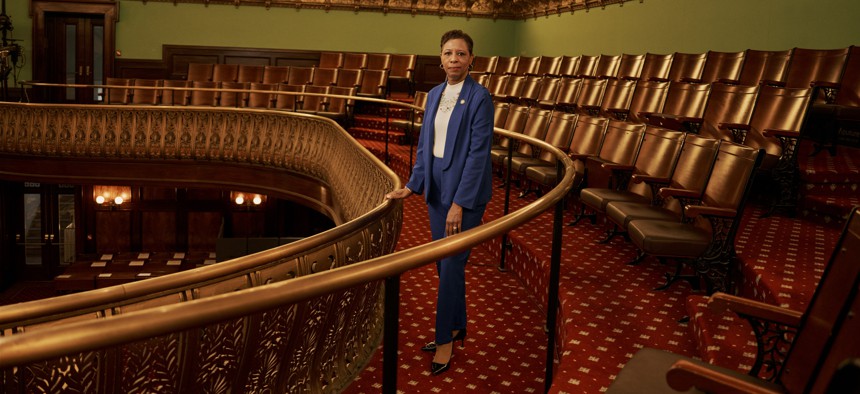
New York City Council Speaker Adrienne Adams poses for a photo shoot in the council chamber. Philip Vukelich


Adrienne Adams wasn’t supposed to be speaker of the New York City Council. The late entrant to the 2021 speaker race was far from a front-runner, but became a compromise pick.
Once elected – as the council’s first Black speaker – Adrienne Adams wasn’t supposed to lead the body as a foil to the left of Mayor Eric Adams’ administration. The self-described moderate from Southeast Queens endorsed Eric Adams in the 2021 Democratic primary for mayor, but went on to battle his administration on many issues.
And last year, Adrienne Adams wasn’t supposed to run for mayor. Up until a late push to join the race, Adams had displayed few signs that she hoped to use the speaker position as a political launchpad. (She finished fourth in the Democratic primary’s first round.)
Having bucked political wisdom on a few fronts in the past four years, Adams’ next move is hard to predict. She still has detractors over issues like outdoor dining and critics inside the body who argue the council wasn’t fair or transparent enough.
City & State caught up with Adams late last month (two days before City Council Member Julie Menin declared victory in this year’s speaker race) to look back at the legacy she’s leaving. This interview has been edited for length and clarity.
Over the past four years, is there one action this council took that you can pin down as the most significant? As one you want to feed into the story of the legacy you’re leaving?
I think I’m going to go ahead and choose housing, since it is top of mind and my leadership has really changed the entire culture of the City Council when it comes to housing. We have approved 157,000 units, or a little more. We have approved 94% of housing proposals that have come before this council, and we have made sure that we look forward into affordability. And I know that’s the buzzword of now, but I can assure you that this council has been using that term over the past four years because we are the most diverse council in the history of the city of New York. We come from a need of affordability where we live. Particularly being a speaker of an outer borough, far outer borough, I come from a place of a necessity for affordability. So it would be that housing that is so desperately needed. We’ve changed the way that people view it, the way that people speak about it, the way that people prioritize it across the city of New York.
What is an accomplishment of this council that you think didn’t receive enough attention?
The new programs. We have created new programs that have changed the lives of thousands of New Yorkers, of those that have been left behind that people don’t talk about. … We created CUNY Reconnect to bring in those students that had some CUNY credits but were unable to fulfill their degree for whatever reason – be it taking care of a parent, becoming a parent, financial strain or anything else. Those credits are now brought back into reality of attaining that degree for – I thought it would be maybe 10,000 – (but) to date we have about 50,000 reenrollees because of CUNY Reconnect. And we have been able to make sure that graduation has happened for about 8,000 students or more. … Our trauma recovery centers – the first ever in New York state history, by the way – we’ve got four of them. I believe we’re working on our fifth now. This is where people actually get therapy, they get counseling. They know that they have a safe place to come where they can speak to professionals. They can speak about their experiences, either being that one that perpetrated some type of violence onto another person or people, or that victim that gets put away in a corner someplace, and nobody ever looks at again, except to count as a statistic. … We also don’t talk about our CUNY Social Work Fellows Program. We know that we’ve got such a mental health crisis in New York right now, why not utilize CUNY where we can get our professionals? That’s what we’re doing with our Social Work Fellows Program. And finally, the guaranteed income for new mothers. … With the guaranteed income program that we facilitated in the City Council, we are now bringing women and children out of shelter and into permanent housing.
When you became speaker, some questioned whether you would be too aligned with Eric Adams. But this council took on some fights that were championed by progressives – passing police accountability legislation, restricting solitary confinement, fighting U.S. Immigration and Customs Enforcement at Rikers, expanding housing vouchers. Was it always your intention to take the council in that direction? Did that come from listening to more progressive members? Did the mayor’s actions cause it to ricochet in that direction?
Imagine that. To my surprise as well. But what I discovered when I listened to my colleagues, when I listened to the bills that they presented – commonsense legislation. Again, we take a look at the diversity in this council, the fact that there are so many different avenues, so many different types of New Yorkers that have been left behind, never discussed, never thought about, put away in the corner to be forgotten. The members themselves brought that legislation because of what they saw in their districts, what they heard from their constituents and what they lived in their own lives, myself included. … I’m a moderate. I still am pretty moderate from Southeast Queens, always have been. But what I saw in legislation, I saw a move that talked to the heart of older adults, seniors, the fact that they were not able to get food. That talked to child care for families like my own, children that I didn’t want to leave New York, but unfortunately left because child care was not affordable. That spoke to those mothers dealing with maternal health issues. Things like that, things that people don’t really talk about, or previous councils may not have seen or prioritized – this council did because of the members, because of the diversity. … I don’t necessarily call it progressive. I just call it the everyday life of everyday New Yorkers.
Your district is more moderate – I think one where there was more pushback on some of the high-profile actions this council took, like City of Yes and I believe the How Many Stops Act. How did you balance the direction of the entire city and council with the preferred direction of your district?
I’m not just a speaker for District 28 in Southeast Queens, but I am a speaker and a leader for all 51 districts of this city. … As far as looking at the legislation – not so much the How Many Stops Act, but City of Yes, for sure – it has to do with, quite frankly, the makeup of our diverse communities. There have been more communities than others that have gotten more density than others. Some districts just aren’t used to having that in-depth conversation about what this really looks like, what New York is facing right now. … So while I think that, yeah, there’s been some pushback, there’s also been a greater effort of education citywide, for what we are up against in New York City with a housing crisis, with a mental health crisis, and what we must do as those servants of the city to make things better for everybody.
There were other times you sided with the outer borough moderate stance on issues – like maintaining parking in the outdoor dining debate or even the current negotiations over the daylighting bill. Does that just broadly reflect where you stand on maintaining parking spaces in the city, or is it a middle ground you try to find?
It is always trying to find middle ground. And in finding middle ground, we have to take into account the way that everybody lives. I come from a transit desert. Some of my predecessors in this role have not come from transit deserts. So I’ve had to bring in both sides of this equation, had to take a look at the way that, again, the way that people live from every end of the spectrum. Everybody’s not going to be happy with everything that the council legislates. We know that is a given. But what we have to do is – and I know that you all hear this very often from us – we have to respect the legislative process. … So yes, I bring a perspective, just like every council member, just like every council member before us, but I think that it’s really important to take every side into account, make sure that voices are heard, and then we work it out.
This council has clashed, at many times, with the Adams administration. How did those clashes affect your personal relationship and communication with Mayor Eric Adams?
My hopes for this relationship between the mayor and myself were very, very high. I had great expectations for this legacy. Both of us come from similar backgrounds. Both of us knew each other in high school. If you look up that yearbook, you’re going to see both of us in that Bayside High School yearbook graduating that same year. And I want to believe that Mayor Adams wanted the same thing. Unfortunately, it didn’t work out that way. … I wanted to protect the council, and at times, I did not see a level of respect coming from the administration. The way that this council was handled was an issue. I tended to believe at some point that perhaps there was so much contention with some of the members and the mayor that the mayor tended to take that out on the entire body, and that influenced the relationship between the administration and council members, and the entire council at that point. My hope, once again, was that there would be more collaboration, more partnership, more communication. I had asked time and time again to the mayor personally, “Let’s communicate more. Let’s communicate more.” And he agreed with me. And time and time again, that would not be the case. My hope is that this council would have been invited into his conference room for the executive budget sessions, as has been the (case with the) administration prior to his. We always look forward to going into the mayor’s conference room to get that executive budget. … To this day, this body has not been invited into the conference room of the mayor of the city of New York. And for me, that is a very, very sad state of affairs for where we end up right now.
When it comes to the council’s oversight role, the administration presented some challenges: refusing to show up to oversight hearings, providing limited information on migrant spending, for example. Should the council have used its subpoena power more? Were there other ways you could have exercised the oversight role?
I don’t think so. We did what we should do as a council, as a body, as a respectful body. We carried out the respect that was due this mayor and this mayoral administration to the nth degree. I don’t think that our subpoena power was necessary. I don’t believe that we should ever weaponize our power like that. As a City Council body, we acted professionally and we acted respectfully with regard to this administration.
Do you have any regrets about running for mayor?
I am super glad that I ran. I heeded the call of so many folks that wanted me to jump into the race to be the first woman mayor of the city of New York. I still think that New York is terribly behind when it comes to other cities in this nation. It’s high time for New York to have a woman to lead the city. I still believe that I was the most experienced candidate in the primary race, and would have absolutely been honored to be the first woman mayor of the city of New York. I have no regrets as far as running, except maybe what I hear from folks out there: You should have gotten in earlier.
What’s one piece of advice you would impart to the next City Council speaker?
Listen to the members. Respect the voices of the body. Remember that when the rubber meets the road that you are still a council member. Collaborate well with the mayoral administration, partner as best you can, as best you are allowed to with the mayoral administration. Keep your eyes on the prize. That prize is serving the people of the city of New York. Don’t ever miss that mark. Don’t miss it for your colleagues. Don’t miss it for the mayoral administration. Always keep your eyes on New Yorkers. They deserve your very best.
What’s next for you in 2026?
I’m looking toward the next great thing, whatever that is. I still expect to be connected to politics in one way or another, and I am looking for the next great way to serve, to be that servant that I have always been, and I have always wanted to be.
Is it fair to assume that means not ruling out running for elected office ever again?
I would never rule out elected office ever again. No, I would not. Who knows what’s on the horizon. It may not be the immediate thing, but who knows what’s on the horizon.
NEXT STORY: This week's biggest Winners & Losers