

Interviews & Profiles
Here’s why you keep seeing Mamdani’s consumer protection commissioner everywhere
Sam Levine, who moved to the city in June, has had a particularly active start in the Mamdani administration.
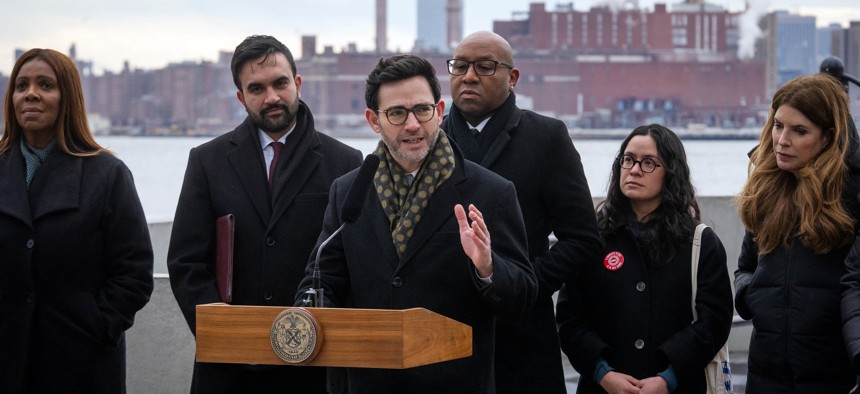
Sam Levine speaks at an announcement about curtailing junk fees on Jan. 5. Michael Appleton/Mayoral Photography Office

If you’re a delivery app company, an e-commerce giant, or even a hotel chain, you might not be the biggest fan of Sam Levine right now.
Just three weeks into Mayor Zohran Mamdani’s administration, the new commissioner of New York City’s Department of Consumer and Worker Protection has hit the ground running. The department will be targeting junk fees, giving a platform to tenants at “Rental Ripoff” hearings and banning hidden hotel fees.
As new laws protecting delivery app workers come into effect, the administration has left little doubt about their intention to strictly enforce them. In one week, DCWP released a report slamming DoorDash and Uber for cutting workers out of tips – DoorDash called it “wrong” – and sued another company, Motoclick, and its CEO, alleging stolen pay and illegal fees.
Some of that work, Levine acknowledges, began before his time and under Mayor Eric Adams’ administration.
Those actions shouldn’t be all that surprising. Mamdani campaigned on affordability for working-class New Yorkers, and has positioned himself as an ally of Deliveristas, for example. And those companies are likely no stranger to Levine, who previously led the Bureau of Consumer Protection at the U.S. Federal Trade Commission under Biden and worked closely with Lina Khan, Mamdani’s transition co-chair.
City & State caught up with Levine in his office about the work so far, blowback from the tech sector and what lies ahead.
This conversation has been edited for length and clarity.
How did you first hear about the opening with the Mamdani administration? Were you approached? Did you apply?
I moved to the city in June. I had been planning to move to the city for months – turns out it’s not easy to find an apartment here. I was not planning to go back into government, at least immediately. I left the federal government, I wasn’t really tied down in D.C. I wanted to live in New York, my partner wanted to live in New York. I thought, let’s just try this. Mamdani was already on my radar, but I thought, I’m a new New Yorker, I did not have ambitions for it at that time. I did start talking to Lina (Khan) about it. I had always known about DCWP … but I had started digging more into what the authorities were at the department. I started talking to some people who work here, or had worked here. And I thought, this is actually a place I think I could do some good. So I told Lina that. I put in my application. Eventually I got a call that they wanted to interview me.
And the rest is history.
And the rest is history. Well, history in the making, I guess.
DCWP has had some of the biggest policy-focused press conferences of the administration so far in the first few weeks. Was there a directive from the administration that DCWP was going to be a priority area? Or was it mainly that you were already running with it?
It was a give and take, right? I knew generally what the mayor’s priorities were. I knew what his platform said about DCWP and about his economic justice work, generally. I’d had conversations with City Hall about the junk fee agenda, for example, the subscription trap agenda. … One of the things I’ve been really delighted by – and I did not always see this in Washington – is to have the attention this mayor has placed on the sort of bread and butter work we are doing to enforce worker protection laws, enforce consumer protection laws, and get money back to people who have been cheated.
Some of the work that has come out of this administration so far – the report about Uber and DoorDash’s tipping practices, the Motoclick investigation – had been started under the last administration. Do you feel like they set you up with room to run here?
I think the staff here did really great work. I wasn’t privy to – and I’m not privy to – whether City Hall, at times, under the last administration, impeded that work. I certainly have, you know, reason to believe things I’ve read in the press that City Hall was not always standing up for workers, standing up for consumers. They had other interests in mind. But there’s no doubt about it that we have a wonderful consumer protection and worker protection team here in place. One of my goals early in is how can we accelerate this? For example, last week, it was a very deliberate decision that we were going to pair the Motoclick lawsuit with the DoorDash and Uber report with the warning blitz – which we’ve never done before – to all app delivery companies. That wasn’t an accident. The idea was we want companies to be on notice that there’s a new sheriff in town.
Politically, the mayor has already faced pressure from the business community to not make an enemy out of them, and I’m sure he’ll continue to face that pressure. Is that a pressure that rests on you at all?
I don’t feel it as pressure. I want businesses in New York to thrive. I want businesses in New York to boom. But the fact of the matter is we’ve had two economies in the city. I don’t just mean for the rich and the 99%. If you look at the business sector in New York, you just saw reporting last week – thousands of New York small businesses closed in the second quarter of the Adams administration … even as some of the companies headquartered down here (near Wall Street) enjoyed bumper profits. … Sometimes when you hear “we have to protect the business community,” sometimes you’re hearing from a narrow trade association representing the biggest companies in New York. Look, I want them to thrive too. But the fact of the matter is small businesses in the city have not been thriving. … Far more people in the city are employed by small businesses than by the biggest companies, and I think there’s a lot we can do to make life better for small businesses. Not only by enforcing the rules to make sure they compete on a level playing field, but like the executive order you saw last week to try to reduce fines, fees and regulations so that small businesses can thrive.
There’s a bit of a theme emerging in holding tech companies accountable – whether that’s going after delivery apps or highlighting how hard it is to unsubscribe from Amazon. Is that an intentional place to target attention in your view?
It’s not about targeting a certain industry. It’s about targeting where people are getting squeezed. I was at the FTC when we sued Amazon for trapping people in subscriptions – that’s because they were trapping a lot of people. They ended up paying the FTC $2.5 billion, including $1 billion in penalties for what they did with their Prime subscriptions. When we sent the warnings to Uber and DoorDash and the other app companies last week, it’s not because I don’t like tech. It’s because they need to follow the law. I have been in the tech oversight space for a long time. I’ve brought cases against Facebook, TikTok, against Microsoft, against Amazon, most of the companies, against Twitter. And what I’ve seen is that there is a certain culture of impunity sometimes you see with Big Tech giants. So I think the reason you’ve seen so much enforcement against them – on consumer protection, worker protection, antitrust – isn’t because there’s an animus toward that sector. It’s because these are massive companies, and it’s where you see a lot of the biggest problems.
We know that these companies don’t tend to take enforcement action lying down. Can you provide any insight on what any internal pushback has been since last week on the delivery companies front?
It’s not internal, I mean DoorDash has come out and criticized us very aggressively. And they have every right to do that. And I have the right to tell the truth about what actually happened, which is that every word of the report we put out is true. I stand by everything I said about DoorDash’s conduct and Uber’s conduct. … I would welcome a meeting with DoorDash or any other company, but I’m not here because I want to be invited to their Christmas party. I’m here because we have a job to do, and it’s to enforce the law and protect our workers and consumers. And if companies aren’t doing that, we’re going to hold them accountable.
Also some of those companies were pretty active in the campaign cycle. DoorDash donated quite a bit of money to Andrew Cuomo. Any response you would say to someone who said this looks like retribution?
No, they have a right to support whoever they want. Absolutely. Mayor Mamdani has been very clear, he is the mayor for all New Yorkers, doesn’t matter who they voted for. And I feel exactly the same way. In my career – I’m a Democrat – I’ve sued companies that have been associated with Democrats. We need to enforce the law, and it’s always been my approach, without fear or favor, we have to follow the facts and enforce the law when we see it being broken.
Three weeks into the job, what has surprised you the most?
I think the resources are limited. I mean, that’s not a huge surprise. But I think when you’re actually here and you look at what our responsibilities are, the new laws coming online this year – they give us even more responsibility – and you have to plot out how are we going to meet our obligations over the next year. That’s a real challenge. But, you know, I do have a track record. The FTC was also a deeply underfunded agency. The bureau I led was about the same size as DCWP, actually. The composition was different. What I found is that if you have a clear orientation, a clear vision of where you want to go, you can do a lot. And I think there’s a lot more this agency can do. Obviously, you know, the mayor ran on doubling our budget. We’re going to see what the proposal looks like soon. But my commitment to him is that whatever resources we are given, we’re going to use them to squarely focus on advancing his affordability agenda. And even if I wish we had more, we’re going to do the most with what we can.
Any progress on the “Rental Ripoff” hearings that you can point to?
There’s been a lot of work behind the scenes. I know we have not announced the dates yet for the hearings. We are eager to do that. But I can tell you, we are not sitting idly. We've been talking to tenant advocates, we’ve been talking to housing experts, both inside and outside the city. We’ve been scanning both the complaints we've received, I believe we’ve scanned the state. … We are doing our homework now so that we can go into those hearings with questions, with clear things that we want to know, and that’s so we can come out of the hearings ready to take action.
What did you learn from Lina Khan at the FTC that you’re taking with you in this administration?
Lina’s approach to the world was she saw problems out in the world, whether it was the high cost of EpiPens and insulin, or monopolization by Facebook or subscription traps – you name it. And she said, ‘What can I do to solve it? What can the FTC do to solve it? And if the FTC can't solve it ourselves, how can we push other parts of the government or push other parts of the system to solve it?’ I think some people come into jobs and think, ‘Oh, here is our set of tools. And here are some cases we can bring that will get us good press.’ Lina was looking outward into the world and saying, ‘What are the problems in the world, and then what can we do to solve them?’ And that’s really how I want to approach this job at DCWP.