

Personality
Yvonne Armstrong isn’t discouraged by the challenges facing health care workers
An interview with the (relatively) new president of 1199SEIU.
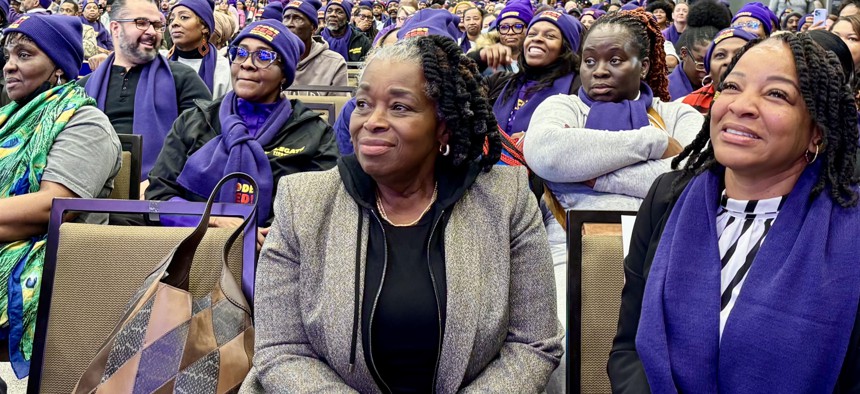
1199 SEIU President Yvonne Armstrong attends a "Code Red: Protect our Health Care" rally in Albany on Jan. 12, 2026. Jeff Coltin



On the first real day of the 2026 legislative session in Albany, thousands of 1199SEIU members bused up to the state capital in order to call for state action to protect hospitals against deep impending cuts from the federal government. Six months into her tenure, President Yvonne Armstrong offered a show of force early in the year as the health care system braces for crisis and turns to Albany for help.
Members elected Armstrong last May in a highly contentious race for president. She unseated longtime leader George Gresham in an upset victory, ending his nearly two-decade tenure as head of the powerful union representing health care workers. It was the first competitive leadership election in the union since before the 1990s as she and her slate criticized Gresham for alleged corruption and lack of transparency. Just a month before the union election, Politico New York published a months-long investigation into alleged abuses of power and misuse of union finances by Gresham.
All that to say, Armstrong is ushering in a new era for 1199 – and she started it with a splash in Albany. With health care workers and the system they work for under threat, Armstrong plans to apply consistent pressure on legislators and state leaders while building up a comprehensive advocacy campaign. City & State caught up with her after the start-of-session rally to discuss her plans for leadership and vision for the union at such a turbulent time. This interview has been edited for length and clarity.
What were you hoping to achieve with your first Code Red rally in Albany right at the state of the legislative session? Do you think lawmakers are listening?
I think they're listening. I think the membership understands how serious it is, enough to get on the bus in (those) numbers to come up here. That's the first thing – that they really believe that there is a process that is put into place to help them, to fight, to make changes or to bring funds into the hospitals. And so they take that very seriously. Secondly, they know that they need to do that in order to make sure that the hospital is still there.
What was it like for you to step into the role of president during this crisis in the hospital system?
It didn't matter where I stand in the organization. I was a senior executive vice president, and so (even if I were not president now) I think I would be at the same place where I'm at. Because it is not a one-person issue. It is the organization issue, and it is a top leadership (issue), and I was part of the top leadership.
What’s been the biggest change for you in the past six months now that you’re president?
We made a pledge that the first 100 days, that we would meet all our members in the entire union in the five states. And that was a change for me, because we realized that our members want to meet with top leadership. Our members want to speak with top leadership. One of the things that doing (this) listening tour kind of gave me – let me just speak for me – is the sense of where members are and the sense of what members believe that this organization means to them.
The governor didn’t speak at your rally, and funding decisions really fall within her purview. Have you spoken to her, and do you think you have a partner in Hochul?
The team of us spoke to the governor right after the rally, and we believe that there's a bridge. Not sure if we cross the bridge yet, but there's a bridge that we believe that we can find mutual grounds to work on. (Following Hochul’s State of the State Address after this interview, Armstrong told City & State that the governor’s attention to health care was lacking.)
Leading up to the budget, are you planning to be up in Albany often?
That’s our job!
Obviously, dealing with federal cuts is a massive undertaking. But beyond crisis mode, what else do you envision for your tenure as president?
To build the capacity of the union, to grow the union. Our union was at a space where it needed to look at it differently, reshape the way that we have been looking at it, (involve) our members more. That's why we did a 100-day tour to hear from our members what it is that they believe that they're missing, to listen to what they're saying and to try to shape the union in a way that answers all their questions to the best of our ability. But (also) to make sure that they're involved as much as possible.
We're a rank-and-file union. Many of us that (are) on staff came from the rank, so we understood what it is like to be a worker and to leave being a worker and come on staff. So we know exactly what that builds. It builds the stability of our members’ trust and our members’ belief in our organization, and you saw it today. How long did it take us to organize those folks? 10 days? 15 days?
Despite the circumstances facing hospitals and your members right now, are you feeling hopeful?
I am very hopeful. I am so hopeful. If nothing else, so far everything that we have asked members to do, everything that we have asked staff to do, they have done it and done it 100%. They also are looking for changes. They also are hoping that we can get to the path where we were before, (where) we once were.