

Personality
Dorcey Applyrs is ready to treat Albany’s ills
An interview with Albany’s first Black mayor
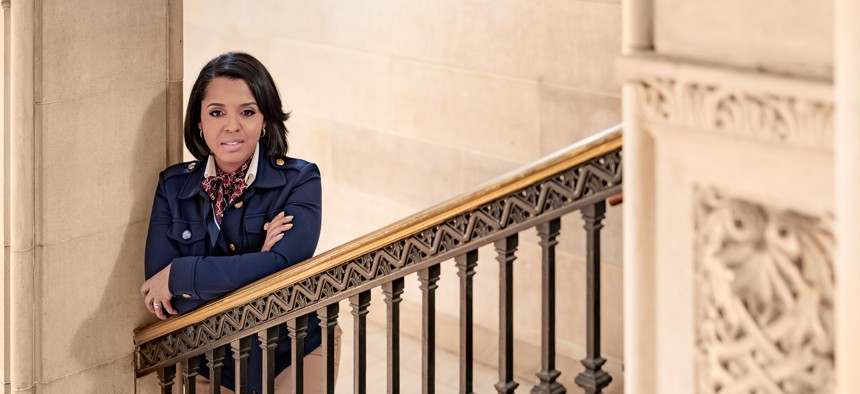
Dorcey Applyrs, a public health expert, is Albany’s first Black mayor in the city’s 340-year history. Franco Vogt


The city of Albany is nearly 100 years older than the nation and holds the title of oldest continuously chartered city. It has changed a lot since Dutch colonists first decided to settle there. And it continues to change, since for the first time in 340 years, Albany has a Black mayor.
Mayor Dorcey Applyrs won her historic election in November, following a hotly contested Democratic primary earlier in the year. As a native of Washington, D.C., the rough-and-tumble world of politics that characterizes New York’s capital was perhaps not foreign to her – but was certainly one she initially didn’t see herself taking part in. After moving to Albany to continue her graduate school work, Applyrs unexpectedly made the city her home, and even more unexpectedly decided to run for office after earning multiple advanced degrees in public health.
Beginning her first term, Applyrs faces a plethora of issues. Crime, and in particular youth violence, is a major problem. A high-profile shooting on July 4 last year made headlines. Downtown Albany faces decades of disinvestment that has left many businesses struggling. And residents face a housing crisis that has no easy solutions. And if the weight of all those problems weren’t enough, Applyrs also carries the weight of being Albany’s first Black and only second woman mayor.
Applyrs recently sat down with City & State to talk about bearing those multifaceted responsibilities, her pathway to leadership and some of her plans for Albany. This interview has been edited for length and clarity.
What has it been like settling into the mayor’s office?
It is hard to put into words. People, even the night of (the) election, were asking me like, “How do you feel?” I mean, we campaigned for three years. When I started campaigning, my youngest daughter was in a stroller, and (by) election night, she was walking and running. It’s still surreal to download what it means to win a race that many said we couldn’t win, I couldn’t win. I had someone tell me it was statistically impossible for me to become Albany’s next mayor. So one, the processing of the fact that we’ve won, but also processing the history made.
I didn’t set out to make history. This is the oldest continually chartered city in our nation. And in that conference room there, if you walk, you just see the legacy of white male leadership in the city. And you get to the one photo, and that’s of Mayor Kathy Sheehan, our first female mayor. It is almost surreal, but at the same time, I am so deeply humbled and so proud, honored that we get to start a new chapter in the city.
For you personally, what is the significance of holding this historic role?
I think there’s a nostalgia that gets associated with the outcome, but I always go back to the process. I think that process is so important, especially in terms of inspiring future generations, because I feel like the process is designed to break you. If you’re without the grit and the tenacity, the determination, the fight, you don’t make it on the other side of the process, and there were times during the process, during the journey, that I did feel very discouraged. It was so challenging, not just for me, but for my kids, for my family. And then being a candidate, you are very vulnerable. Everyone has an opinion, and oftentimes those opinions don’t portray you in the best light. I say all that to say I reflect on the process so much because we won in the process. The winning happened before the outcome.
The other side is – you learn it’s not really about you. The other side is about being able to inspire so many others. It’s hard to bottle that up and put that into words in terms of how it makes one feel, but it feels so damn good. It feels amazing. I feel the weight of it, because it also comes with a lot of expectation, and sometimes unrealistic expectations. I always tell the team and I tell my neighbors and residents that I wear the weight proudly.
Why do you think it took so long for Albany to elect a person of color as mayor, and what is the importance of having a mayor who might share more experiences with the city’s diverse population?
Albany is a diverse city, but (it’s a) very segregated city. You have to see it to see it. I’ve had so many residents, including seniors – one who is 99 – say to me, “I never thought I would see this in my lifetime.” Politics is a bloodsport. It takes a certain type of person to want to do this work. My career started in public health. I’ve always had a love for people and public service. But in this role it’s a little different, because you can’t just love on people and do the work without navigating the politics. And Albany is a layered political town. Even though there have been people of color who have run – in particular, Black residents who have run for mayor – in this city, I think what made my candidacy different is the way we organized. I ran a very well-oiled machine in terms of a campaign. I campaigned for three years, and so we started early, and we met people in their homes, in their kitchens, in their living rooms, in their backyards. People underestimated (me) as someone who wasn’t born and raised here. I didn’t realize that I had been preparing for this role my entire time. I didn’t realize it, until I would be on the campaign trail and people that I served when I did HIV/AIDS work on Clinton Avenue, they would say things like, “You were always good to me. You helped me when I was at my lowest.” It all came full circle when I started to run for mayor and those residents wanted me to know, “We have not forgotten about the fact that you fought for us, you’ve served, you’ve been a woman of integrity.” And so all of those pieces came together to create the perfect recipe for success.
What made you decide to stay in Albany after coming here for graduate school?
I kept thinking that I was leaving for a very long time. Albany was a very lonely place for me. (When) I moved here, I knew two people. That was my mentor, who recruited me to come here, and his wife. And it was a culture shock. So I thought I would get my two-year master’s degree, and I was out – so much so I applied for doctorate programs, and I applied everywhere but Albany. I was declined by every doctoral program. While I didn’t get into the doctoral program, I started doing HIV/AIDS work right on Clinton Avenue. That was the first time that I was attempting to leave, but something just drew me right back in.
Several years after that, I got a job in New York City. I left, worked for a national nonprofit doing HIV/AIDS work. I really thought that I was headed back … home. And then my husband, boyfriend at the time, he was still here, (and) he proposed. So I left New York City, came back up here (and) started my doctoral program. Every time I attempted to leave, there was something significant that happened that would just bring me back. I learned about the Center for Women in Government (and Civil Society’s) Women and Public Policy fellowship. I applied, I got in, and that fellowship changed the trajectory of my career. When they say you have to see it to see it, I started to see it. Shortly after that fellowship, someone asked me to run for City Council, and that was the start of my political career.
How has your public health background influenced your approach to your roles in government?
Some critics said, “Are you crazy? Why would you spend all this money and time working on your degree?” They didn’t make the connection, but I knew that quality-of-life issues are public health issues. I was able to, right out the gate, see the connection. We know that someone’s life expectancy can be determined by their ZIP code. That’s a public health issue, because it relates back to the environment in which that person is living and playing. So if people have unsafe environments, that has a direct relationship on their life expectancy and their health outcomes.
Some of the most major issues in the city since I’ve been an elected official have been public health issues. Violence is a public health issue. I was chief city auditor, newly sworn in, when the pandemic hit. While most people froze when the governor declared a state of emergency, I just sprung right into action here. My public health training kicked in innately. It all just kicked in during a global crisis. And that has been consistent, whether it’s the murder of George Floyd and we had racial unrest. I think racism is a public health crisis. I do not run from conflict. I do not run from difficult conversations. I actually run toward them. I definitely tie that back to my training and career in public health. We are taught to address complicated issues from a solutions-based perspective. And so that’s the lens in which I approach my work. I am very accessible, sometimes to my detriment, but that is public health. At its core, you are there to be a servant to the public.
From a crime and youth violence perspective, how do you balance a public health approach of addressing the root causes and responding to the dangerous incidents occurring?
Some people subscribe to “more cops equals effective public safety.” The residents have always appreciated community policing. Police presence is a big part of public safety, but what we have learned is that police are being stretched too thin. We have, at the current moment, like most urban areas, issues of drug use that some say rival the ’80s. We’re dealing with increased drug use. We’re dealing with increased mental health crises and issues on our streets, and we’re dealing with increased homelessness. As a city, we do not receive funds for social services. It requires us to be a partner with the county and with the state. Anyone who points their fingers and says that violence is just a city’s issue, I push back on that notion. It is the manifestation of decades of disinvestment in certain neighborhoods. It is the manifestation of redlining. If you think that Black people are more violent just because they’re Black, this is a result of racist policies, systemic racism – and I say that word out loud – and lack of access and opportunity. What that means to me is more coordination to get the resources we need to address the crisis, working on trauma-informed services, making sure young people and young adults and those who have traditionally not had access, they need access to opportunity. In the absence of that, we will continue to see violence despite how many beat cops you put on the ground.
There was originally talk of revisiting the Raise the Age law in the state budget. Is that something you think state leaders should do and would help Albany?
I know that that is a touchy piece of legislation, and I think that, as someone who was a lawmaker, lawmaking is nuanced, and there is no one-size-fits-all approach. I appreciate the intent behind Raise the Age, especially having watched the Kalief Browder documentary and hearing of so many other instances in which young people whose brains are not fully developed are tried as adults, and their lives are forever impacted because of that. But I also recognize that there are some young people who have made some horrific decisions and need to be held accountable for that, and then being out on the streets not only creates detriment to other people, but to themselves. I think the main point that I’m recognizing is that there is no easy answer here.
Last year’s state budget included $400 million for Albany. How will you ensure the projects receiving investments will come to fruition and avoid pitfalls that have led other economic development efforts to fizzle?
I want to be clear that we, as a city, will be working very closely with the governor, her team, our state delegation. In particular, the $200 million going directly to revitalize downtown, we are in lockstep in having conversations that reflect our shared desire to ensure that Albany thrives again. This money is intended to be a catalyst to spur economic development, to jump-start the revival of our city starting at the downtown level. Given the conversations that we’ve had, there’s a sense of urgency and a priority coming from the governor herself. And with the community input that they have facilitated, the countless meetings that they’ve had with me as incoming mayor and my team, I am very confident that that money will be invested and leveraged appropriately so that $200 million serves as that catalyst that will in turn attract additional investments into our city.
Your predecessor broached the topic of revisiting Albany’s inclusionary zoning laws before leaving office, which is a thorny issue. Have you given more thought about how to amend the law that keeps with its spirit while attempting to spur more housing development?
Even during my inauguration speech, I highlighted the fact that there are a lot of priorities in the city that I look to tackle, and housing was one. The point that I have been making is that this is an ecosystem, and in order for this ecosystem to thrive and in order to develop the housing that we need to develop, (my) housing audit (from last year) was very clear. The city of Albany is experiencing a housing crisis. We have not seen significant market-rate development in two years. There’s a great demand from low-income housing to luxury housing. There is a market for all levels of housing development. I have been meeting with our housing advocates and developers. We have been talking about an amendment to the existing legislation. I’ve even brought both groups together. This is the first time that both groups have been brought together to have honest dialogue, to hear each other’s points and perspectives. I feel very confident that we are right at the cusp of a piece of legislation.
How is Albany being affected by the actions coming out of Washington, D.C., and what is your approach to governing while the federal government attacks places like New York and Albany?
Even just thinking about the emotional well-being and psyche of our residents, I heard it loud and clear, even as a candidate. Some people did not even want to vote. They were so devastated by what was happening at the national level that they felt like their voice and vote did not matter. People felt and feel very hopeless. We are a sanctuary city, and we hear that some of our even documented immigrants are scared to come outside. It has created challenges for our residents and even our nonprofits who serve those most vulnerable because of some of the new requirements and basically a disregard for harm reduction. We will have residents who will suffer. There are residents who are suffering, and we will have residents who will continue to suffer because of some of the policies and practices coming out of Washington. This is not the America that anybody should want – one that invokes fear, one that doesn’t allow and equip municipalities to help our most vulnerable. It is really tying the hands of those at the local level, closest to the pain, closest to the problems.
NEXT STORY: This week's biggest Winners & Losers