

Interviews & Profiles
Asad Dandia is Brooklyn’s new borough historian
Borough President Antonio Reynoso tapped the popular tour guide, who’s close with Mayor Zohran Mamdani, to safeguard Brooklyn’s past.
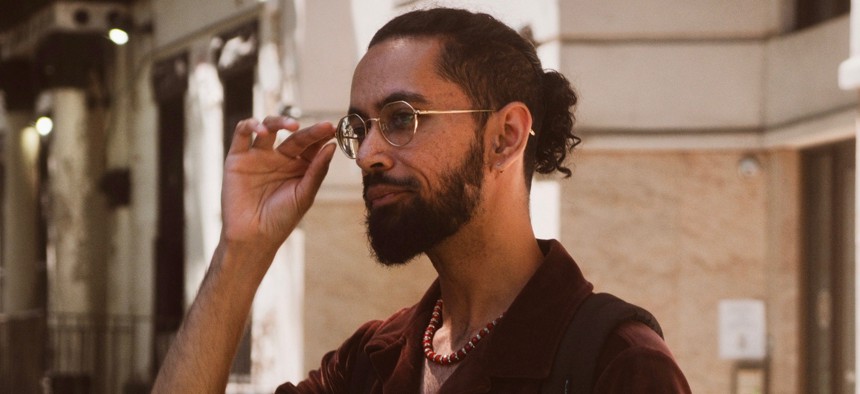
Asad Dandia leads walking tours in New York City. Asad Dandia

You’d be hard pressed to find another millennial who knows more about New York City than Asad Dandia, a 33-year-old historian and urbanist who runs a walking tour group called New York Narratives.
Over the past few years, he’s led immersive storytelling tours, taking special care to highlight cultural and social perspectives that are often overlooked. He’s also one of a small group of people who can say they believed that a young, little-known democratic socialist Assembly member could win the mayoral race early on. In August 2024, just before Zohran Mamdani launched his mayoral campaign, Dandia posted a picture of the two of them together, saying “I can’t say much, but politics in the world’s most influential city are about to get a lot more exciting. Keep an eye on this Muslim socialist.” On election night, more than a year later, he returned to the post. “Did I lie? DID I LIE?!?” he wrote.
As of last week, Dandia has taken on another role: the official historian for his home borough of Brooklyn. Every borough has one, but it’s often been a low-key role – one that most New Yorkers aren’t even aware exists. With a background in organizing and keen grasp on social media, Dandia has big plans to leverage the position, blending his focus on the city’s underrepresented voices with its duties.
“The idea is that I’m to serve as a resource to Borough Hall, the press and to cultural and education institutions that are seeking to uplift, advance, preserve and interpret the stories of Brooklyn,” Dandia told City & State. “When they called and offered the role to me, I was elated because this is something I already do on my own.”
City & State caught up with Dandia to discuss safeguarding Brooklyn’s history, his relationship with the mayor and how he reclaimed his love of the city in wake of a traumatizing experience with police. This interview has been lightly edited for length and clarity.
In an interview with The New York Times, Brooklyn Borough President Antonio Reynoso said that you’d all but campaigned to be the borough’s historian. Why did you want to do this? It’s not a paid position.
I think it’s more that he and I were sort of chatting, having done a video together previously around this time last year. His team had wanted to do a video with me about the history of Muslim and Middle Eastern communities in Brooklyn – short, simple, nothing too intense. We met up on Atlantic Avenue and we were just chatting. I think at that point I’d already met with the borough historian, which I’d told Reynoso, and he seemed to suggest that the role wasn’t being necessarily utilized to its fullest potential. I basically said that it sounded interesting and asked whether he was considering having someone utilize it. I think he took that as a hint and we decided to talk. I didn’t hear about it again until this past month though.
From what I understand about your walking tours, a central thread of them is to share the stories of underrepresented New Yorkers. How do you intend to bring this perspective forward as Brooklyn’s historian?
I’m just going to continue doing what I’m already doing. At least in that capacity, I don’t think I’m going to change, I’m going to continue moving forward. It’s always been a passion, but I think now I view myself as responsible. I feel obligated to carry the stories of this borough forward. I feel obligated to listen to people all over the borough, from Bushwick to Brighton Beach, Bensonhurst to Brownsville – wherever they may be, if they are a resident of Brooklyn, if they were once a resident of Brooklyn, if they love Brooklyn, if they have any connection to Brooklyn.
You know, you can argue that much of the country has a cultural connection to Brooklyn. So much culture comes out of here. I am interested in those stories and I’m hoping I can do whatever I can with this new platform that I have to advance them and to develop a deeper appreciation for what it means to be not just a Brooklynite but also a New Yorker.
I’d be remiss not to ask about your experience as a young Muslim being targeted and surveilled by the New York City Police Department more than a decade ago. You ultimately joined a class-action lawsuit against the NYPD and won, but it’s hard to imagine that experience not shaking your trust in this city’s institutions. Where do you stand on this now?
I'm actually very grateful that you asked that. It is kind of wild to think about the fact that a guy who once sued the New York City government as a teenager for surveilling him is now in this position to tell the stories of that same city, right? The way I like to think about it, or the way I like to frame my own narrative, is that New York City does not belong to any single person. It doesn't belong to me, it doesn't belong to you, it doesn't belong to any individual – it belongs to all of us collectively. Each one of us has the power to claim and shape our own narratives and our own relationships to the city. Nobody can say that we do not belong. This is the one city where, no matter where you come from, you will find a place to belong.
If I allowed my experience with surveillance to prevent me from doing the work that I'm doing, that would mean ceding the ground to people that don't want me here – to the racists and to the bigots and to everyone else who tries to say that Muslims don't belong in the city. As a friend of mine says, Muslims don’t just belong in this city, they belong in City Hall – and we are indeed in City Hall now. A lot of my trajectory has been about reclaiming my narrative. My tour company and storytelling project is called New York Narratives for that reason because every single one of us has a New York narrative.
While much of the Democratic establishment and mainstream press initially scoffed at the idea of Zohran Mamdani winning the mayoral race, you were an important early supporter for him. What did you know that so many didn’t?
Before he ran for mayor, we actually sat down together. It was in Greenwich Village. I think initially we’d proposed meeting at Qahwah House, but I actually advised against that as we’re both well known in the Muslim community and we’d never get to have a one-on-one without people continuously coming up to us. We went to Cafe Reggio instead. I saw that he had a very kind of quintessential New York cosmopolitanism in him. I saw the fire of commitment in his eyes. I saw that this was something that he was very serious about, this was not going to be a vanity run as is sometimes the case with people who run for office. I saw that he embodied what it means to be somebody who wants to represent the world's most diverse city.
I think most importantly, I saw a guy who was willing to listen. The reason why he met with me is because he wanted to hear from me and get my feedback on how to reach out to communities throughout New York. We spent a lot of time talking specifically about Muslim communities of course, but we also talked about his fundraising strategy, which parts of the city he would do well in, his agenda and what he wants to do. He was very much willing to listen to me. I’ve never worked in government a day in my life and he was a state Assembly member with government experience. Still he heard me out, I gave him some counsel, and he said he might call me at some point in the future. Two weeks later, he called and said he wanted to put me on his kitchen cabinet, which was sort of his informal advisory team. I was there on the day he launched. I was there on the day he won the primary. I was there on the day he won the election. I was there at his inauguration and I was at his 100-day speech. I will continue to be there for as long as he is my mayor.
One of the big criticisms the mayor received on the campaign trail, during the primary in particular, was that much of his base were young, lefty transparents – not “real New Yorkers.” The reality of Mamdani’s support is obviously much more nuanced, especially in the general election where his support expanded greatly. Still, you’ve lived here your whole life, you know so much about this city, what are your thoughts on this?
One other thing that I really admire about the mayor that I think distinguishes him from a lot of people on the left, is that while he did extraordinarily well with young professionals who moved here from somewhere else, he did so in such a way where he did not alienate what I call the Eric Adams’ base of outerborough, ethnic communities. I think part of that has to do with the fact that his story is a story of international migration. His father’s side, their family was exiled from Gujarat in India. They went to Africa, to Uganda, and when they were exiled from Uganda they came to New York. His father marched in the Civil Rights Movement. His mother of course is a superstar in the Indian cinema world.
I think Zohran having that international experience of exile and migration and multiple identities that might seem at odds, made him someone who was far more empathetic to outer borough immigrant communities, who often have that kind of narrative as well. Most people are not the children of academics and movie directors, but they are immigrants. They are people who came here from somewhere else. And because he’s also young, he’s college educated, he was just as much able to blend in well with the young professionals, the “transplants,” the DSA.
His biggest demographics in the primary were of course young people who rent – there is a class dimension here – Muslims, Asians and Latinos. As far as “transplant politics” is concerned, I think a better way of looking at it is the politics of those who rent versus those who don't – or even better, those who have the means to live in the city comfortably and those who don't. Those who have the means to live in the city comfortably are very few in number and those that don’t are much greater. As the mayor himself said, there’s really only one constituency: the working class. People who are transplants they’re coming here because they want jobs, they want opportunities, they want to be part of the city that promises something. That city for a long time has fallen short of that promise. I think by aligning themselves with the mayor, they are aligning themselves with the politics that will make it not just easier for them, but for longstanding residents as well.
Going back to your job as borough historian, any specific things on the agenda yet?
To whatever extent I can serve Brooklyn, I will be here. I’ve been a Brooklynite since the day I came out of my mother's womb, and if I can help it, I hope to stay a Brooklynite for as long as I can.
One more thing, because I said I’ve been a Brooklynite forever. There are no Muslim or Muslim-focused cemeteries in Brooklyn. I could be wrong but to my knowledge, they're not here. Muslim New Yorkers, when they pass away, they get buried in either a cemetery in Long Island or New Jersey. And as a native New Yorker, getting laid to rest there is kind of a downgrade. One of my dreams for Brooklyn is that we can have a burial place for Muslims. We’ll see. It’s on my agenda to see if we can get somewhere so that our stories that are central to the Brooklyn borough can also be laid to rest in the borough of Brooklyn.
NEXT STORY: This week’s biggest Winners & Losers