

Personality
Christian Celeste Tate’s notifications are going crazy after his Assembly win
A Q&A with one of the DSA-backed challengers who unseated an incumbent in New York City.
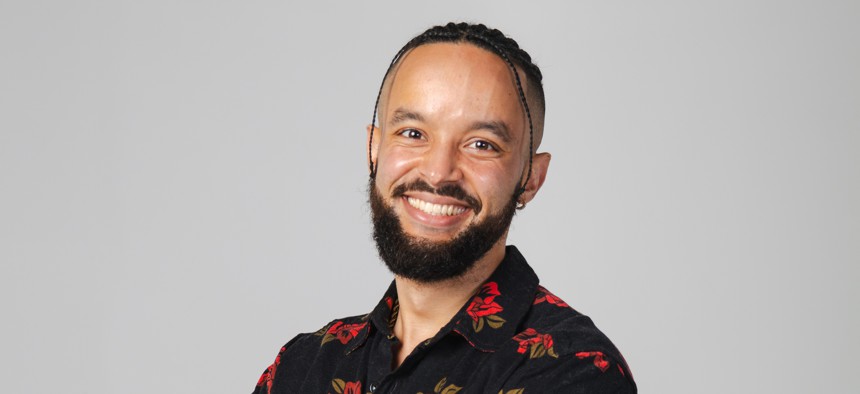
Christian Celeste Tate is now the Democratic nominee for Assembly District 54 in Brooklyn. Alexandra Chan


Primary election night was a bad one for incumbents and a shockingly good night for candidates backed by the New York City chapter of the Democratic Socialists of America. Christian Celeste Tate was part of that wave with his win in Assembly District 54 with 62% of the vote over incumbent Erik Dilan, who represents Bushwick, Cypress Hills and East New York.
Tate has been involved with Brooklyn Community Board 4, becoming first vice chair. His work as an activist, volunteering with Zohran Mamdani’s mayoral campaign and within the NYC-DSA’s Afrosocialists and Socialists of Color Caucus led to his decision to run for office.
Dilan has represented the district since 2015 and was endorsed by 1199SEIU, District Council 37 and the Hotel and Gaming Trades Council, among others. Dilan’s quiet campaign reflected his talked-about absence in the district, which was noted a few days before the election by New York City Council Member Sandy Nurse at a community board meeting.
Tate knocked on 4,000 doors to meet his future constituents and connect with them. Bushwick has a large Hispanic population and Tate’s rudimentary Spanish skills were put to the test.
While he was endorsed by DSA and the Working Families Party, Tate was not endorsed by New York City Mayor Zohran Mamdani, who instead focused on congressional races. He did receive an endorsement from Rep. Alexandria Ocasio-Cortez, who backed candidates for the state Legislature.
City & State spoke with Tate about his win and his plans to represent Bushwick and East New York in Albany. This interview has been edited for length and clarity.
How did you feel waking up this morning?
The notifications had been going crazy. Yeah, it’s been a lot of calls this morning, and then I popped over to one of the senior centers in the district, just to say hi to folks there, met up with the chair of Community Board 4, (the) district manager (and the tenants association) president over at Palmetto Gardens. So, you know, mostly I’m trying to tread my way through these notifications, but also starting to show up, which is pretty exciting.
Who do you credit to being a key contributor to your success?
There absolutely is no single contributor. This was a big coalition, and, first and foremost, it centered the people of this community. I can list the organizations that showed up and organized to make this possible, but at the end of the day, this campaign was inspired by the love I have for my neighbors, the love I have for the people of Bushwick and East New York, and the amount that I have grown watching them show up, and how much I cherish this opportunity to represent them, because these communities are organized. Bushwick and East New York have organized themselves; they’re not looking to be saved; they just need representatives that understand that and are here to uplift that work, so there’s no single contributor that made this possible. This was the community mobilizing.
A lot of democratic socialists won on election night. How do you feel being one of these candidates winning on a progressive platform?
I’m so proud to be in this moment. This is not even a New York City story. This is a national story about the type of politics that people are demanding in this moment, and I think, in part, that’s a response to fascism, and in part that’s a response to oligarchy, in part that’s a response to genocide, and to war. There are a lot of different ingredients that lead us to this moment, but I’m so grateful to be able to be an organizer in this moment, because every action has an equal and opposite reaction, and the shittier things get, the more powerful the resistance becomes, and that’s like, in some ways, a really bleak thing to experience up close, but it’s also a really hopeful and empowering thing to see and be a part of.
Bushwick has been experiencing gentrification and an influx of newcomers living alongside long-term residents. How are you going to balance the needs of these two different groups?
I think first and foremost is just seeing the commonality of that struggle when I have talked about housing. The pillar of this campaign is about keeping everybody in their homes, and that applies to tenants just as much as that applies to homeowners, and I think the types of interventions that tenants and homeowners need can be different, but at the end of the day, this is about keeping all of us providing housing security to all of us and allowing everybody to stay in the communities that they love, whether you’ve moved there recently or whether you were born and bred there. So we can talk specific policies, but really I think for me, the housing organizing that I’ve done through the East New York Community Land Trust, they’ve done an incredible job of emphasizing that commonality, because this is something that all of us can be organizing around together. There doesn’t have to be this divisiveness that I think we sometimes see between tenants and homeowners.
When you get to the Assembly, what is the first thing you’re going to do in Albany?
The beautiful thing about being part of a bigger movement is that I don’t have to start from scratch, right? There are a lot of solutions that I’m excited to champion, and our campaign has elevated a lot of ideas that don’t have existing bills for them, but when I think about, like, my day one priorities, it’s signing on to the incredible work that my colleagues in the Assembly are already doing, right? It’s signing on to New York for All, signing on to the New York Health Act. It’s signing on to ending toxic home flipping. Folks have been doing the work, and step one is to find my place in that existing movement, in that existing work, and then step two is figuring out where there are gaps that I can fill with the ideas that are campaign-elevated from the grassroots.
You have been a social organizer for years. How was your approach to speaking to people who are disillusioned with politics and trying to get them to engage in voting and get them engaged into your campaign?
I totally get that. I have been disillusioned with politics. How could you not be? And that’s especially true when you’re organizing in predominantly Black and brown communities that have been intentionally and systematically underrepresented, intentionally cut out of our political process. How can people not find that demotivating, if not demoralizing? And so, in those conversations, I connect on that point.
And then the second thing is not pretending as though this campaign is going to be the answer to that, right? This race was deeply important, because who represents us in the state Assembly matters, but your state Assembly member alone is not going to save you, right? It’s organizing in your communities and building community, building solidarity, that’s what is going to save us, that’s what’s going to uplift us, and our representatives have a big part in that, but I think by not pretending as though this campaign was the end all be all. I think people felt that realness, because we weren’t telling stories, we weren’t overpromising, we were talking about the world that we deserve, and talking about how this campaign is about playing our part in a much bigger movement.
NEXT STORY: Winners & Losers: Primary Edition