

New York State
Dr. James McDonald is Hochul’s first line of defense
The state health commissioner has to navigate a politicized medical landscape and multiple Trump administration probes while a gubernatorial election looms.
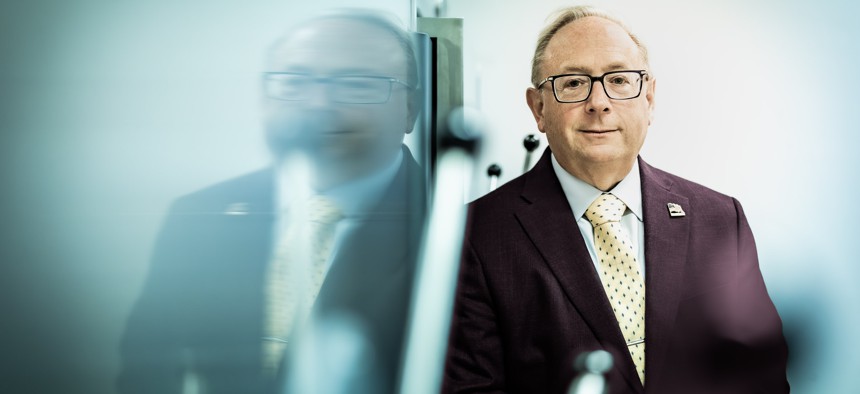
Dr. James McDonald has a lot on his plate. Franco Vogt


If you give leery public health workers a cookie – or a special recipe for one – they might listen to what you have to say. And if they start to listen, they might start to trust you, and then they may just stick around. At least, that was Dr. James McDonald’s strategy when he became the 18th state health commissioner in 2023 – back when rebuilding a COVID-19-ravished workforce was his biggest problem.
Gov. Kathy Hochul appointed McDonald as the acting leader of state health policy three months before the World Health Organization declared the pandemic officially over. Any remaining department staff were exhausted, and still reeling, from the lingering national embarrassment of working for the infamous state agency connected to the COVID-19 nursing home death scandal under disgraced former Gov. Andrew Cuomo. All of that and more contributed to an immensely eroded level of public trust in health officials, particularly on the right – not just in New York, but nationally. McDonald knew all of this, too, when he accepted the role.
In his first few weeks as acting commissioner, McDonald called an all-staff meeting to give the bruised, bare-bones department a literal taste of his leadership style: sharing his special homemade chocolate chip cookie recipe – one he perfected some four decades earlier. Something clicked within the department that day, the commissioner said.
“What they saw was, well, our new acting commissioner is a normal, regular person who’s relatable,” McDonald told City & State in a June 3 interview. “It made them start rooting for me and working for me and making sure they could work as hard as possible, so that I succeeded and we succeeded.
“It’s funny – in some ways, that cookie recipe really did help rebuild the New York state Department of Health.”
This is textbook McDonald. The commissioner has a gentle demeanor, carries himself as calmly as he speaks, even when under duress. His slow and steady wins the race attitude makes him feel approachable to both the public and his employees – a trait that, at times, can be a double-edged sword. But that hasn’t stopped him from connecting with others the way he does best; he makes a point of occasionally greeting Health Department employees as they arrive for work at Albany’s Corning Tower.
Now three years on the job, several federal battles regularly compete for the attention of New York’s top doctor. President Donald Trump’s Department of Justice sued McDonald on June 16, accusing him and state Medicaid Director Amir Bassiri of rigging the state’s Medicaid-funded home-care program for a favored vendor. The Trump administration is continuing a separate probe into the state’s Medicaid program. Thousands of state staffers are dissecting the imminent effects of federal changes to Medicaid. That’s as the commissioner continues to lead the transition to the state taking over vaccine recommendations and guidelines once handled by the U.S. Centers for Disease Control and Prevention.
None of that has really helped solve the question of public trust. McDonald has, within New York state, become the face of those struggles, particularly the Consumer Directed Personal Assistance Program and the ongoing investigation. It has become commonplace for the state health commissioner and the department to face public demonstrations and, at times, harassment in recent years.
Health officials are forced to walk a fine line to protect the public, and themselves, while staying loyal to the executive and maintaining their trust. The mild-mannered McDonald is certainly loyal to Hochul. Yet within his go along to get along temperament rests an unfleeting resolve that makes him the governor’s ideal trusted public health interpreter.
In other words: Critics’ image of McDonald as something of a CDPAP boogeyman is a far cry from the version of McDonald who baked his entire department cookies – the version people know and trust. And as he tries to weather the perfect storm of the CDPAP probe, post-pandemic trust issues, reduced health care coverage for New Yorkers, a gubernatorial election and more, his recipe for success – or even just survival – will likely be leaning into his authenticity.
Back in the New York groove
Medical school was always at the back of McDonald’s mind growing up in the Albany suburb of Cohoes, but the years of arduous study intimidated him until something hit him his sophomore year at the Rochester Institute of Technology. Then a photography major, McDonald vividly remembers going to take a close-up of a penny, but instead looking at himself in the mirror. Staring into his own gaze, the young McDonald said to himself: “Jim, you’re 19 years old, you can do this. I will undoubtedly fail, and yet I will work as hard as possible.”
And he did just that. McDonald, 62, has had a storied career, having served as an officer in the U.S. Navy, practiced medicine in rural areas and worked as a medical director of outpatient medicine in Chinle, Arizona, serving in the Indian Health Service in the Navajo Nation. Before returning to New York, he worked at the Rhode Island Department of Health for over a decade.
That breadth of experience – and his Capital Region roots – were, by their own accounts, appealing to both the governor when she selected him to lead the department permanently, and earlier, to McDonald’s predecessor, Mary Bassett, when she hired him as medical director of the state Office of Public Health in 2022.
Bassett had inherited a department in peril after Cuomo appointee Dr. Howard Zucker resigned in scandal for his role in the administration’s handling of nursing homes during the pandemic. Only some six months later, Bassett resigned to return to teaching full time at Harvard University’s T.H. Chan School of Public Health. She recommended Hochul name McDonald acting health commissioner. “He has the temperament of a leader,” Bassett said. “He listens, and he’s decisive to things that you need to be able to do.”
Hochul agreed, and McDonald quickly found himself leading the department starting Jan. 1, 2023.
He has worked to return the department to normalcy post-pandemic through increased hiring. The agency had about 4,000 staffers when he became commissioner – down from about 4,800 in 2019. The agency has slowly accumulated personnel with about 5,392 people currently on the department payroll.
But people still want answers regarding the state’s handling of the pandemic – even as Bassett and her department worked to put the difficult chapter behind them, for which she received much criticism. While the state hired the Olson Group to review its pandemic decisions, many, like Bill Hammond, senior health policy director at the Empire Center for Public Policy, argue the review and resulting 262-page report was ineffective.
A multitude of lawmakers and health experts have sent letters to Hochul and McDonald urging them to do a more thorough review to examine how state’s pandemic policies aligned with federal guidelines. They argued the state Department of Health counsel’s reluctance to do another review means New York may be leaving itself wide open to making the same mistakes next time. If McDonald is interested or pushing for a review behind scenes, he hasn’t made it known publicly.
Loyal and true
The injection of politics into public health has become commonplace since the pandemic – and just as health workers continue to navigate that added layer of complexity, so too, does the governor. Key to that for Hochul is having a good soldier in McDonald. And while the pair, who speak regularly, have a well-known partnership, at times, that partnership means he’s a master of vague, politics-approved answers counsel won’t fret about.
“I understand McDonald’s in a tough spot,” Hammond said. “He answers to the governor – he has to.”
But that’s not what McDonald would have you believe. The commissioner often boasts of the level of autonomy the governor gives him. He frequently speaks with the public and in the press defending the Health Department to lawmakers in Albany. “I think that’s unique to this governor, that … I get to go speak the truth without spin,” McDonald said.
That’s the kind of statement McDonald’s critics would balk at. In their eyes, he’s a master of political speak who doesn’t take a strong public stance on much. McDonald cautiously chooses his words and doesn’t react emotionally to lawmakers’ probing questions, nor demonstrators who jeer at him as he walks through a doorway.
But Hammond said pushing back against the governor is any health commissioner’s job. “That’s what they should be there for,” he said. “Why bother having anyone, then?”
Yet the doctor’s soft demeanor should not be mistaken for weakness – at least from where the governor stands. He’ll answer any question, but never strays far from delicate word choice department officials and the Executive Chamber would approve of. This balance was perhaps clearest at one of McDonald’s earliest press conferences with Hochul in 2023. Asked whether the state needed to do a thorough review of the state’s COVID-19 policies, the commissioner initially hesitated and looked to Hochul. The governor then replied, “It’s a new day, say what you like.”
McDonald’s careful way of speaking is most evident in the controversy surrounding a plan Hochul negotiated in the fiscal year 2025 budget to substantially alter a $9 billion Medicaid home care program – a deal led by the Second Floor that has raised questions of bid-rigging and invited an onslaught of litigation against the state.
The Consumer Directed Personal Assistance Program, which allows older adults and people with disabilities to choose their own home caregivers, underwent a rushed, yearlong overhaul to transition hundreds of thousands of vulnerable New Yorkers to one company and eradicate hundreds of fiscal middlemen operating with minimal oversight. The transition was an intensive battle to register thousands of people with the new company in an abbreviated, arbitrary window Hochul insisted upon, while advocates paid by fiscal intermediaries going out of business sowed a harmful disinformation campaign to CDPAP consumers about the changes – convincing program users they didn’t need to transition and slowing down the process.
“I think the CDPAP thing was harder than it needed to be,” McDonald told City & State. “It had a lot more to do with just all the external voices. … And when you get right down to it, my job was to speak the truth and implement a law, and overcoming all that herculean opposition was hard for us, but we did that.”
But McDonald said the process wasn’t made difficult by Hochul not consulting him. “I can talk to the governor pretty much anytime I want,” the commissioner said. “She’s very supportive of everything I’m doing, and I’m not just saying that.”
When state Sens. Gustavo Rivera and James Skoufis led a legislative probe last year examining the controversial changes to the program, they released new evidence to show the high likelihood Hochul handpicked Public Partnerships LLC to take over the state program. The legislators gave the commissioner an extra month to prepare for a public hearing on the matter. But when he went before lawmakers in August, McDonald did not know, or claimed not to know, answers to basic questions. When Rivera asked how many workers were paid the first week after PPL took over, McDonald replied, “I don’t know that number off the top of my head. We have the number at the department.”
Anyone who knows the commissioner well would likely find that hard to believe. McDonald’s impressive recall and attention to detail were evident in a one-hour interview with City & State. Several times throughout the hour, he easily rattled off the exact dates of a discussion he had with someone, like the night he and his wife decided to move back to New York (March 14, 2022) and his first all-staff meeting (Jan. 23, 2023) without being asked. It’s clear he doesn’t miss much.
As most of the CDPAP litigation brought against the state has been settled – though the federal probe is still ongoing – McDonald is maintaining a similar tone to last summer’s public hearing: The Health Department was implementing the law, and did nothing wrong to follow it.
But the commissioner admitted his direction from the governor was clear, and he was happy to be the governor’s diligent soldier.
“I don’t ever mind being told to speak the truth and just have the courage to keep pushing the truth,” he said of the program transition. “And absent any change in that law, which never happened, I had my marching orders, I knew what I was going to do, and that’s what we did.”
The war ahead
The initial challenges that existed when McDonald took office seemed like a heavy lift, but those pale in comparison to the current weight on the commissioner’s shoulders. He may have had his marching orders from the governor before, but now, they’re off to battle together.
“Now more than ever, we need strong partners in pushing back against the damaging cuts and policies coming out of Washington and Dr. McDonald plays a critical role in my administration’s efforts to protect public health in the face of those challenges,” Hochul said in a statement to City & State.
Indeed, the questionable CDPAP rollout caught the attention of the Trump administration, prompting the Department of Justice and the U.S. Centers for Medicare and Medicaid Services to open separate probes into the state’s Medicaid program earlier this year. The Department of Justice commenced an investigation into the circumstances of the $9 billion home-care program contract, but McDonald raised questions about its credibility, likening Trump’s recent tactics to weaponize the department to his crusade against former FBI Director James Comey.
And in March, CMS Administrator Dr. Mehmet Oz sent the state Health Department and Hochul a letter demanding the administration answer 50 questions delving into the amount of waste and fraud in New York’s $124 billion Medicaid program, much as he did in California and Minnesota. The Centers for Medicare and Medicaid Services later admitted, though, that the administration made a significant error in how it calculated the number of New Yorkers who use Medicaid services to justify the probe, and misidentified the state’s approach to applying billing codes. The department responded to more questions about two months before the Department of Justice lawsuit was filed.
But McDonald isn’t concerned by the ongoing probe. “We run a very solid Medicaid program that really we’re doing a lot to actually control fraud and we have a strong reputation of doing that,” he said.
The Department of Justice filed a lawsuit against PPL, McDonald and Bassiri a week before June 23 congressional primaries and five months before the governor is up for reelection. It alleged Hochul’s overhaul of the program resulted in an unchecked fraud scheme and that her administration conducted a sham bidding process to select the company. The department is also accusing the Health Department of failing to take action to hold PPL accountable after state leaders learned the company intended to violate the financial terms of the five-year contract. Bassiri will testify before Congress on June 25, a source familiar with health department discussions said.
Cadence Acquaviva, a spokesperson for the Health Department, maintained McDonald’s prior sentiment. “This baseless complaint is the latest attempt by Washington Republicans to score political points at the expense of vulnerable New Yorkers,” she said in a statement after the lawsuit was filed. “It is inexcusable and completely lacking in merit. The fact of the matter is this administration saved CDPAP from a fiscal crisis by removing hundreds of wasteful administrative middlemen.”
What the fallout will look like for McDonald remains to be seen, but expect it to be a significant talking point for GOP gubernatorial candidate Bruce Blakeman as the general election cycle kicks into gear.
A spokesperson for Hochul also dismissed the suit, calling it “another sad attempt by the Trump administration to weaponize the justice system to attack political opponents in an election year.” They also said: “We are confident the facts are on our side.”
Meanwhile, the majority of department staff are working to prepare for significant Medicaid changes enacted under H.R. 1, the tax and spending plan passed by Congress last summer that altered workforce eligibility rules for Medicaid patients. The new work requirements have yet to be finalized, so it’s unclear how many New Yorkers will be impacted.
On top of that, roughly 450,000 New Yorkers who rely on low- to no-cost state-subsidized healthcare coverage, known as the Essential Plan, will lose their coverage July 1 because of additional Medicaid changes made in H.R. 1. And while the federal government approved a waiver earlier this year to avoid up to 1 million New Yorkers losing coverage, state lawmakers left Albany without taking action to help those remaining 450,000 New Yorkers. The Legislature posed solutions to fill the gap during budget talks, but state Senate Majority Leader Andrea Stewart-Cousins said Hochul “frankly wasn’t a supporter,” and ultimately, nothing was done.
A spokesperson for the governor pointed fingers at the state’s Republican members of Congress. “While no state can backfill these devastating cuts, the governor took decisive action to protect coverage for as many New Yorkers as possible.”
McDonald is not particularly political in his nature. He is, after all, the man who longs for the days “when people were just polite to each other,” the man who bakes his staff chocolate chip cookies. But he uses Hochul’s strategy – pointing the blame toward the Trump administration – plenty. After he defended Hochul’s decision on the Essential Plan, voicing similar cost concerns as well as confidence employers would provide coverage, he took a page out of Hochul’s playbook. “H.R. 1 is what caused all this, and I think the Republicans in Congress need to own that,” he said.
But he’s also learning to mix that approach with his own when it comes to navigating the federal government: appealing to people’s humanity. He’s well aware of the fact that the public is less inclined to trust the government and health officials these days. “I think people are stuck with not knowing who to believe,” McDonald said.
So what can he do?
“When I speak, and I can control me and my health department, we always put out honest, objective information. The work we do is noble. … We help heal the sick, we help feed the hungry, we help everyone’s lives get better. If people are criticizing that, maybe we’re not the problem.”