

New York State
How Jordan Wright held off the DSA
The Assembly member gave the DSA its only loss in last month’s primaries. He said it’s thanks to old-school campaigning.
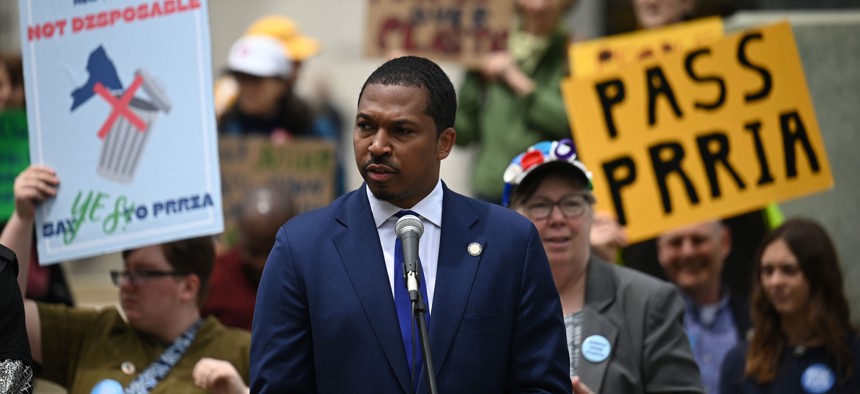
Assembly Member Jordan Wright said doing hard work in the community was the difference in his primary victory. Will Waldron/Albany Times Union via Getty Images



As a socialist wave overtook New York in last month’s primaries, with candidates endorsed by the Democratic Socialists of America winning across New York City and beyond, one incumbent remained standing. In Harlem’s Assembly District 70, Jordan Wright held off an insurgent challenge from Conrad Blackburn, even as several of other sitting lawmakers got bested by a member of the DSA-endorsed slate. And he also prevailed in a portion of the congressional district that Rep. Adriano Espaillat lost to democratic socialist Darializa Avila Chevalier.
Wright is a third-generation Harlem official. His father Keith Wright is a former member of the Assembly who heads the Manhattan Democratic Party, and his late grandfather Bruce Wright was a judge. The sitting Assembly member’s victory in June was a rare dynastic victory at a time when traditional party machines and political family influence is dwindling. But Wright doesn’t attribute his win to his family name. He sat down with City & State to discuss how old-fashioned, boots-on-the-ground campaigning led him to success where so many others failed in the primary, and what to take away from it. This interview has been edited for length and clarity.
What in your campaign do you think you did that propelled you to victory, while others with DSA challengers lost?
We’ve been working very hard in Harlem for a long period of time. My team and I knocked on a cumulative 40,000 doors, (made any) number of phone calls and just talking to voters at any moment possible, meeting people where they are, helping them understand I’m their Assembly member, what an Assembly member does and why it’s important for Harlem in the community. I’m grateful, eternally grateful, that the community has selected me to be their Assembly member for another two years.
Obviously, you weren’t deeply involved in anyone’s race but your own, but why do you think you won while Rep. Adriano Espaillat lost?
I can speak to why I won. I won because I’ve been working really hard for my community for the past two years. People in the community, they know who I am. They see me in the streets every day. I’m not a mystery. I’m out here, I talk to people – and that’s why I won, because people know me. I’ve been on the community board, obviously. I’ve been the campaign manager and chief of staff for (New York City) Council Member (Yusef) Salaam, and in this community my entire life.
How much do you think the intergenerational presence of the Wright family in Harlem played in this race and your ability to reach voters?
Well, I’ll say this: When I go to senior centers, I go to churches, sometimes I’ll introduce myself. And I’ll introduce parts of what my family has done, and I’m very proud to say that when I mention my grandfather, Judge Bruce Wright, that gets the loudest applause. It’s important to understand the work that he did in the community. It’s important to understand why that work is so important. Just the blessing of my life to be able to continue the family legacy of service.
The mayor didn’t endorse against any incumbent Assembly candidates. His backing can carry a lot of weight. Did the absence of that presence help you or hurt your opponent?
I think the mayor is obviously a very well-liked, very popular politician. As an elected official, I think he’s doing great work. I think he has a lot more great work to do. I’m not sure why he didn’t want to get involved in this race, but one thing I do know is I was able to serve with him in the Assembly. We had a good relationship when we were in the Assembly. I look forward to doing that work with him, no matter what that looks like going forward.
Did you make conscious choices to shore up your left flank in anticipation of a challenge from the DSA? You attended several DSA-organized rallies, like tax the rich events, since the start of the year. Was that intentional?
I’ve been in the New York state Assembly for less than two years still to this point. I’m still growing as a legislator. Any rally you see me at, those are things that I’m there for, not for no other reason than I want to be there for them. I think that I can answer your question directly: No. I’m just legislating and governing, no matter what’s going on around me politically. What's at the core interest for me, as always, are the constituents of the 70th Assembly District, and how it can make life better for them.
Given you succeeded where some of your colleagues in similar circumstances failed, do you think some of them might have taken their seats for granted? Something must have been different for you.
There’s clearly a taste for (the) opportunity for younger folks to be involved again. I’m lucky to be the president of the Manhattan Young Democrats. (At 31 years old,) I’m the youngest elected official we have in Manhattan. I think I’m the third-youngest in the Assembly. So I say that to say, at the end of the day, I’m a young man from this community who wants to do work. People want to see younger people more involved, so I’m happy to be able to say that’s something I have on my side, and I look forward to keeping on doing the work for the community.
There is this view that DSA is a threat to traditional Black political power in places like Harlem and Brooklyn. Do you think your victory refutes that?
It’s a bit of a false equivalence. I think that again, my race was my race. And I think that as far as Harlem is concerned, Harlem came out and Harlem spoke, and I’m happy to have won reelection. I think that in the process, in my first term, I’ve learned a lot so far. I look forward to doing more work in my second term and getting more influence in the New York state Assembly, doing more work, and more than anything else, and just always happy to be a Harlemite.
There was a lot of outside spending in your race, both for you and against your opponent. There were specific ads attacking Blackburn for his past internship with Pam Bondi. Do you think the influx of outside cash influenced the election?
The outside spending, whatever it may be, that didn’t impact the work that I was doing in the community. I think that there’s nothing like good old campaigning, end of the day, and that’s where my brain was mostly focused. Talking to people who are actually going to be voting. Because, (at the) end of the day, politics is a contact sport, and people are going to get contacted.
Rule #8: DSA can be beaten ... but it's not easy. Read the rest of the 26 new rules for elections in '26 here.
Correction: This story previously misstated Keith Wright's past office. He is a former member of the Assembly.
NEXT STORY: This week’s biggest Winners & Losers