

Personality
Gale Brewer’s intern investigations
Have you seen a college student counting trees on the Upper West Side? That’s probably one of Gale Brewer’s summer interns.
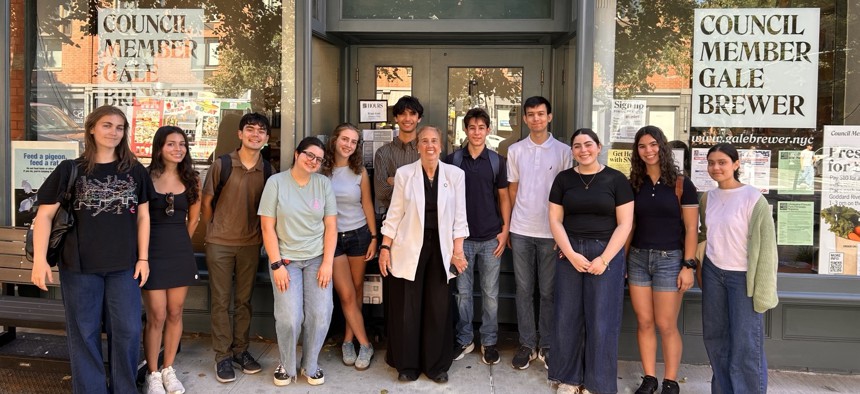
New York City Council Member Gale Brewer with some summer interns outside her district office this year. Office of New York City Council Member Gale Brewer

Over the course of Gale Brewer’s career, as Manhattan borough president and two tours as a New York City Council member, she has amassed a small army of interns – after 24 years in public office, the number has been estimated to be over 1,000.
They’re not just answering phones or copy editing social media posts. Each semester, those interns are assigned to walk every block of the district to collect data for quality-of-life surveys: logging instances of ice cream trucks blocking bike lanes, noting broken streetlights and counting trees.
Some of those interns are paid by their colleges or outside programs, or get course credit, but out of the 25 to 30 interns who Brewer said are cycling through her office this summer, she estimated about half of them are being paid. Asked about a push for a uniform $32 wage for City Council interns by a group of former interns, Brewer declined to comment.
Her interns, however, have gone on to big things. Among them are former Mayor Bill de Blasio’s chief of staff Emma Wolfe, and Mayor Zohran Mamdani’s Charter Revision Commission Chair Patrick Gaspard.
With summer internship season winding down, City & State rounded up some of the many surveys Brewer’s interns have completed over the years.
Tree canopies
Year: 2026, 2022
What interns surveyed: This summer, interns and community volunteers are identifying every single tree bed in Council District 6. A similar survey was completed in 2022, when volunteers counted 4,873 trees across the district. This year’s survey will update that information and focus on empty tree beds and trees in poor health to help focus planting and care efforts.
Result: In progress
Graffiti on mail collection boxes
Year: 2026
What interns surveyed: After Brewer’s 2024 and 2023 surveys found graffiti on almost every block in her district, interns are taking the anti-graffiti crusade into their own hands. This year, they’re focusing on U.S. Postal Service mail collection boxes, logging which types of paint and stickers are marking them up, and then using heavy duty sprays to remove the graffiti.
Result: In progress
Menstrual product access in public schools
Year: 2026
What interns surveyed: In 2016, New York City required that free menstrual products be provided in public schools, shelters and correctional facilities. Ten years later, Brewer’s interns collected responses from 99 public school students across 25 schools to see if that requirement was being met, and found that 56% of the schools surveyed did not regularly have menstrual products available in student bathrooms.
Result: Brewer has been advocating for stronger enforcement of the law. She told City & State that access has improved, but that her office is staying on top of the issue ahead of the coming school year.
Broken water fountains
Year: 2025
What interns surveyed: The City Council passed legislation sponsored by Brewer last year that would require the Department of Parks and Recreation to install additional drinking fountains by park entrances. At the same time, she tasked her interns with evaluating the working condition of her district’s existing fountains. Of the 216 water fountains that were covered in the survey, interns took notes on cleanliness and functionality, finding that 17 fountains were completely broken and 49 were impossible to access.
Result: “There are still broken water fountains. Very frustrating,” Brewer said, adding they’re keeping on it this year.
Unlicensed cannabis shops
Year: 2024, 2022
What interns surveyed: Brewer famously took on Zaza Waza, an illegal cannabis shop that was finally closed in 2024, but she couldn’t do it herself. In 2022, interns found that 26 locations in the district sold cannabis without a license. The survey spurred Brewer and several of her colleagues to petition the City Council and Gov. Kathy Hochul’s office to crack down on illegal sellers. In 2024, Brewer’s interns updated the data and found a 104% increase in unlicensed cannabis vendors in the district.
Result: Zaza Waza remains closed, Brewer said, but there’s still a need to crack down on bodegas illegally selling cannabis under the table.
Microfulfillment centers
Year: 2022, 2021
What interns surveyed: Interns collected data to map out 115 microfulfillment centers – which occupy commercial storefront space but effectively operate as warehouses – across the city. They found 93% were operating in zoning designations that did not permit warehouses.
Result: Brewer said that there have been huge closures of microfulfillment centers in Manhattan, which she guessed might have been helped along by stores receiving summonses for failure to accept cash payments and list prices.
Empty storefronts
Year: 2020, 2017
What interns surveyed: Surveying Broadway’s 244 blocks, Brewer’s interns counted 335 storefront vacancies along the avenue in August 2020 – a 78% increase from her office’s 2017 survey that counted 188 vacancies.
Result: City Comptroller Mark Levine said in a June report that vacancies across the city have recovered some since the COVID-19 pandemic, but found persistent vacancies remain a challenge in some neighborhoods – including on the Upper West Side.
NEXT STORY: This week’s biggest Winners & Losers