

New York City
How the Upper West Side challenges even the most prepared candidates
Former New York City Comptroller Scott Stringer looks back on the past 20 years.
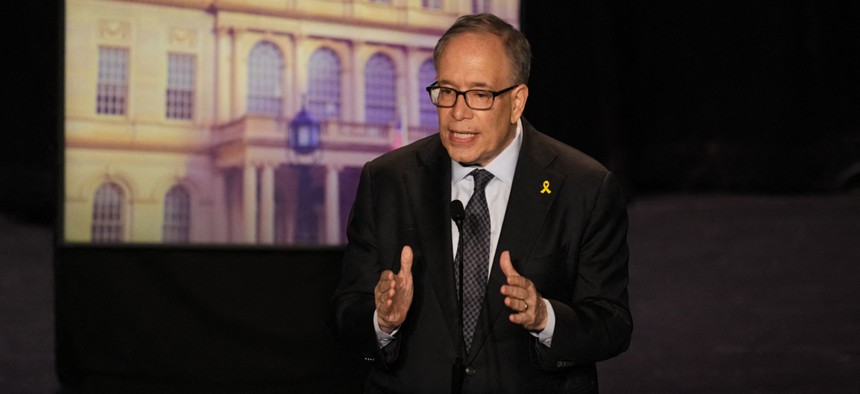
Scott Stringer reflects on his major accomplishments as Manhattan borough president and New York City comptroller. Vincent Alban/Pool/AFP via Getty Images



Scott Stringer has been synonymous with Manhattan politics since his appointment as a 16-year-old to his Washington Heights community planning board in 1977. A former Assembly member from the Upper West Side, Stringer served two terms as Manhattan borough president and another two terms as New York City comptroller, along with making unsuccessful runs for mayor in 2021 and 2025. Now a consultant living in the Financial District, Stringer talked to City & State about Manhattan politics over the past 20 years. This interview has been edited for length and clarity.
How has Manhattan politics changed over the past 20 years?
I would say the more things change, the more things stay the same.
How so?
Because Manhattan has been more about fiefdoms than traditional political bossism.
Do we still see that?
Yeah, I still think there’s a tremendous political diversity that’s more about distinct communities and less about an overall top-down political structure.
How did being an Upper West Side elected official prepare you for higher office?
The West Side electorate puts you through your paces. When I got elected to the Assembly in 1992, I remember being in Albany, as a young freshman legislator, I’m writing my newsletter, and another freshman came up to me and said, “I saw your newsletter. How come there were few pictures and all of this copy? Who reads this stuff?” And I go, “My constituents don’t send me postcards on an issue; they send me Ph.D dissertations for me to respond to.”
While that can be time-consuming, it’s no accident that constituent pressure, whether you’re talking about a national economic issue, Reaganomics, Clinton, Obama, this district, nationally and locally, they just are very engaged. So it’s no accident that if you serve this constituency well, it does prepare you for higher office.
You have the distinction of having run against two former governors seeking political comebacks. Eliot Spitzer for New York City comptroller in 2013 and Andrew Cuomo for mayor in 2025. Can you talk a bit about that?
For me, as a kid growing up in Washington Heights and coming from a political family, is there something about being able to mix it up with some of the best-known elected officials in the country? Sure, that was a challenge. But what a tremendous opportunity. The comptroller race was fascinating. I had this clear field, which was truly unprecedented if you think about it, right? Nobody was running against me. And that worked for me because I had a 18-month-old, and I had a 6-week-old child, and I’m sitting in my little kid’s bedroom in a rocking chair, and I’m talking to my son Max, who is 18 months old, and said, “Daddy did good, going to take care of you and your new brother.” All of a sudden, I get a text message, this is a true story, a text message from Jumaane Williams, and he goes, “I stand with you.” And I said, “That’s so lovely. What a nice man. What a nice councilman.” Ten minutes later, Brad Lander texts me, “I’m all in.” And I’m like, OK, two of them in the span of five minutes, and suddenly my phone starts to, (I) literally thought there was going to be smoke coming out of my phone. My wife comes into me and goes, “Scott, Eliot Spitzer’s on TV. He just announced against you.” And she closes the door. The phone starts to, whatever, and my kid’s just jumping up in the crib, and I look at my son and I said, “Dad’ll be back, but he’s got to hunt for food,” and I walk out. And then it was like a shiva call, people coming over to the house, dropping off food. Micah Lasher came with I think bagels and lox just that night to say it’s going to be OK. It was like I just died. And then the campaign started and I was, “Here we go. Let’s see what we can do.”
It was really an epic campaign and the Times, labor, the elected officials, nobody broke even though I was down 19 points, 20 points. I won the debates. Maybe it was because of low expectations, but we won the election. It was close, 52%-48% is not nothing, you know.
Central Park always served as a dividing line for Manhattan’s congressional districts above 14th Street, and then they were merged in 2022, leading to the Democratic primary between Rep. Jerry Nadler and former Rep. Carolyn Maloney. How has that impacted local politics?
Yes, they’re two distinct neighborhoods. There’s that. There’s the Upper West Side, perhaps the more moderate East Side, both heavily Jewish communities, both ultimately liberal communities. I’m not sure that the constituencies were so different. The political relationships were obviously different. It was unfortunate that we had to go through a congressional fight with two titans. But I think the district figured out in the post-Nadler congressional seat, just like they did the post-Ted Weiss seat a generation ago, Micah Lasher was the right candidate for this moment. The people have always wanted a cerebral, thoughtful member of Congress, but they also wanted somebody who could think out of the box. If you look at all of these congressional representatives we’ve had since the 1970s, Micah fits that profile.
Jack Schlossberg didn’t fit the bill of a typical Manhattan congressional candidate with decades of local experience, but rather he ran on his celebrity as the grandson of former President John F. Kennedy. What do you think of Jack and his candidacy this year?
I thought that Jack actually got a bad rap during the campaign. I thought he came across sincere, earnest. He had ideas. I think people forget that all the great ones have lost a race, their first race. I mean like almost everybody. Jerry Nadler lost a race, I lost a race, Mario Cuomo lost two races, Bill Clinton lost a race for reelection. Your first-time race is the learning curve. I mean Micah lost his first race. I don’t think we should critique a first-time candidate’s first outing. The question for Jack and for those who lose their first race is: What do you do now? Do you say to yourself, I took this race, maybe I didn’t do well, but I’m going to get back and I’m going to be an activist and maybe I’m going to run again. And the ones that think like that are the ones that end up making a great contribution to the city, and you can see that throughout the city. How many times did Percy Sutton, the great borough president of Manhattan, lose his local races? And look at the impact he had. Look at David Dinkins losing a race, two races for borough president before becoming mayor of the city of New York. Ruth Messinger lost to Jerry Nadler for Assembly by (23) votes, (and) she became the Democratic nominee for mayor in 1997, and she’s still contributing every day. I lost against Ronnie Eldridge for City Council in 1989. Eli Northrup loses to Micah Lasher; he’s the assemblyman today. Micah loses the state Senate race; he’s in Congress, just on the West Side and East Side. I think if Jack or Alex (Bores) want to do it again, I think they’re going to have opportunities to do it.
What happened in Upper Manhattan this year with Darializa Avila Chevalier unseating Rep. Adriano Espaillat?
If I had all the answers to that, I would be on the Sunday morning talk show circuit as a political expert. I still think that the race needs to be unpacked and analyzed, because while the warning signs were there, I really expected Adriano to win, to be honest. I do think there’s a larger issue that needs to be litigated for future elections, which is, how you run for office in a changing media landscape, and I think a lot of the campaign tradition that perhaps people like me and Jerry (Nadler) and others relied on successfully for 30 years, I think there has to be adjustments to this.
What are your biggest accomplishments?
Oh man, here we go. Look, as borough president, I really ran as a reform candidate. First thing I did was I changed the way community board members were selected, went to a merit-based selection process, took the politics out of the community board process. I have to tell you, Brad Hoylman-Sigal is basically reintroducing that reform, and I think it’s going to pay dividends for the people of Manhattan, and I think he’s taking it very seriously. That was one of our big reforms. The Go Green committee was reformed. The Columbia expansion, which I spearheaded, which resulted in a special district that preserved the architectural history and the people of West Harlem, so we did not gentrify and throw people out of their homes. I also did the NYU rezoning, protecting the community, and the Fordham rezoning, three university expansions in eight years. As comptroller, we were on Bill de Blasio 365 days a year, seven days a week, and our audits, our investigations, our going to court, preserving the right to reject contracts, I’m very proud of the substantive record of what we accomplished. I don’t think you’ve seen a comptroller in modern history who is as aggressive as we were. We looked at this dysfunctional pension system, and we had five different boards meeting, talking about the same five things over and over again, slowing down investments. Every mayor, comptroller, from (Mike) Bloomberg and (John) Liu, tried to consolidate the five pension funds to no avail, right? I get elected comptroller, I held those pension funds to one investment meeting for eight years. You think that was easy? No, it was a Tums-inducing eight years, but we were able to do it. And I also was the only comptroller who really, since (Jay) Goldin and (Alan) Hevesi, that did real divestments. I did the first-ever fossil fuel divestment, divested from guns, divested from private prisons. I have a lot to be proud of.
NEXT STORY: This week’s biggest Winners & Losers