

Personality
Rafael Espinal talks New York City press passes, film tax breaks and economic justice
The commissioner of the Mayor’s Office of Media and Entertainment also discusses his creative side.
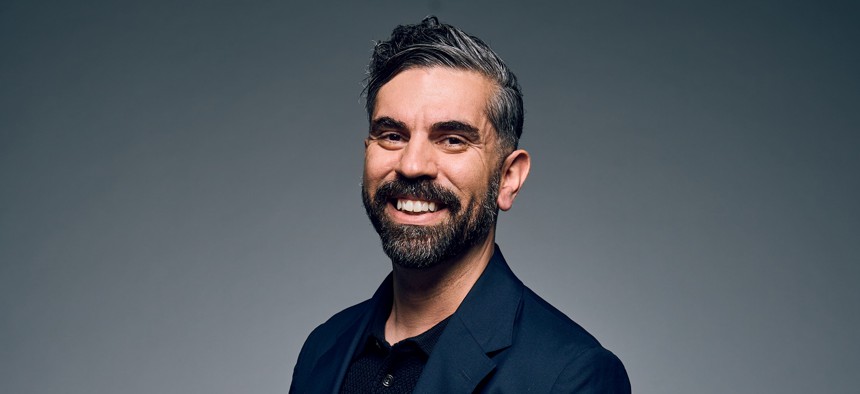
Rafael Espinal is no stranger to the world of New York City politics. Mario De Lopez


Rafael Espinal was the youngest elected official in New York when he won his seat in Assembly District 54 in 2011 and then went on to serve in the New York City Council for six years before resigning to become executive director of the Freelancers Union. Nine months ago, he was appointed by New York City Mayor Zohran Mamdani as commissioner of the Mayor’s Office of Media and Entertainment. Espinal sat down with City & State to talk about the film production industry, his dream job and his plans for the office. This interview has been edited for length and clarity.
What’s your favorite “Made in NY” production that’s up for an Emmy this year?
I don’t have a favorite, but I recently watched “The Chair Company,” and it’s an extremely bizarre show. Bizarre in a good way, and I recommend anyone who’s a fan of obscene, old-school and bizarre comedy to check it out.
If you had to choose to live the life of any character in a show that’s up for an Emmy right now, which would it be? And why?
I relate with the guy in “The Chair Company” a lot, Tim Robinson. I go into rabbit holes and try to find solutions for things that maybe don’t need solutions because I want to be great at my work.
Your office reports to Julie Su, deputy mayor for economic justice. What can we expect in terms of economic justice when it comes to the work that you’re doing here?
Many of the conversations when I came here were around how we improve business development. But under this new administration and under my leadership, we’re turning that (on) its head. We’re now approaching our work by measuring the success of those industries through the success stories of its workforce. Yes, we’re seeing an uptick in productions, but are we seeing an uptick in the amount of people being employed? Broadway shows are posting record numbers in tickets sold, but are we hearing from New Yorkers and their ability to experience the magic that these shows bring into our city? So, we’re focused on economic justice from a jobs proponent, but also from an experiential proponent. Are New Yorkers able to access the experiences that the industries are creating in our city, or are they just limited to the few who can afford them?
There’s always the debate over how much to subsidize TV and film production with tax breaks. In your estimation, is New York striking the right balance?
New York is striking the right balance in terms of ensuring that we are the most competitive state and city in the country. But I always believe that you can’t simply offer studios tax credits, right? You have to offer a complete package of, yes, credits, but also service in the back end, and that’s where our office comes in. I’ve been laser-focused on ensuring that we’re providing top-of-the-line quality service to those productions when they come through the door to this office to receive a permit. The production world is a small world, and when they come into a city, they often spread the word to other productions about what their experience has been like, and, knock on wood, to this day, they’ve been having a very positive experience since we’ve started this administration.
In regards to the controversy with the credentialed reporters who expressed their support for Luigi Mangione, some people feel the press credentialing system is too loose. What are your thoughts on that, and are there any changes under discussion?
Our agency has done the work of fulfilling its duties according to the laws that were passed prior to this administration and the rules that were enacted prior to this administration as well. All the evidence shows that our team went through the proper vetting process to ensure that everyone who received a press card was eligible for that press card. But obviously, I think these moments create opportunities for us to look under the hood and see if there are better ways to approach the topic around who qualifies and doesn’t qualify for a press card. We’ll be convening a roundtable of professionals to hear from the broader journalism community about what they feel can be improved. We’re going to have even more discussions down the line about how we approach changing the rules and whether or not legislation will be necessary.
(Editor’s note: After the interview was conducted, the New York Council introduced a bill that would make it easier for the city to suspend or revoke press passes and directing the Mamdani administration to review its current practices. Espinal’s office declined to comment on the legislation.)
You were the youngest elected official in New York for a period of time. What was your experience adjusting to life as an elected official at such a young age?
I was 26 when I launched my campaign for state Assembly. What I remember most clearly was waking up the first morning after being elected and feeling the weight of the role on my shoulders. I knew that it was on me now to ensure that my constituency was receiving the level of service they needed to overcome any sort of challenges they were facing as New Yorkers. For the first time in my career, this job has allowed me to have a little more fun with the work that I do. I had to set aside a lot of my creative work to focus on the political/government work. And now this job allows me to marry both of those passions.
What was the work that you had to put aside?
I studied film in school. I graduated with an English degree, and my plans were to pursue a creative career, whether it be as a writer or a filmmaker. I grew up with that dream and what I did instead was serve the community I grew up in. I didn’t have a clear pathway or pipeline on how to break into the film industry growing up in East New York. Now that I’m here, I want to make sure that every young person, no matter where in the city they live in, knows exactly what steps they need to take in order to build a career in film or TV or theater or advertising or video games, which are many of the industries we help serve here.
You mentioned you aspired to be in the film industry. What was that journey like for you, which ultimately ended up with you in the Assembly?
My story isn’t unique in the sense that I was like every artist just trying to figure it out. How do I pursue my plan while being able to pay the bills? There came a point in time when I was 23 years old and I needed to find a job. I graduated from CUNY’s Queens College and I was applying for a (Master of Fine Arts) program when I received a call from a community leader who called me to inform me that there was a local City Council member who was looking for a good writer who was young. I took this job with the council member and as I was working with him, I received a notice from NYU that they couldn’t fully review my application. While I was in that office is where I actually got to see and learn the inner workings of city government and growing up in a neighborhood like mine, I had a lot of grievances. Instead of being a director behind a camera, I became a director of my community.
There are workshops available in partnership with specific CUNY schools. Tell me more about those programs you're offering.
It’s through our “Made in NY” Media Academy. It’s a groundbreaking way in creating programs for New Yorkers to be able to learn the skills they need to break into the amazing industries that exist right here in our city. CUNY is responsible for looking at real-world employment data and career data to determine what sort of programming they should tailor for these programs so they can actually work on building the skills they need to access the jobs that are available in the current market. There’s music production, content creation and a marketing program. So our hope is that when people go through this program, at the end of it, there is going to be a job waiting for them. It is on us to make these industries aware that these programs exist so we can provide further support in ensuring that New Yorkers are being hired at the end of the program.
What’s your favorite movie?
One of my most recent favorites is “Past Lives.” To be able to see the city of New York captured with this very romantic lens does a lot of great service to the city’s character and the people living in it.
NEXT STORY: This week’s biggest Winners & Losers