

Personality
Fighting for immigrant service members in New York City
A Q&A with city Department of Veterans’ Services Commissioner Yesenia Mata.
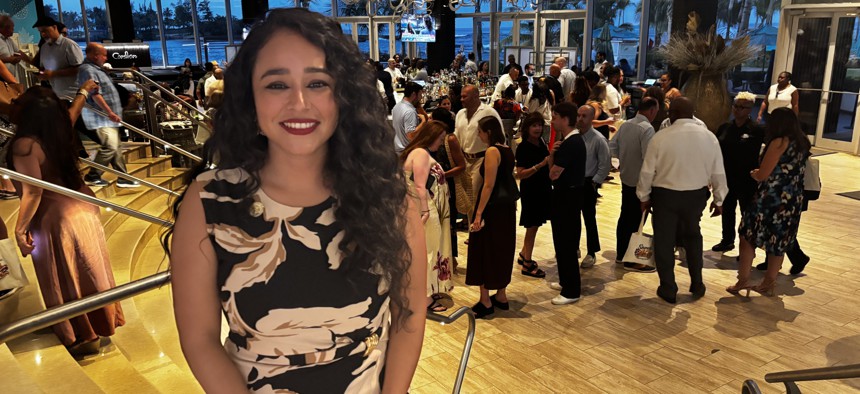
New York City Department of Veterans’ Services Commissioner Yesenia Mata spoke with City & State at the Somos conference in Puerto Rico. Jeff Coltin


New York City Department of Veterans’ Services Commissioner Yesenia Mata made history when New York City Mayor Zohran Mamdani announced her appointment on Jan. 31. A civil affairs officer in the U.S. Army Reserve and the first Latina to hold the position, Mata grew up in a military family and is a military spouse – her husband is an Army Reserve captain.
Mata said the Mamdani administration discussed the position with her after taking notice of her longtime advocacy work with immigrants and service members. This interview has been edited for length and clarity.
How did you decide to go into the service and was there a moment where you knew you wanted to enlist?
I come from a military family, and I’ve seen firsthand what soldiers go through if they don’t have the proper transition. That is what motivated me to be part of the service. I know firsthand what it means to be part of a military family. I know firsthand what it means to be a military spouse and also to be a service member as well. My brother served in the Iraq War (and) during 9/11. I was around 12 or 13 years old, so I did see what my family went through (during) that time – the uncertainty. It was something that wore down my father a lot. And when my brother got out of the military, as a Latino family, we don’t talk about mental health, right? So when he got out, we just didn’t know how to support him and I wish that what I know now I would have known back then. We just thought: “He’s home, we don’t know why he’s acting like that.” As the years passed, we have seen how that ended up affecting him and what that comes with. So has it been easy? No. So on a personal level, that’s something I always wanted to try and support other fellow soldiers. Coming from a Latino family, we are so grateful to this country. My father is so grateful to this country, and he taught me the importance of serving the community in and out of uniform. So that pushed me to be like: “I want to serve.”
How old were you when you enlisted?
I joined at an older age, per se – I joined at 28. And one of the reasons is because, when I wanted to join, my parents said, “Yes, but wait until you finish college.” Then it was, “Wait until you finish grad school.” Then I realized, “You’re never going to let me join, are you?” They told me they wanted me to serve but were also concerned that what happened to my brother would happen to me. I understood that, and I knew where they were coming from. But I said, “I want to join, and I want to serve.” And luckily, I married my husband, who also wanted to serve. We both joined the military together and ended up being in the same station at Fort Leonard Wood, Missouri. He joined as a green card holder, so as soon as he was able to join, we enlisted together and we rose up the ranks together and are both officers. He’s a JAG officer, or a military lawyer for the army. Most recently, he got stationed at West Point. So what pushed me to join was seeing what my brother went through, but also what other Latinos go through in the military.
You and your husband enlisted at the same time? Was it on the same day?
Basically, we enlisted within the same week, and we both enlisted together. When he graduated from basic training, his mom couldn’t attend. She was outside the base because she wasn’t documented at the time, so that’s also what a lot of other soldiers go through. They graduate basic training and the parents aren’t even able to join. This is why I also focus a lot on families too because I know what families go through.
But why become Department of Veterans’ Services commissioner? Is this something you’ve always wanted to do?
I was the executive director of La Colmena, it’s an immigrant workforce development nonprofit on Staten Island. In a lot of my work, I saw what Latino soldiers were going through and to make sure that their families weren’t separated.
I worked very closely with deported veterans. We served primarily immigrants and many service members who had family members in deportation proceedings, or their father was in a detention center, they were a green card holder themselves and needed help with legal services. We would go down to Tijuana to hear the stories and support them. I have a big picture in my home, and it’s all the deported veterans, and they signed it when I went. Sorry … I do get a bit emotional when I talk about that, just seeing what my husband went through as a green card soldier too. When I see families go through that, that is very personal to me, and so that’s why I take this position very seriously. When I talk about diversity and outreaching, this is where it comes from. When I went down to the deported veteran bunker, it wasn’t just Mexicans, and I think that’s what people thought. No, there were many people from different countries, and that’s what brought them together, saying, “We serve, and we’re not going to forget one another.” So I’ve always said, “I’m not going to forget about you.” And we’re going to continue to put that message out. I saw Mayor Mamdani was for the people, for the community and I wanted to be part of that new era and speak to communities like myself.
There’s a new program, the Staff Sgt. Alex R. Jimenez New York State Military Immigrant Family Legacy Program that helps undocumented service members and their families get a pathway to citizenship and protects them from deportation. Do you rely on programs like those, or how do you plan to continue doing that work for immigrant service members?
That program stems from a particular case where a service member died in service, and then his wife started to face deportation. That was the kind of work that I was doing – making sure that we can be there for those families, for those members. Earlier this year, the Department of Veterans’ Services hosted the first-ever Latino/Latina veteran panel. That’s the importance of representation. What I heard from various people on the panel was how representation is very important. They also spoke about Puerto Ricans who were born on the island who are currently serving, but they can’t vote. This is why representation matters, because it’s important for us to highlight those issues. As a Latina myself, my first language was Spanish. So if you speak to me in Spanish, that’s a personal touch for me. So we are having conversations to ensure that we can outreach to all of these communities the way they need to be reached because the military is so diverse, and that’s what we’re trying to do at the agency.
How do you try to connect with veterans who don’t know about the services available to them, or the resources your agency can connect them with?
There’s 130,000 veterans in New York City, however, veterans are not self-identifying to the agency. If we don’t know where they are at or the services that they are seeking, then it makes it a bit challenging for us to be able to provide those services directly. What we’re trying to do is outreach to them the way that they need to be outreached: in their language, in their culture, in the traditional way that they would like that to be reached. If I know that veterans are going to Brooklyn or Queens or Staten Island or the Bronx or Manhattan for specific services, and they’re going to a certain nonprofit for these services, it allows us as an agency to be able to understand where they are. We’re working very closely with the commissioners, and that’s why it was the first time ever where so many commissioners got together to be part of a panel here at Somos to talk about Latino veterans – and not just Latino veterans, but all veterans as a whole.
Of all the city agencies, yours is smaller than a lot of other departments, and it doesn’t get as much attention as others. Do you feel like the city gives your department what it needs? Do you get enough resources?
Mayor Zohran Mamdani has been a huge supporter of ours. This year, the mayor’s administration hosted its first-ever ruck. For those that may not be familiar, when you are in training in the military, part of your training is a ruck (tactical backpack) you have to carry between 10 to 15 miles, and it can weigh between 30 to 50 pounds. Part of that training is that when you are done, it’s kind of an initiation process, per se. With that, you became a soldier. And with Mayor Zohran Mandani, what he did (was) host one of the biggest rucks that has happened in New York City. We had over 1,200 veterans that came. At the end, we were doing the videos, and we highlighted them saying, “This is the first time that I came back, and I got reminded again that I am a veteran.” What happens when service members transition out, no one’s reaching back out to them as much or having events like that. So it was a way to bring them back all together. That event increased our traffic in our agency by 50%, it increased our social media platforms, and more veterans want to get connected. They’re like, “When’s the next ruck?” That’s one component of the visibility that Mayor Mamdani is using to ensure that veterans can know that the city is here for them. At the end, we also had our first veterans resource fair within the administration, and we had over 30 organizations. Agencies and veterans who were there said that this was the first time they’ve been reached out to like this, so I can say that under this administration, this is why I wanted to be part of it, because I know that it’s part of the community at the grassroots level.
What are your priorities that you’re going to be telling the mayor’s administration about?
Being here at Somos, we know that bringing that visibility is very important – especially visibility amongst people that may feel that they are not a designated veteran, per se. What we were trying to showcase is that you are serving veterans without you even knowing. I told people, many of you who are providing even within the food pantry, there’s veterans there. That’s why we started the Heroes Pantry at Fort Wadsworth, along with the Blue Star families, because many of them are going through food insecurity. It was a way to connect them to veterans and say, “We’re here.” As we are humanizing what it means to be a veteran or service member, we’re really focusing on housing and the aftercare, because it’s not just placing a veteran at home. The goal is to make sure that they can handle that transition, that this is sustainable. Oftentimes, you could place a veteran in housing, but if they don’t have the proper workforce development support or like the benefit support, they could go back into being homeless. That is we’re focusing on the aftercare. The second component is benefits. We are making sure that veterans can self-identify and let them know they may qualify for benefits and what types exist. And thirdly, as a workforce, we want to make sure we’re letting businesses know or employers know that a particular position that a service member may have done in the military can transition to them being a manager, or transition to them being handling different components within your business. We are there letting them know DVS is here for you, and also the posts.
As a Department of Veteran Services, we’re doing that dignified transfer and ensuring that we can bring in more people. We’re going to do a map of all the (Veterans of Foreign Wars, American Legion, etc.) posts that exist in New York City. We want to preserve that history of each post because each post has a story of why it was created, and we want to make sure that we can preserve that history.
What are the needs for female veterans in the city? Are they different, and how?
For me on a personal level, being a woman myself and still serving, I do see that oftentimes when people think about a service member, they don’t think that it’s a woman. When my husband and me go to events, people say, “Oh thank you for your service!” But they always ignore me. Then my husband says how I am also an officer and a captain, and people say, “I’m sorry, I just didn’t think it was you!” That’s what we’re doing as an agency: highlighting women and saying that we also come from different backgrounds and we look different and our service is different. As an agency, we also hosted the first woman roundtable, and even when I was sitting there, it shocked me. I thought that it had been done before, and I had people thanking me for hosting the first one. It’s been difficult to hear that. I guess as a woman myself, but each one of them had their own story. They also say, had it not been another woman veteran reaching out to me, I wouldn’t be here today. Female veterans are twice as likely as civilian women to commit suicide, and it’s just because there’s different components that they’ve gone through. That is one of the things that we’re trying to highlight. There’s still a lot of work to do around that.
You come from Staten Island, which is typically a conservative stronghold in the state. Tell me about how you toe that line being in the Mamdani administration. How do you communicate to people when they hear or they have a preconceived notion of what being part of his administration means and who you are representing? How do you talk to conservative families?
I make it very clear that the mission here is to serve veterans and their families, and that we’re going to tackle this issue the same way that we see each other as service members. That we just see one color or uniform, and we’re going to stay focused on that. So I am very direct about that, and with that, we’ve been able to work from both sides. People with different beliefs and wherever they may stand in the political realm, we are working together and focusing on veterans in New York City. That’s what we’re doing, and when you just keep that focus, it works.
Is there anything else I didn’t ask you that you want New Yorkers to know?
At the Department of Veterans Services, it’s a new era, and we are going to continue our outreach. We’re doing much of the social media in different languages too, and we’re going to go to different boroughs. We are here, and if we are not visible, then people won’t know the needs that we also have, or that also nonprofits have. We just want to thank everybody for their service.
NEXT STORY: This week’s biggest Winners & Losers