

Events
Aging leaders celebrate new funding amid demographic boom
As New York’s senior population grows, DFTA Commissioner Lisa Scott-McKenzie said providers need to think beyond the pasta.
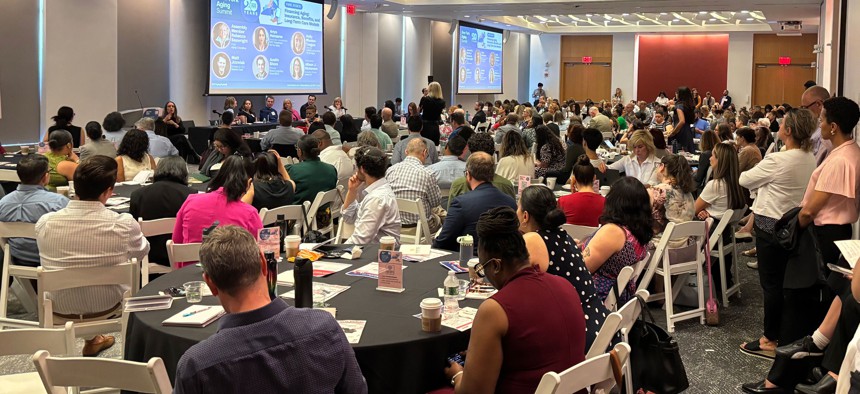
Aging industry professionals packed a room at Fordham Law in Manhattan Wednesday to connect with colleagues. Jeff Coltin/City & State NY


New York and the people who call it home are constantly changing, including the state’s fastest-growing demographic: adults over 60.
New York City Department for the Aging Commissioner Lisa Scott-McKenzie and New York State Office for the Aging Director Greg Olsen addressed City & State’s New York Aging Summit on Wednesday, touting increased budget allocations that will allow New Yorkers to “age with dignity.” There are now more than 5 million New Yorkers over the age of 60. So beyond economic investments, the government leaders are also challenging the way we think about aging.
“I remember with my kids when they were little, we watched ‘SpongeBob SquarePants,’” Olsen said in his keynote remarks. “Did you ever see the way they portray the old fish? It’s funny, but it’s not, because it starts there,” Olsen said in his keynote remarks. “And language is important. ‘Silver tsunami.’ I absolutely hate that. What good has ever come from a tsunami? Death and destruction. So language matters.”
Money matters, too. The state Office for the Aging received $436 million dollars in the state budget for fiscal year 2027, a slight, $1.9 million increase from the year before. That includes an $8 million initiative to expand the state’s naturally occurring retirement community program, plus funding for community-based service organizations and resources to combat elder abuse and scams.
On the city side of things, DFTA received a $30 million increase to its baseline funding this year, raising its budget to $635 million for fiscal year 2027. During her keynote remarks, Scott-McKenzie emphasized the importance of using those funds to support home modifications to address increased fall-related mortality, financial exploitation prevention and access to healthy and flavorful meals.
“We like pasta, but we’re tired of pasta,” Scott-McKenzie said. However, “some of our older adults are not as enchanted with the plant-based meals … Food is medicine, so we want to be sure that if we are replacing some of these meals, that what we are offering is just as healthy. But what difference does it make if it’s healthy, and no one wants to eat it?”
Despite these wins, DFTA and the SOFA budgets both make up less than 1% of the city and state’s FY 2027 budgets – even though 60-and-older New Yorkers make up nearly 25% of the state’s population. Lawmakers and advocates have argued that the percentage should be higher, with state Comptroller Tom DiNapoli and New York City Council Speaker Julie Menin both advocating for funding increases.
Or, as state Sen.Cordell Cleare put it: “It’s about the money. Show us the money,” she said during a panel discussion at the summit. “You want people to take care of people? Then you gotta pay them.”