

New York City
Mamdani orders NYPD to review use-of-force practices, increase transparency
The reforms aim to make it harder for police officers to avoid misconduct charges, and to staff up the NYPD’s oversight agency.
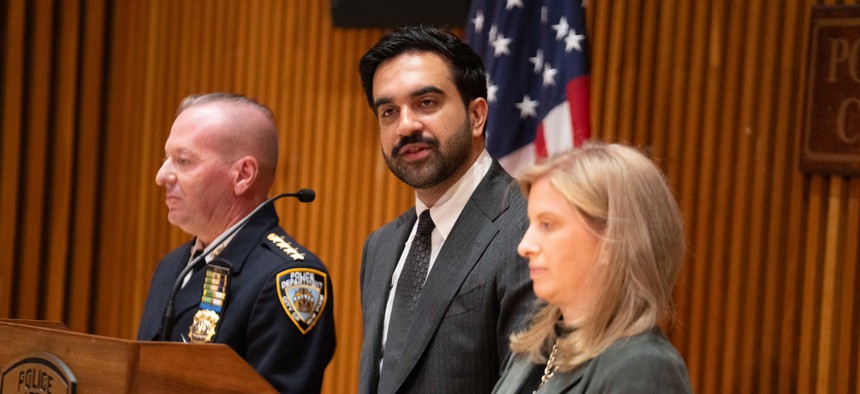
New York City Mayor Zohran Mamdani and New York City Police Commissioner Jessica Tisch announcing crime statistics in October 2026. Michael Appleton/Mayoral Photography Office



Mayor Zohran Mamdani is moving to bolster accountability within the New York City Police Department, directing the department to review its use-of-force practices and announcing a handful of actions aimed at increasing transparency and oversight.
The review, which will take place across the upcoming months, and package of reforms, come more than two years after two police officers shot and killed 19-year-old Win Rozario at his home in Queens. Rozario had been experiencing a mental health crisis when he called the NYPD for help. Body camera footage shows the officers repeatedly firing their guns at Rosario after failing to deescalate the scene.
At a rally at City Hall last week, Rozario’s family revealed they learned the NYPD had allowed one of the police officers involved, Salvatore Alongi, to retire with a disability pension last spring. By retiring, Alongi was able to avoid disciplinary charges from the city’s police oversight office investigating misconduct complaints, the Civilian Complaint Review Board. The board had recommended multiple misconduct charges against him and the other police officer, Matthew Cianfrocco, last year.
While the NYPD is required to notify the Civilian Complaint Review Board when an officer facing disciplinary action moves to retire, the department failed to do so in this instance – thus robbing the watchdog agency of the opportunity to speed up Alongi’s disciplinary trial.
In a statement last week, NYPD Commissioner Jessica Tisch acknowledged the error. “We should have notified the CCRB before the Pension Board considered Officer Alongi’s disability pension so that CCRB could take whatever steps it deemed appropriate,” she said. “As a result of human error, we failed to do so, and I apologize for that mistake."
The package of reforms is aimed in part at addressing cases like Alongi’s. Under one of the changes – which was implemented in August, but never officially announced – the NYPD began using a new notification system. According to a press release from City Hall, this will “facilitate the completion of the disciplinary process before an officer retires.”
The NYPD will also standardize its process for sharing information with New Yorkers after a critical incident, such as use of deadly force or injury, including by releasing NYPD Force Investigation Division final reports to the families of individuals killed or seriously injured by police. In an effort to prevent officers facing disciplinary charges from leaving the NYPD and finding employment at a different law enforcement agency, the NYPD will formalize its current practice of notifying the State Division of Criminal Justice Services and submitting information to revoke their certifications, according to the release.
The Mamdani administration is also investing an additional $2.6 million in the Office of the Inspector General for the NYPD, the city’s independent watchdog for police policy and practices. As of last May, the office was critically understaffed, operating with less than a third of its workforce, Streetsblog New York reported. City Hall said the new funding would allow the office to staff up.
In a statement, Mamdani said that the city has an obligation to Rozario, his family and to other New Yorkers who have sought aid “in a moment of crisis.”
“Every New Yorker deserves to know that force will be used lawfully, carefully and only when necessary,” he said. “This review is about making sure our policies reflect that responsibility, that our officers have the guidance and training they need and that New Yorkers and their families can trust their city will treat them with care and dignity.”
As a mayoral candidate, Mamdani promised to overhaul NYPD operations. Since taking office, however, some criminal justice advocates and those within the mayor’s democratic socialist base have grown increasingly frustrated with his light-touch approach to policing. The fact that he’s yet to dismantle the Strategic Response Group, the controversial NYPD counterterrorism unit that also responds to protests, as he vowed to on the campaign trail, is one particular point of tension. As is keeping on Tisch, a moderate appointed by former Mayor Eric Adams, as police commissioner.
Pressure to do the latter ramped up significantly last week after a federal immigration agent shot an immigrant New Yorker in northern Manhattan. The NYPD’s handling of the ensuing protests spurred more calls from the left for Mamdani to ditch Tisch. The administration’s plans to announce these reforms predated the ICE shooting and ensuing renewed pressure on Mamdani to abandon Tisch.
NEXT STORY: Kristen Gonzalez and the fight to regulate AI