

sponsor content What's this?
Sponsored Content
The Construction Justice Act is a true path to the middle class
It's time to do the right thing for workers by passing the Construction Justice Act.
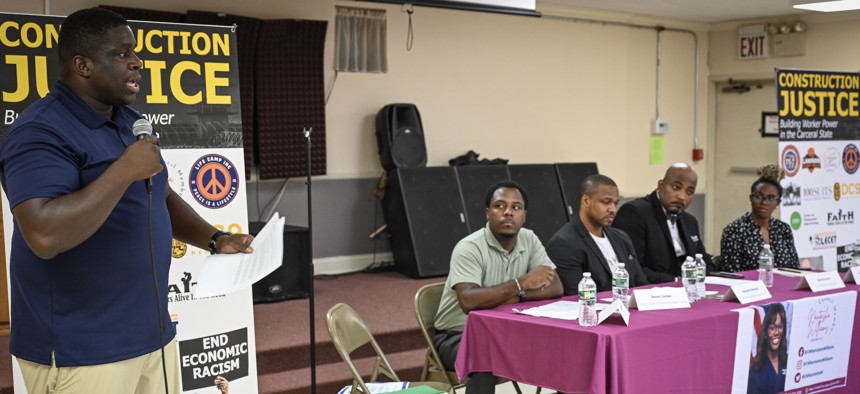
Justice Favor leading a CJA panel Greater New York LECET


The Construction Justice Act would build pathways to the middle class for people like me.
Good jobs rarely reached the families I grew up with in Far Rockaway. Too many of my friends and neighbors were pushed into low-wage work that offered no stability and no future. That is why the debate over the Construction Justice Act is not theoretical for me. It goes to the heart of whether working-class New Yorkers from communities like the one I came from can finally have a genuine pathway into the middle class or will continue to watch opportunity pass them by.
As a union member, I have seen what construction work can do when jobs come with decent wages and benefits. Construction is one of the few remaining industries where someone without inherited wealth or connections can earn a living that supports a family. But that promise never reaches its full potential when workers on publicly subsidized housing projects are paid so little that they cannot even afford to live in the affordable housing they’re building. When taxpayer dollars are sent to developers without standards, it is the workers from neighborhoods like Far Rockaway, Queensbridge, Mott Haven and East New York who pay the price.
The CJA fixes this by setting a combined wage and benefit floor of $40 per hour on affordable housing construction funded by taxpayers. Forty dollars an hour is not going to make anyone rich, but it will give workers a fighting chance at stability. It’s enough to cover rent, groceries, transportation and health care – the basic foundation every family deserves. The bill also requires that contractors make real efforts to hire at least 30% of workers from high-poverty neighborhoods or NYCHA developments. It’s a pathway for so many New Yorkers like the people I grew up with who have been locked out of opportunity for generations.
Opponents of the bill are giving us the same tired argument that workers have heard for decades. Paying fair wages, they claim, is a threat to the city’s affordable housing goals. This is a false choice. Every other component of development, from financing to consulting to administrative overhead, is built into the cost of doing business without scrutiny. The only line item people question is the pay earned by the lowest-wage workers on the site. That mindset has kept people trapped in cycles of poverty while developers, lenders, lawyers and consultants all receive their full share.
Taxpayer dollars must do more than generate a number of units of housing on spreadsheets. Public money should strengthen the communities that need support. Public investment should be measured by whether the work creates opportunity that lifts families and generates economic activity in the neighborhoods where it is desperately needed. When construction workers earn enough to stay in New York, they spend their money locally. They support small businesses, pay for child care, invest in their homes and contribute to the long-term stability of their communities. That is how lasting affordability and economic impact is built.
The CJA would also expand opportunity for justice affected New Yorkers and recent immigrants who depend on the construction industry for work. Without adequate wages, these jobs only lead to more hardship. But with fair wages and benefits, it becomes a path toward a pension, health care and long-term economic mobility. For people returning home from incarceration, these jobs are often the single most reliable way to rebuild a life with dignity and security.
This bill already has broad support from labor, community organizations, faith leaders and the overwhelming majority of the New York City Council. What is needed now is action. The votes are there. The coalition is in place. The city is facing an affordability crisis that is pushing out the very people who keep it running. We cannot afford delay.
Passing the CJA is not only about fair pay. It is about redefining what public investment should accomplish. It is about saying that working-class New Yorkers deserve the same consideration as every other part of the development process. It is about finally giving communities like Far Rockaway the economic foundation we have been promised for generations. The City Council must pass the CJA and ensure that the workers who build New York have the chance to build a future here as well.
Justice Favor is a field representative for the Mason Tenders' District Council of Greater New York and Long Island, representing more than 20,000 laborers. He works to strengthen partnerships between developers and contractors while advocating for fair labor standards and union growth.
NEXT STORY: Seeking a comprehensive approach to best support youth mental health