

sponsor content What's this?
Sponsored Content
Serving the City While Searching for Space
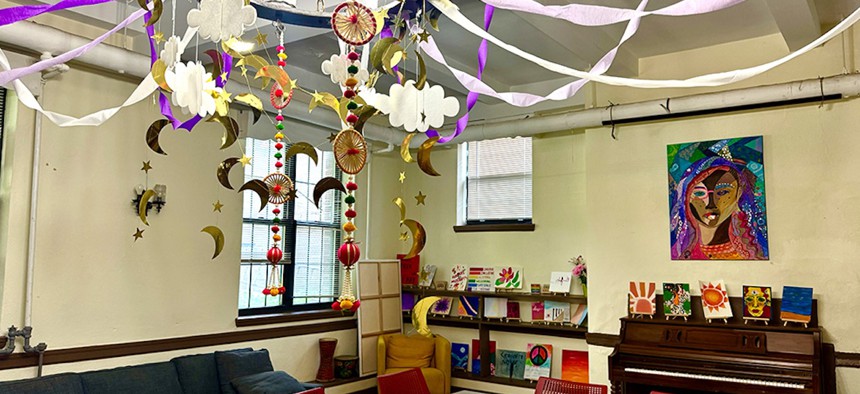
A multi-purpose space, decorated by students, at SAYA’s current location in Elmhurst, Queens. Jenna Post


Jenna Post sat down with David Lebenstein, a longtime real estate broker who works exclusively for nonprofits, to discover how the current market challenges the organizations that quietly keep the city running:
TRANSCRIPT
Jenna: So you need an apartment in New York City for you and your two kids. What’s your first move?
Search online.
(TYPING SOUND)
Look at listings. Set up appointments to visit.
You finally find a place and submit an application.
(DOOR OPENING AND FOOTSTEPS SOUND)
It checks all the boxes. Price is high—but it’s New York, right?
You wait for the call.
(IPHONE RINGER SOUND)
But when the phone rings, they tell you: sorry…someone else outbid you.
It’s a familiar story in New York.
But now imagine instead of a home for three— you need one for hundreds.
And instead of finding a home…you need a building: classrooms, offices, kitchens, loading docks, freezers, space to serve a community.
That’s the challenge nonprofits face when they need space in New York City.
They’re competing for space in the same brutal market as everyone else.
And when they can’t find room, growth stalls… or services shrink.
The logical next step in your search is to call a broker.
(TELEPHONE PICK UP SOUND)
David: (5:27) Brokers do have sometimes a reputation like used car salesman or somebody who’s sleazy and slimy. (5:37) And I don’t think it’s often not well deserved, but maybe occasionally it is.
Jenna: But David Lebenstein is a broker, who works exclusively for New York City nonprofits. He welcomes me into his sunny office near Rockefeller Center. Instead of trophies, David’s shelves are lined with family photos.
David: When I was 15, I walked into the Roosevelt Hotel in Manhattan and volunteered in the campaign of John Lindsay, who was running for mayor.
Jenna: David started out in government and was inspired to make change. He and a colleague created a non-profit focused on public policy, to improve public education and general economic development. It was called Interface, the predecessor to The Center for an Urban Future.
David: Over the years, we really did some cutting-edge work, and one of the last things which wasn’t a public policy thing but more of a practical thing, we kept moving our offices and paying more money for less space.
Jenna: He learned firsthand how real estate can pull nonprofits away from their mission. So he joined with other nonprofits to buy an entire floor of a building, ending the constant chase for space.
David: I kind of got the bug. But my heart was really into helping the nonprofit world, So I started offering my services to nonprofits who needed representation.
Jenna: When nonprofits come to David, they always ask the same question:
David: Should we lease? Should we buy? And I always answer it this way. I say 95% of you are going to lease, 5% of you are going to buy.
Jenna: Buying gives nonprofits stability and control, but it also comes with risk.
David: you could be a worse landlord than your landlord. You’ve got to maintain a roof and a boiler and other physical conditions in the plan. And what happens is nonprofits always put off doing repairs because they don’t really have a budget for that and they’re always unexpected.
Jenna: In most cases, leasing is easier. As a part of most deals, landlords even help fund the buildout.
Ownership is the goal for many nonprofits. Research from the Nonprofit Finance Fund found that among nonprofits hoping to purchase property, 80% say the top reason is to remain rooted in the community they serve.
It’s not just about real estate, it’s about permanence.
Eric: Originally, there was interest in what can we buy versus lease. (9:00) As you might imagine, in New York City, buying any kind of industrial space. (9:04) It’s a pretty big price tag. And so we found out early on that leasing was going to be a bit more feasible for us.
Jenna: That’s Eric Ragone, of God’s Love We Deliver, one of David’s clients.
God’s Love We Deliver prepares medically tailored meals for people who are too sick to shop or cook for themselves. Every year, 20,000 volunteers prepare and pack more than 4 million meals for the city’s sick and homebound
When I visited their space, dozens of volunteers were packing meals for the next day’s deliveries
(SOUND OF PACKING BOXES)
Volunteers: We have porkchops with apple sauce. Dessert is different kinds of cookies. Raspberry cookies, raisin cookies, cherry blossom cookies.
Jenna: David helped God’s Love We Deliver find new space when they grew out of their old kitchen in Soho.
Eric: Ten years ago, for perspective, we were delivering just north of one million meals a year. And fast forward to last year, we delivered four million meals. And what we really ran out of first and foremost was freezer space.
Jenna: Freezers take up space, about the size of a basketball court and a half.
(FREEZER OPENING AND ECHOING)
Eric: Got freezer space here! Looking pretty full already. What do we got here? Vegan vegetable casserole. That’s a good one! Stewed pork with pumpkin. Ginger braised beef. Roast pork wine with cabbage.
Jenna: If they didn’t have freezers, they’d need to deliver the meals fresh, which raises cost and logistical challenges. But industrial-sized freezer space isn’t readily available in the city. Nor are loading docks and freight elevators built for operations this large.
Industrial space like this is increasingly scarce in New York, squeezed by the rezoning of manufacturing space for residential development.
And what’s left is snapped up at top dollar by companies like Amazon and Fedex, who also want space in the city to make their deliveries faster and more efficient. So Ragone and his team turned to leasing.
They looked at dozens of properties, over 4 years in all boroughs. They even expanded their search to Westchester. When they finally came close to signing, the prospective landlord was being difficult
David: Sometimes also, part of our job is educating landlords about the credit
of the nonprofits. Obviously, you know, nonprofit, what does that mean? They have no money, they don’t make a profit?!
Jenna: God’s Love ultimately found a more flexible landlord and, with David’s help, negotiated room to expand in the future.
Eric: When we signed the lease, we signed a blank box, nothing but columns and nothing in it.
Jenna: Four walls were just the beginning. God’s Love launched a $40 million campaign to turn that shell into a facility capable of delivering 80,000 meals a week. So far, they’ve raised $24 million.
But if expanding was this complex for God’s Love We Deliver, organizations with fewer resources face even steeper obstacles.
Sonia Sisodia is the Executive Director of SAYA, South Asian Youth Action. They are another of David’s clients, but much smaller than God’s Love We Deliver.
Sonia: The mission of SAYA is to really ensure that all young people feel like they have a third space where they feel like they belong, where their identities are affirmed, regardless of their cultural background, their immigration journey, their family story.
Jenna: They’ve been renting space below market rate from a church in Elmhurst for the last 30 years. For years, demand grew, but expansion felt financially risky.
Their needs were specific: large, open space with room for classrooms, art studios, and most importantly: an entire basketball court. (That’s the highlight of their current home, a court where kids can play even in the winter.) They set off with David to find a place in Central Queens.
Sonia: If we want students to be able to easily get here after school, or you know, on the weekend that we really needed to stay in Central Queens.
Jenna: But David knew this was going to be a tough task.
David: We had worked in this neighborhood, Jackson Heights, Elmerhurst, Corona, Woodside, that whole area. And there’s almost no space there, it’s a miracle every time you find something.
Jenna: When they could find something, it was pricey.
Sonia: We were talking about tripling or quadripling our rent which in the long run would not be sustainable.
Jenna: Eventually, leasing stopped making sense. Buying became the only path. They found three residential lots in a row for sale. It needs a full demolition and construction to fit their needs, but it’s in their current neighborhood.
Sonia: I didn’t necessarily expect that we would find another youth community center that we could just like buy and move into, but I was hoping we would find a space big enough. That felt less risky, that felt less expensive (laughs,) than buying three lots of property that we are going to have to fully develop and build
Jenna: David warned that it wouldn’t be easy. They’ll have to raise money through donors, foundations, and government grants.
But even then, the math is tough. In New York, when the government contracts nonprofits to deliver various services, like after-school care, they reimburse them later. The organizations have to front the money themselves– sometimes with loans that carry interest. That interest often isn’t reimbursed.
David: So they wind up subsidizing the city as crazy as that sounds.
Jenna: So SAYA has an uphill battle ahead to deliver on this $20 million project, after usually operating with a $7 million dollars.
But they’re breaking the mold as a non-profit led people of color. The Nonprofit Finance Fund found that organizations led by people of color are less likely to own their own space, and Asian American-led nonprofits are the least likely to own of all demographics. There’s also an ownership disparity for organizations that serve people of color.
(SOUND OF COMMUNITY GATHERING)
And ownership means they can permanently remain just blocks from where they’ve been for 30 years. The SAME street they throw their block parties on, the SAME one where generations of students hop off the subway after school.
David invites me to lunch to learn more about him. He insists I try a bagel with lox, my first ever.
David: This one has nova in it if you want it.
Jenna: I’ve never had it. David: Never ever had nova?
Jenna: No.
David: Like bagels and lox?!
Jenna: No. (16:35)
David: No?!
Jenna: I’ll try it!
David: Well try it!
Jenna: Over lunch, he recounts the deals that still stick with him.
David: In the last couple of years, because of budget cuts from Washington, many of the groups are forced to sell some asset to get money to survive, to pay a deficit, to carry their expenses. (6:47)
Jenna: He’s referring to Planned Parenthood’s Manhattan location, which served the community for over 35 years. David was part of the team that sold the building.
David: And it was the most valuable asset they had and they sold it for a lot of money. And that’s going to help them get through the next couple of years until maybe times are better. Let’s hope. But it’s kind of sad to see that thing go.
Jenna: And what’s going to be there?
David: High-end, fancy residential condos.
Jenna: In this market, nonprofits need more than a broker. They need someone who understands that a real estate deal can determine whether an organization — and the people who rely on it — can survive.
He recalls representing Volunteers of America in the sale of a single room occupancy building — a type of deeply affordable housing often for low-income and elderly New Yorkers. Luxury developers offered millions for the building, but only if it was delivered vacant.
David: From the point of view of the nonprofit, we’re not going to create more homelessness. We’re not going to kick these people out. You can’t do that. So I understand that. I don’t know that all brokers often (laughs) understand that challenge and I know on several of these brokers tried before us and were unsuccessful because they didn’t really understand that.
Jenna: David said the challenge wasn’t selling the building.
David: And those are things that are inside baseball, where you really have to understand how this works and be sensitive to the issues and not just be a sales broker or a marketing person.
Jenna: David found a nonprofit that agreed to buy the building AND keep the residents in place, but they couldn’t afford the market price that Volunteers of America needed. So David and others went to City Hall to close the gap.
David: And we got them to fund the difference. So basically, we sold the building for $42 million as is with the people in place. We kind of took the building off the market from residential luxury housing and preserved it for a nonprofit purpose for all time.”
Jenna: David speaks about his work modestly. But it’s clear what keeps him going. In commercial real estate, clients are passed down from one broker to another. But David says he hasn’t found someone with the same experience or the same commitment to nonprofit work.
David: That’s been a frustration because I have thought about succession and finding the right person and it’s just not that easy So I just keep going. I have terrific people I work with…
But that’s not all that keeps him in the game. It was never really about the buildings for David, it was about what goes on inside them.
(SOUNDS OF THE CITY)
My work is unimportant compared to feeding the hungry or helping the homeless I’m not at all claiming to work at the same level. But I do know that helping them get the right facility helps them offer the right program and services to their clients.
You feel really good about what it when you get invited to an open house and maybe they say thank you, and you see wow, this is the new place. Its so much better than the old place. That’s fabulous What more would you want?