

sponsor content What's this?
Healthcare
NYC needs to prepare for Trump healthcare cuts, commissioner warns
The Primary Care Development Corporation and City & State event discussed pathways forward under the One Big Beautiful Bill Act.
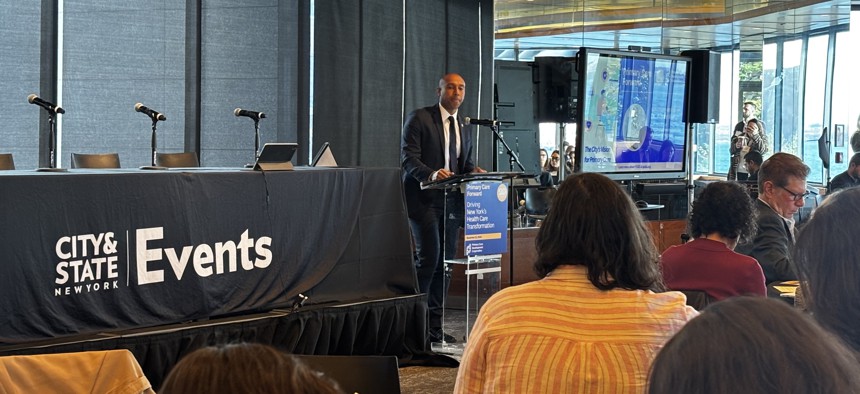
NYC Health Commissioner Dr. Alister Martin warned about coming healthcare cuts Jeff Coltin


Medicaid work requirements set to go into effect in the new year will target vulnerable populations, New York City Health and Mental Hygiene Commissioner Dr. Alister Martin warned Tuesday, and without a strong primary care social safety net, people will be in tremendous jeopardy.
Changes in President Donald Trump’s “One Big Beautiful Bill Act” that could cause many Americans to lose insurance coverage are “nothing short of bureaucratic violence,” Mayor Zohran Mamdani’s top health appointee said.
“I mean this from the perspective of not just the New York City Health Commission, but as an ER doctor who has seen what happens when patients lose access to their health coverage,” Martin said. “They don't stop getting sick. They don't stop coming to the ER. They wait. Their issues worsen. Their chronic health conditions deteriorate, and people get sick and die.”
New York City cannot change federal law, Martin said. And while he was pleased with Democrats winning the House and Senate, “the reality is, January 1st is still two months away. We need to work as feverishly as we can to help prepare the city.”
Martin was among the speakers at City & State’s Primary Care Forward: Driving New York’s Health Care Transformation summit, presented by the Primary Care Development Corporation.
Primary Care Development Corporation CEO Aparna Mekala opened the event at the Museum of Jewish Heritage in Lower Manhattan with her own call to action.
“Our decisions, our investments, have to reflect what evidence tells us, and that's what I hope we'll explore today,” she said. “What it will take to make primary care a priority in New York state, and how we turn that commitment into meaningful, lasting change.”
For current legislators in New York state, the answer has been there all along; pass the Primary Care Investment Act and the New York Health Act.
“We need to move in the direction of spending more state dollars into investing in primary care. And not only that, but it costs the system a lot less if people have access to primary care before,” state Sen. Gustavo Rivera said, speaking on a panel Tuesday. “Just starting with the Primary Care Investment Act, I think is really a bare minimum.”
Rivera is the lead sponsor of that bill in the state Senate, which would require healthcare plans to mandate 12.5% of their total expenditures on primary care services. It passed the Senate this session, but never made it out of committee in the Assembly.
“But I think that we need to actually have some real conversations about being far bolder. That is where I think conversations about the New York Health Act need to be had, and I've been having conversations about the New York Health Act in this room for many years,” he said.
Rivera is also the lead Senate sponsor of that bill, which would bring single-payer universal healthcare to all of New York state. First introduced in 1991, the bill has never made it to the floor for a vote.
Rivera was joined by his colleagues in the State Legislature, Assembly Members Phara Souffrant Forrest and Amy Paulin at the event, to discuss how essential institutional investment into primary care is for health outcomes. Keynote speakers also included Dr. Andrew Philip, group director of the Learning and Diffusion Group at the Center for Medicare and Medicaid Innovation, and Dr. Nathan Graber, chief medical officer at the Office of Health Insurance Programs in the New York State Department of Health.