

New York State
How State of the State addresses have evolved over the past 20 years
What have governors highlighted in their agenda-setting speeches?
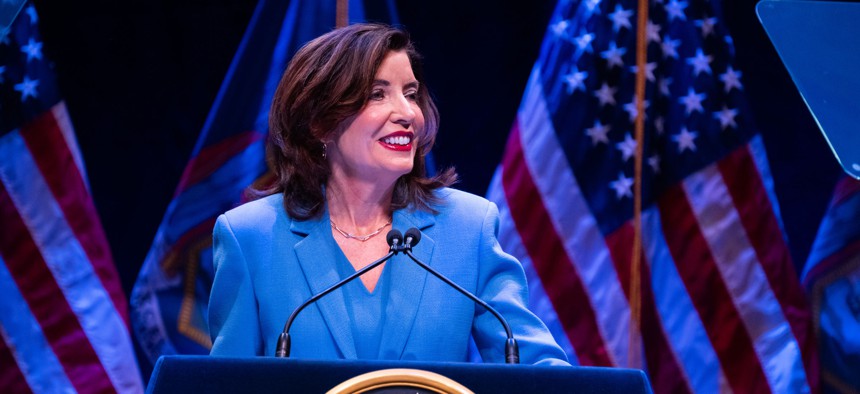
Gov. Kathy Hochul presented her State of the State this year at The Egg in Albany. Darren McGee/Office of Gov. Kathy Hochul


It’s hard to imagine New York politics 20 years ago if you weren’t there for it. Both the state and the city had a Republican in charge. It was very far from having a democratic socialist running the Big Apple. Control of the state Legislature was still split in the two chambers. The first name that came to mind when someone said “Cuomo” was Mario rather than Andrew. And City & State, only just beginning its run, was not yet the must-read magazine of the state’s political class.
State of the State addresses have also changed significantly in that time – especially when the younger Cuomo first decided to move the speech out of the Assembly chamber. Gov. Kathy Hochul is now following his example after a brief return to tradition, with her fifth address in The Egg performing arts center. But what hasn’t changed is governors’ penchant for laying out big ideas they want to achieve in the next year in addition to providing New Yorkers an assessment of how the state is doing. Between five governors over 20 years, those big proposals are certainly plentiful, even if they did not all come to fruition or turn out as intended. Here are a few proposals from State of the State speeches from each governor in the past two decades.
George Pataki
New York’s most recent Republican governor delivered his final State of the State address in 2006 after 11 years in office. Much of George Pataki’s speech focused on building on the achievements of his administration, not proposing any entirely new or overly complex items with just one year left to achieve them. Though he did once again pitch incarcerating people convicted of violent sexual offenses for life.
Eliot Spitzer
Eliot Spitzer came into office with big plans to change Albany. Unfortunately, he lasted just a little over a year. In the first of his two State of the State addresses in 2007, Spitzer laid out a grand agenda with major proposals to reform and completely reshape the state Capitol. He pitched lowering skyhigh contribution limits, closing the LLC loophole and (eventually) implementing a public campaign finance program. Spitzer wanted an independent redistricting commission. He proposed consolidating the state’s byzantine court system and getting politics out of judicial selections. Spitzer’s first agenda was the holy grail for good-government advocates.
His second State of the State, Spitzer ditched his lofty reform ideas in favor of safer policy proposals. Among his marquee pitches in 2008 was a property tax cap. It didn’t come to fruition in the mere weeks Spitzer remained in office.
David Paterson
Taking over just months into Spitzer’s second year in 2008, David Paterson needed to hit the ground running while the country weathered its worst financial crisis in decades. His 2009 State of the State address reflected the tough economy, but also focused heavily on health care. Taking a page out of then-New York City Mayor Mike Bloomberg, Paterson included a proposal to ban trans fats in restaurants statewide and to add an “obesity tax” on sugary sodas.
After a 2009 that could be described as cartoonishly corrupt and dysfunctional, Paterson finished out what would have been the last year of Spitzer’s term with a returned focus on ethics and government reform. He laid out an ambitious plan to implement term limits, reduce campaign contributions to just $1,000 and completely ban all corporate donations. Those didn’t come to pass, but the Excelsior Jobs Program he proposed to spur economic development is still around today.
Andrew Cuomo
One can say many things about Andrew Cuomo’s 10 years in office, but ineffective wouldn’t be one of them. He had big ideas, and if he wanted them accomplished, he would see them done. His first State of the State address in 2011 set the tone for his tenure, with a promise to limit property taxes, reduce Medicaid spending (Cuomo formed the first Medicaid Redesign Team that year) and to cap the annual growth of state government spending. The next year, Cuomo proposed the ill-fated Buffalo Billion economic development plan.
By 2013, Cuomo was on a roll. Standout proposals from his State of the State address included his promise to enact the strictest assault weapons ban in the country (the SAFE Act passed that year) and decriminalizing the possession of small amounts of cannabis. The following year, he pitched a pilot program to legalize medical marijuana. That was also the first time Cuomo proposed a pathway to universal pre-K, the first of what would become several proposals from then-New York City Mayor Bill de Blasio that Cuomo would adopt.
Cuomo’s 2015 State of the State proposal to increase the minimum wage to $11.50 in New York City and $10.50 elsewhere in the state was another marquee pitch that could find its origins in sticking it to de Blasio. His 2016 address was marked by transportation infrastructure projects, first previewing his plans to renovate John F. Kennedy Airport and promising to rebuild LaGuardia Airport. In the first year of Donald Trump’s presidency, Cuomo touted his liberal bona fides in his annual address, and proposed the Excelsior Scholarship to provide free public college to many middle- and low-income New Yorkers. In 2018, Cuomo made bail reform the top policy issue in his address – though he would distance himself from it nearly a decade later when he would run for mayor of New York City.
Entering the home stretch of his tenure with Democratic majorities in both chambers, Cuomo offered his plans to legalize recreational marijuana and enact congestion pricing in his 2019 State of the State speech. In 2020, there was Cuomo’s pitch for guaranteed paid sick leave. And for his final address – though he didn’t know it at the time – Cuomo threw his weight behind mobile sports betting with his own proposal after initially poo-pooing the idea.
Kathy Hochul
Entering the modern gubernatorial era, Gov. Kathy Hochul found herself propelled into the executive seat after numerous scandals – most notably sexual harassment allegations that he has denied – led to Cuomo’s resignation. She immediately sought to strike a different tone than her predecessor, with promises of a more cooperative and transparent Albany. That was reflected in her first State of the State speech in 2022, when she proposed replacing the state’s ethics agency, limiting statewide officials to two elected terms and banning outside income for legislators. The following year, Hochul first tried to leave her mark on the state’s housing landscape by proposing her Housing Compact. Though not achieved in 2023, she set out enact measures that would see 800,000 units of housing built over the next decade. In 2024, Hochul wanted to make New York a global leader in AI research and development with her Empire AI initiative. And one year ago, Hochul made rollbacks to the state’s discovery reform a cornerstone of her policy agenda. But also pitched universal school meals and banning cellphones in schools.