

NYN Media
Report: New York fails to meet federal outcomes for child protective services
From delays in permanency hearings to weaknesses in staff and provider training, The New York State Citizen Review Panel underlines the bleak state of foster care.
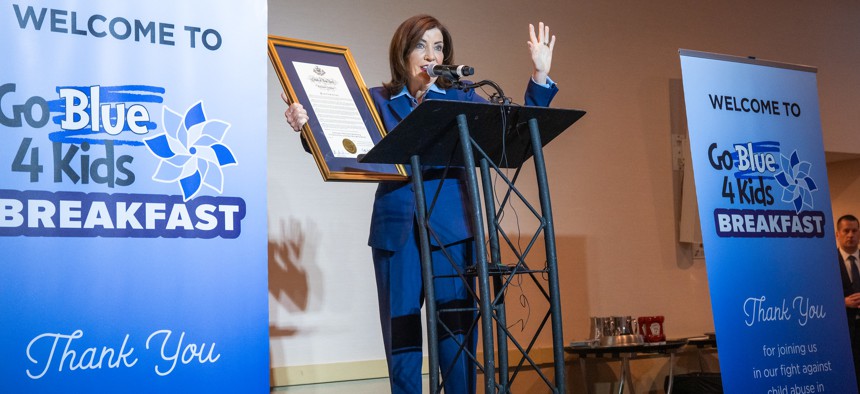
Gov. Kathy Hochul presents a proclamation declaring Child Abuse Prevention Awareness and Supporting Child and Family Well-Being Month on April 18, 2025 in Syracuse. Darren McGee/ Office of Governor Kathy Hochul


New York City and state’s child protective services failed to meet federal standards in outcomes for child safety, permanency and well-being, according to an annual report by the New York State Citizen Review Panel.
Titled “From Crisis to Accountability,” the report found failures in all seven federal outcomes areas, with major inadequacies in statewide data systems, gaps in staff and provider training, and a lack of services catered to the needs of children and families. Despite roughly $3 billion invested annually in child protective services, New York state continues to show some of the highest rates of maltreatment and longest stays in temporary care in the nation.
“You can never strip away all the liability from the system,” said Todd Sage, an author of the report and co-chair of the review’s Western Panel, which oversees 17 counties including Erie, Ontario and Niagara County. “What happens is, too often, in the name of liability, we traumatize kids by putting them in foster care because the county doesn't want to take on the liability.”
Following the federal Child Abuse Prevention and Treatment Act, the New York State Citizen Review panel was established in 1999 as a federally mandated independent oversight body that monitors child protective services. The panel recently sent a letter to the New York State Office of Children and Family Services outcrying poor conditions in the state’s youth prisons.
As New York operates a county-administered child welfare system with state oversight, OCFS is ultimately accountable for ensuring county obligations. With Gov. Kathy Hochul appointing Dr. DaMia Harris-Madden to lead the office in April 2024, Sage and other critics are feeling optimistic.
“One of the reasons we're hoping that with the new director in charge, is that through communication, we can really start to work towards having more collaborative conversations to improve the system, because the one thing we do know is the system is flawed,” said Sage.
The report, which was released in January, highlights key systemic areas and outcomes that have yet to be met by the state. According to the report, many children remain in foster care far longer than federal timelines suggest, with only 32% of children finding permanency in a year. Some older children and teens can wait up to six years to be placed in permanent homes, according to Sage.
And while the report paints a dire picture of New York’s care for its most vulnerable children, the state is being held to a high standard. In fact, no state nationwide has received an entirely satisfactory result in the past 25 years of the Children and Family Services Review’s existence, according to a November briefing from the U.S. Department of Health and Human Services.
The report comes as state and local governments face federal funding pressures under the Trump administration, namely shifts to Title IV-E and Title IV-B streams that could affect child welfare capacity. Recent ICE activity has also complicated casework and deterred families from seeking help. These stressors have been amplified by gaps in workforce training, as high caseloads and staff turnover continue to hinder child services.
“By just putting a warm body in a seat doesn't mean that we're actually serving families,” added Sage. “A six-week training isn't going to really prepare you for a career,” he said.
The report also found that more than 75% of calls to the Statewide Central Register of Child Abuse and Maltreatment were unfounded. An OCFS spokesperson said that New York state law’s mandating child abuse and neglect “reporters” (educators, medical professionals and law enforcement officers) can lead to higher levels of calls, which don’t always lead to founded claims.
“We are guided by a belief that you don’t have to report a family to support a family, because poverty is not neglect, and addressing systemic problems is critical for children’s safety,” the OCFS spokesperson said in a statement. “Rather than intervening only once abuse or neglect has occurred, we employ a host of proactive outreach and assistance tools to prevent those harms.”
But according to advocates, systemic issues such as inadequate housing, food insecurity and lack of child care are frequently conflated with neglect during the investigation process with poor Black and Latino families continuing to be disproportionately represented.
In order to curb the disproportionate impact on Black and brown families, OCFS has aimed to address racial bias in abuse reporting systems while requiring local districts to use a “blind removal” process that hides demographic information. Despite these efforts, Black children are still twice as likely to enter foster care with fewer chances of permanency, while Latino children continue to experience high rates of maltreatment.
In building on these observations, the panel further recommends that OCFS publish race-disaggregated data and assist counties in meeting equity goals through parent and youth advisory councils.
Despite system shortcomings, the panel found that the state improved in strengthening existing community-based partnerships with Family Enrichment Centers and with programs like Healthy Families New York: a voluntary home-based social and educational service to expecting and new families. With programs across the nation, Healthy Families serves over 5,600 families each year and is available in New York City as well as Westchester and Monroe Counties.
“It makes sense because, who knows your community better than a community based organization?” said Sage. “Having that community based [organization] allows for relationships to be made, allows for trust to be made, and really stripping it away from that government oversight.”
The report also urged state actors to prioritize culturally competent care, while focusing on a systemic focus on preventive care – where essential needs like food and shelter are addressed before children are removed from their families.
“Any large systems are like people – they don't like to change,” said Sage. “You have to use some sort of practice that is evidence-based, that shows that it's going to keep children safe and reduce kids coming into care.”