

NYN Media
Immigrant students aren’t letting a more dangerous postsecondary landscape shrink their dreams
An interview with Molly Delano, executive director of Futures Ignite
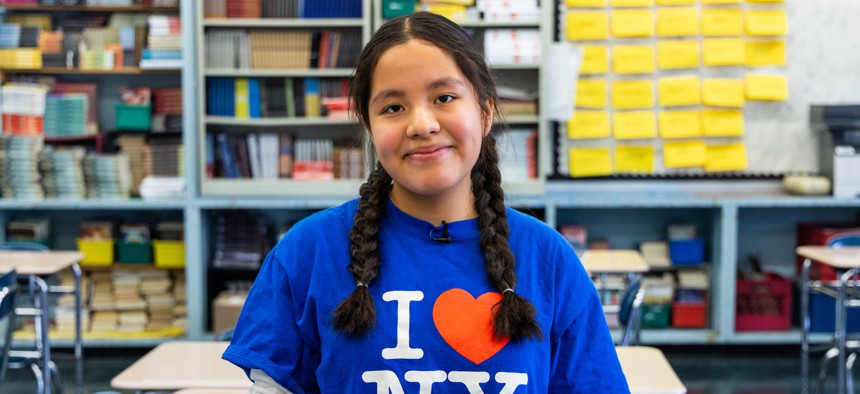
Lucero, WHEELS Class of '26, is a community environmental leader and proud Futures Ignite student. She’s going to St. Lawrence University this fall. Katie Nuñez-Rodriguez

Futures Ignite partners with New York City public high schools to spark and propel bold college and career futures for every student. Working directly inside schools, the nonprofit organization supports young people and their families as they navigate the deeply personal process of building life after graduation. Many of their students are first-generation college students; the vast majority are Latino, immigrants, or children of immigrants.
New York Nonprofit Media spoke with Molly Delano, executive director of Futures Ignite, about how working with young people to plan their next steps after high school feels different this year. This interview has been edited for length and clarity.
What is different for young people today from a year or so ago?
What happens when immigrant students are still dreaming boldly and planning expansive futures, while the country around them keeps telling them to shrink, take up less space, stay close, and even hide?
Our students are still ambitious. They are still thoughtful, bright, funny, powerful and full of possibility. Yet more and more, we are seeing young people hesitate in ways we have not seen since the period immediately following COVID.
More students are choosing to stay close to home. More families are weighing proximity, safety and affordability as heavily as opportunity. More young people are asking questions that they are nervous to say out loud: Will I be safe there? Will I belong there? Can my family afford this? What happens if the political climate worsens?
This is not apathy. It is not a lack of motivation. It is a rational response to a country making college and postsecondary opportunities feel more dangerous, more uncertain, more expensive and more out of reach for immigrant students and their families.
The current wave of anti-immigrant rhetoric, xenophobia, heightened enforcement, and political attacks on diversity and inclusion is very real for our students and community. It shows up in college lists, family conversations, decisions about whether to travel and fears about rural campuses, predominantly white institutions, documentation, safety, and belonging. Even 45 minutes north of New York City can feel so much further and a different world.
Layered on top of that is affordability. For many of our students and families, even a strong financial aid package does not make college feel affordable. HEOP (Higher Education Opportunity Program) and EOP (Educational Opportunity Program) are comprehensive New York state programs designed to help motivated, low-income, and educationally disadvantaged students succeed in college. A near-full financial aid package with HEOP or EOP support may still leave costs that are very real: an enrollment deposit, transportation to and from campus, books, bedding, winter clothes, fees, food, or the cost of visiting home a few times a year. For families doing a whole lot more with a whole lot less in one of the most expensive cities in the country, those costs are not small. They can be the difference between possible and impossible.
Futures Ignite counselors, working alongside our NYC Public School colleagues, talk honestly with students and families about debt. We believe there can be such a thing as good debt when it opens a strong, affordable, well-supported pathway to a degree and future earnings. For years, our general rule of thumb has been to help students avoid taking on more than about $5,000 per year, or $20,000 total. Even that guidance is something we are rethinking carefully as costs continue to rise.
But increasingly, we are seeing students and families reject any debt at all, or reject even smaller amounts of debt than we would have previously considered manageable. A SUNY or private college that leaves a $10,000 annual gap may simply feel not worth it, no matter how strong the institution is. For many families, that is not fear-based or short-sighted. It is math. It is a reality.
And let me be very clear: choosing CUNY can be an excellent and powerful decision. We love CUNY. CUNY is one of the greatest engines of opportunity in New York City. It is affordable, rigorous, diverse and deeply connected to the lives and futures of our students. However, there is a difference between choosing CUNY from strength, alignment, and excitement and choosing proximity because the rest of the country feels unsafe, unaffordable or out of reach. That difference matters. Our job is not to tell students where they should go. Our job is to make sure fear and financial pressure do not quietly become more important than their goals, plans or dreams.
How is Futures Ignite responding to this moment?
The power of our counseling team has never been clearer. Our college and career counselors are first-generation college graduates themselves, immigrants or children of immigrants. They know, personally and professionally, what it means to carry ambition and fear at the same time. They know what it means to be the first. They know what it means to navigate systems that were not built with your family in mind, while holding culture, language, money, responsibility, hope and pressure all at once. That lived experience matters every single day.
Our counselors are not just supporting students to complete applications. They are pushing back, quietly and loudly. Quietly, in one-on-one conversations when a student starts to shrink a dream they have carried since ninth grade. Loudly, when systems fail to see the full humanity and rights of immigrant students.
They advocate with colleges, schools, and families. They challenge assumptions. They ask better questions. They name what is possible. They stand, with extraordinary clarity and eloquence, for the rights and futures of our immigrant students. They are not pretending the risks are not real. The risks are real. The fear-mongering is real. The affordability crisis is real. Families are right to ask hard questions about safety, belonging, debt, travel, and distance from home.
Yet our team is also holding the line for students’ fullest dreams. They are reminding young people of the ambitions they named as freshmen, or even before – before the world asked them to be smaller. They are helping students continue to imagine lives that include national opportunities, residential college experiences, travel, leadership, studying abroad, internships that spark bold careers, joy, adventure, and possibility.
What high-level questions are you grappling with as a leader?
The question I keep coming back to is: What do students in Title I, unscreened New York City public high schools deserve?
This is fundamentally a question about immigrant students. In New York City, students from immigrant families are not a small subgroup at the margins of public education. They are central to the story of our schools and our city’s future.
Our students deserve what their peers at Beacon, Stuyvesant, and other highly resourced schools deserve: serious college and career counseling, powerful networks, strong applications, rigorous options, family guidance, insider knowledge, real leadership opportunities, and adults working every angle to open doors.
However, the infrastructure is not the same. The question is not whether our students are capable. Of course they are. The question is whether we are building the infrastructure around them that their talent deserves. That means investing in counseling teams who understand the complexity of college access for immigrant, first-generation, and low-income students. It means career-connected opportunities that are robust, relevant, and not treated as second best. It means paid internships, after-school programs, leadership development, family engagement, alumni support, and real pathways that begin before senior year and continue after graduation.
Even when students graduate with a strong plan, the transition after high school is often where students need the most support. That is why we lead a year-long Alumni Bridge Program for students after they graduate, supporting them with advising, resource navigation, mentoring, career exposure, emergency problem-solving, financial guidance, and connection.
For us, the question is not college or career. It is how do we make sure every young person graduates with real options, real leadership experience, real support, and a plan they are excited about. And then has the support to make that plan real?
What do you wish funders, policymakers and higher education leaders understood right now?
We are hopeful that this city administration and a strong community of funding partners can dramatically turn up investment in New York City high school students by linking more dynamic after-school programs, paid internships and summer employment, with public priorities to tee up real wins for young people and their communities.
For example, New York City’s growing investment in its urban forest and tree canopy should also be an investment in young people. If the city is expanding green infrastructure, then students should be equipped and paid to help lead that work in their own neighborhoods, studying heat and air quality, caring for trees, collecting data, educating neighbors, and building pathways into climate, public health, infrastructure, and sustainability careers. That is the kind of triple bottom line we need: healthier communities, stronger public infrastructure, and young people gaining paid experience, leadership, and career-connected skills.
It also means investing in the actual infrastructure students need to navigate this moment. Futures Ignite exists because schools cannot do this alone. The average postsecondary counselor-to-student ratio in NYC public schools is approximately 1 to 388. No matter how talented or committed school counselors are, that ratio makes high-touch, family-centered, financially honest, opportunity-matching support nearly impossible without strong partners.
There is incredibly important and exciting work happening in early childhood and literacy in New York City and nationally, we have to reject the false choice that sometimes surfaces in education and philanthropy: that if we care about early childhood, we somehow invest less in teenagers. That binary is not only shortsighted; it is profoundly deficit-based.
Young people do not stop developing at 10 or 14 or 18. Their brains, identities, confidence, decision-making, relationships, and sense of possibility are still forming well into young adulthood. This idea that high school is “too late” is absurd. It is a powerful, urgent, alive moment to invest, especially for immigrant students and students from immigrant families who are navigating college, career, family responsibility, affordability, belonging, and an increasingly hostile national climate all at once.
That is the kind of investment we need: young people strengthening their communities while gaining paid experience, real leadership, meaningful credentials, and the powerful sense that is their city, too.
Laurel Dumont serves as staff, executive coach and strategic advisor to several nonprofits and charitable foundations, as a senior advisor with Intentional Philanthropy and as an independent consultant through Collaborative Strategies.
NEXT STORY: Opinion: New York is leaving its most vulnerable youth in limbo