

NYN Media
Opinion: Asian immigrant communities need to be protected, too
New York City has an obligation to support Asian-serving legal services organizations
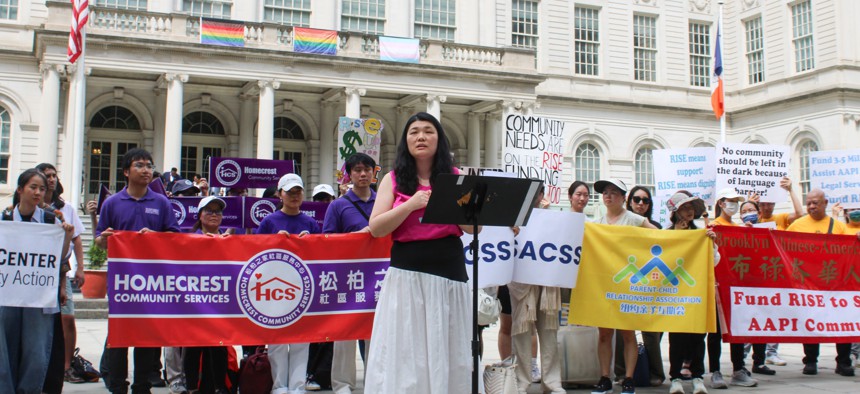
New York City Council Member Susan Zhuang rallied with Asian American groups on June 11, 2026. Courtesy Asian American Federation


As New York City just celebrated Asian American Pacific Islander Heritage Month, honoring the rich cultures and contributions that have shaped this city, many communities did so under a shadow of fear and instability. ICE raids have left families afraid to send their children to school, attend houses of worship, or even step outside. Fear is keeping people from food pantries, SNAP benefits, and other critical services. Families with mixed immigration status are dropping out of public benefits programs due to fear, misinformation, and confusion about changing work requirements.
The numbers tell a disturbing story: between 2024 and 2025, federal immigration arrests in the New York City area of Chinese immigrants rose by 1,044%, and arrests of Bangladeshi immigrants increased by 1,000%, according to the Deportation Data Project, first reported by The City Record. Yet even as enforcement surges, the legal resources to fight back remain dangerously thin. For New York’s AAPI communities, one of the state’s fastest-growing populations, the crisis is made worse by the lack of culturally competent legal support in their own languages.
Asian immigrants make up nearly 30% of NYC's non-citizen population, but Asian-serving legal organizations are severely under-resourced, leaving countless families without qualified representation. When immigrants can't access attorneys who speak their language and understand their culture, the consequences are families being torn apart, people with valid cases deported unfairly, and too many losing the right to fight for the life they built here. This crisis stretches from Queens to Brooklyn, from the Bronx to Manhattan, and is worsening each day.
While the federal government has focused on gutting social services, with minority groups being hit the hardest, the election of Mayor Zohran Mamdani brought a mandate for expanding investment in public services and robust protections for immigrants in New York City. But as the New York City Council weighs competing fiscal priorities, one thing is clear: as our federal safety net unravels, New York's immigrant communities cannot wait.
This moment demands action and commitment that meets the scale of the crisis. That is why we are urging the New York City Council to fund the Rapid Immigrant Support and Empowerment Network (RISE) at $3.5 million in the fiscal year 2027 budget.
For many immigrant New Yorkers, the legal system can feel impossible to navigate: forms in a language you may not speak, processes that take years to understand, and constant fear that one mistake could put your future at risk. RISE changes that – it provides immigrant New Yorkers with actual help when they need it most. By bringing together 14 Asian-led communities with legal service providers, it connects immigrants to trusted advocates who can guide them through complex pathways to legal status and ensure they are not navigating the system alone. RISE isn’t another legal services program; it’s what it looks like when a city refuses to leave its most vulnerable residents behind.
More importantly, RISE reaches people through community: in their language, through familiar faces, and in places where they already feel safe. It funds multilingual outreach in over 12 languages so that non-English-speaking New Yorkers access accurate information before a crisis hits, not after. When misinformation spreads about immigration enforcement, public benefits, or workers’ rights, it’s local Asian-led organizations that can step in and set the record straight.
By investing in collaboration, RISE unites diverse organizations to share resources, coordinate strategies, and push for the lasting, structural solutions that immigrant New Yorkers need. The results are clear. In just the first three quarters of fiscal year 26, 10 of 14 RISE partners served 2,214 clients, which is on pace to exceed annual targets. Across our city, members are delivering in-language support for citizenship and green card applications, accompanying immigrants to hearings, leading Know Your Rights training, and coordinating rapid response efforts. RISE is working.
The demand is there. The infrastructure is in place. What’s missing is the funding to match this moment.
At $3.5 million, less than 0.1% of the City’s $127 billion budget, RISE is a drop in the fiscal bucket. But for AAPI families navigating deportation threats, language barriers, and a hostile environment, it’s a lifeline.
Despite earlier commitments, the city has recently signaled that funding will not meet current levels of demand. This gap is not abstract: every day without adequate legal support is a day families face deportation, separation, or exploitation, often with nowhere to turn.
Investing in RISE is investing in New York. The AAPI community, alongside Black, Hispanic, and other immigrant New Yorkers, has built this city. They pay taxes, run businesses, fill essential roles, and raise families here. When the federal government targets immigrant communities, the city must respond with real commitment, not half measures.
The communities most targeted by today's federal policies are too often left behind to navigate a hostile immigration system and a city budget process that falls short of the urgency of this moment.
The New York City Council has an opportunity to change that. Fund RISE at $3.5 million to protect our neighbors and invest in New Yorkers.
Catherine Chen is CEO of Asian American Federation and Mohammad Razvi is the CEO of Council of Peoples Organizations
NEXT STORY: Father’s Day could be every day in New York