

NYN Media
Opinion: The green economy is a jobs plan
New York City should work with nonprofits to address two issues at once.
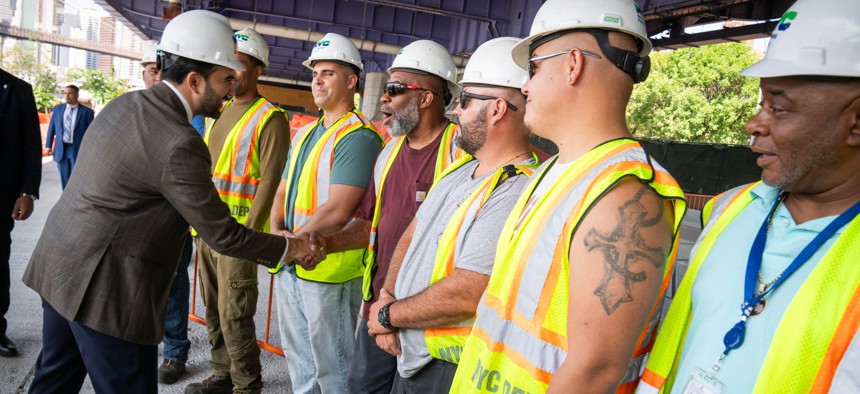
New York City Mayor Zohran Mamdani announced an expansion of the Bureau of Coastal Resilience on July 24, 2026. Ed Reed/Mayoral Photography Office


New York City has employment and climate change problems, and we have spent years treating them as separate emergencies with siloed budgets.
But they are not.
The work of making our buildings more efficient and our neighborhoods more resilient is also a promising source of good jobs. The Mamdani administration has begun to treat it that way, and that is worth building on.
The affordability crisis is not only about the cost of living. It is also about wages that have not kept pace, in a labor market where most new jobs are being concentrated in low-wage sectors.
At the same time, New Yorkers feel the climate crisis constantly – when the heat index pushes past 105, when a cloudburst floods basements in the South Bronx and Queens, or when a storm surge creeps up a block in Red Hook or the Rockaways.
Both crises fall hardest on the same communities of New Yorkers.
Green jobs can address both. They cannot be outsourced, are rooted in the neighborhoods that need them, and many are reachable without years of school or expensive credentialing. The city's own Green Economy Action Plan projects that decarbonization and resilience efforts can create at least 260,000 jobs over the next 15 years.
At The HOPE Program, we have spent more than four decades preparing New Yorkers – many of whom have experienced homelessness, incarceration, domestic violence or long-term unemployment – for careers. Increasingly, those careers are in the green sector.
We are members of the New York City Employment and Training Coalition and JobsFirst NYC's Green Economy Network, each of which has given this administration a serious blueprint. Those roadmaps get the policy right. Over 40 years of placing people into these jobs have shown us where the challenges exist – and why those recommendations matter.
The constraint is not training capacity.
We can train more people than the job market currently absorbs. A graduate who is ready in March may be waiting until August for a job. Every additional training slot the city funds without a corresponding increase in employment produces a credentialed New Yorker with nowhere to use their skills.
But the city has influence.
Public dollars drive most of the decarbonization work in New York for upgrades to municipal buildings, resilience infrastructure and streetscape work. Therefore, the city can decide who gets hired for this work and what the jobs pay. Hiring standards attached to public contracts are one of the strongest workforce levers the city has to pull.
Existing and new housing developments also present major opportunities. The Mamdani administration has proposed its housing plan, Block by Block, which vows to create and preserve 400,000 affordable housing units. Each new development offers construction, mechanical, and electrical jobs. The even steadier work pipeline is for modernizing, weatherizing and retrofitting existing buildings.
Most of this work is familiar, done by the trades with new requirements: the HVAC technician who now installs heat pumps or the building manager who now manages Local Law 97 compliance.
One of our graduates, Rob, does exactly this type of HVAC work. He came to HOPE after returning home from prison, completing building operations and maintenance training to earn multiple certifications. Rob is now a union member earning a solid prevailing wage with a pension and health coverage.
His job exists because our city invested in the training and the jobs to make older buildings more efficient. Those are investments we can, and should, continue to prioritize.
And while job placement is the common metric, retention is where equity is truly won or lost. It provides more context into how many people are still working a year later. The answer usually hinges on factors that cost relatively little: a toolset, transit fare, a licensing fee or childcare during a shift change.
The administration is right that affordability is our defining challenge. Lowering costs and raising wages are the way forward. The green economy is where this city can do the latter – in the neighborhoods that have historically absorbed the most environmental harm and received the least investment.
The infrastructure is already here, in community-based organizations, training providers, and labor partnerships that have spent decades proving it works. The coalitions are organized. The people ready to join the workforce are ready. The city has laid the groundwork. Now is the time to invest deeper to create the jobs, and build the future New York deserves: one green job at a time.
Tracey Capers is executive director of The HOPE Program, a citywide nonprofit organization connecting New Yorkers overcoming systemic barriers to careers while transforming neighborhoods through resiliency and sustainability improvements.
NEXT STORY: New York is still helping Dolly Parton give books to kids