

NYN Media
Restler joins the neverending war against late nonprofit payments
The New York City Council contracts chair is introducing a new agenda to tackle an old issue.
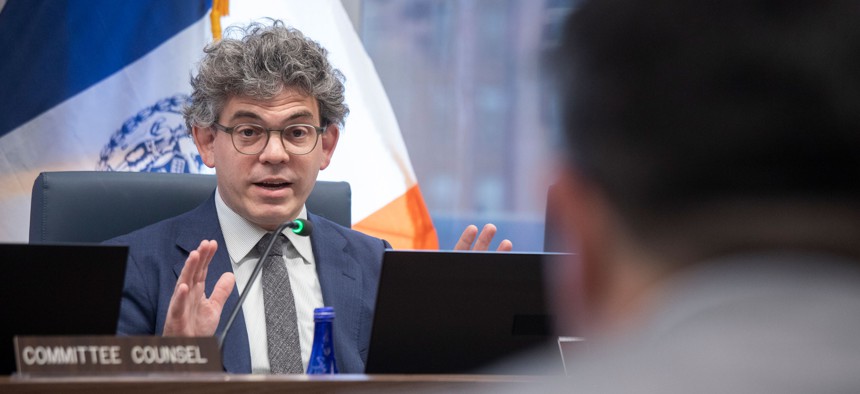
“We fail to pay them in a timely way for their work,” said New York City Council Contracts Chair Lincoln Restler. John McCarten/NYC Council Media Unit

Nonprofits in the human services sector do essential work for New York City and its residents, from operating homeless shelters to providing legal counsel to tenants facing eviction. For that, these organizations have consistently dealt with late contract registrations and delayed payments. Nonprofit leaders tell stories of having to take out loans to tide them over until the agreed upon cash from the city comes in.
”This has been a chronic issue for 15 plus years,” said Michelle Jackson, executive director at Human Services Council, whose organization represents over 180 nonprofits that make up around 80% of total human services contracts at the city level. “Even if your contract is registered, it is not a guarantee you will get that money. Many organizations have to deal with late payments.”
Now, Council Member Lincoln Restler, who chairs the Committee on Contracts, is rolling out a comprehensive agenda meant to tackle the issue.
“We depend on the nonprofit sector to care for the most vulnerable New Yorkers, from little kids to older adults, from the homeless, to the homebound,” Restler said. “And yet we fail to pay them in a timely way for their work.”
The Brooklyn Democrat’s proposals fall within four buckets: reliable access to funding, speeding up payments, enhancing agency capacity and ensuring ongoing accountability.
One problem many nonprofits face with their contracts is the difficulty of accessing interest-free bridge loans offered by the city. The Returnable Grant Fund, which is managed by the Mayor's Office of Contract Services, provides these loans to organizations in need of it. However, the funds are limited and the same agency responsible for the late payment is the same one the nonprofit must interface with to initiate the loan process.
“Oftentimes, you have a choice of, ‘can you register my contract,’ or ‘can you process my loan,” said Jackson.
For many nonprofits, cash on hand is king. The limited funding and “Faustian choice,” as Restler describes it, available to them pushes many nonprofits towards taking out loans with private institutions, which incurs interest that isn’t reimbursable by the city.
“My finance department has to talk to banks to make sure we can have lines of credit … We have to spend more time with our auditors explaining to them what's going on with cash flow,” says Wayne Ho, president and CEO of the Chinese-American Planning Council, which contracts approximately $40 million worth of human services with the city annually. “That's how it impacts us just because things are not registered on time and things are not paid on time.”
As part of Restler’s agenda, each city agency that contracts with nonprofits would have to hire a point person whose job it is to handle bridge loan applications and submit them to the Fund for the City of New York as well as increase agency staffing levels for their respective contract procurement teams. Restler already introduced a bill, Int. 1053, which would require human services agencies to create staffing plans and recommend minimum staffing numbers.
Restler also wants City Hall to reboot a 10-week “clear the backlog” initiative focused on approving budgets and invoices paired with a similar initiative from MOCS to help agencies with contract approvals.
Because contracts both large and small get processed through the same system, logjams crop up. Smaller nonprofits end up waiting for a modest sum of money while large nonprofits are in the lurch for millions of dollars.
“Right now, nonprofits and city agency staff spend similar amounts of time on $5,000 contracts as they do on $500,000 contracts. That's pretty stupid,” said Restler.
Which is why he is calling for the expansion of the Discretionary Grant pilot program, which transforms smaller contracts into grants to help speed up the registration and payment process. Receiving grant funding from the city is a much less onerous process to complete compared to regular contracts and does not need to be sent to the city comptroller’s office for registration.
“You get the procurement benefit of it being grants,” said John MacIntosh, managing partner of SeaChange Capital Partners, which offers grants, loans, financial analysis and strategic advice to nonprofits. “That should make it much easier to process those quickly, which I think is exciting because those have always gummed up the system.”
The final plank of the contracts agenda revolves around ongoing accountability, starting with reviving the Nonprofit Resiliency Committee which started in former Mayor Bill de Blasio’s administration. The plan would be for the committee to meet monthly for at least a year and address the many issues present in contract procurement.
Furthermore, the contracts chair also wants to see ContractStat, which is an internal tool used by the Mayor’s Office of Nonprofit Services and MOCS to track agency performance on contract-related outcomes according to Restler, to become fully public.
“I know that accountability isn't necessarily fun, but it's really important,” Restler said. “We should all have access to the same data on how agencies are performing to effectively push them to do better.”
Last fiscal year, roughly 40% of the $11.4 billion awarded to nonprofits in the human services sector through their contracts with the city came late. The previous two fiscal years were even worse with around 70% of the contract money given out classified as tardy. In fiscal year 2026, 59% of contracts for nonprofits in the human services sector were registered late and when that was the case, they were late by more than half a year on average.
Leaders among the human services nonprofit space have expressed optimism with the current administration’s drive to improve contract procurement, pointing to one of the ballot proposals put forth by the Commission on Government Efficiency aimed at simplifying contractor paperwork and delegating authority to the mayor to approve certain contracts.
"The Mamdani Administration works alongside our nonprofit partners to serve the New Yorkers who need our support most,” said Matthew Rauschenbach, a spokesperson for the mayor. “We look forward to working with Chair Restler to identify where we can collaborate on delivering for the organizations and the New Yorkers who rely on them."
They are also encouraged with Restler’s plan to tackle the ongoing problems human services nonprofits have contracting with the city and want to see more from the administration and the council to finally put the issues to rest.
“That all sounds like really solid steps to get us on a good path to solving this issue,” said Nora Moran, director of policy and advocacy at the United Neighborhood Houses of New York, which represents more than 40 human services nonprofits that have nearly $1 billion worth of contracts with the city. “They don't consider themselves to just be a vendor. They really feel like they're a partner with the city, and so they're looking for that kind of reciprocal relationship.”