

Opinion
Opinion: New York’s powerful combination of business, civic and academic partnerships will drive our next chapter
It’s incumbent upon every elected leader to help forge these powerful bonds.
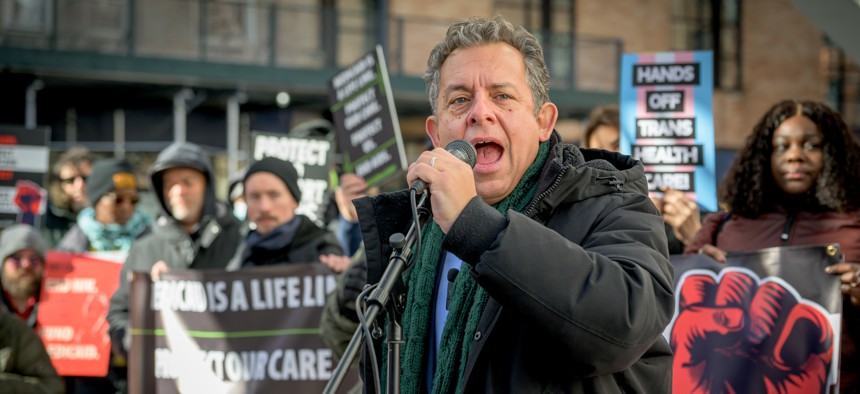
Assembly Member Tony Simone is encouraging businesses, higher education and other institutions to deepen their collaboration. Erik McGregor/LightRocket via Getty Images

New York City has always been a place where ambition meets opportunity. From finance and fashion to media and medicine, we are a global capital of creativity and commerce. But as society and our economy continue to transform, especially with the proliferation of artificial intelligence, our city once again stands at a crossroads. New York City’s tech sector has flourished to become a pillar of our economy and represents nearly 10% of the city’s gross product. Tech jobs have increased nearly 10 times faster than the rest of the city’s private sector.
Our state’s higher education sector is an essential and underutilized secret weapon in bolstering the region’s AI excellence, accountability in the tech industry and future economy. To stay ahead, we must do what we have always done best: make room for the best and brightest to collaborate on bold new ideas, which is achieved by empowering our universities to serve as global magnets for talent.
While promises of an AI-powered workforce revolution range from pragmatic to hyperbolic, what’s certain is that we can’t leave our economic future and workforce opportunities to chance. We must continue to build an intentional ecosystem in which business, civic and cultural institutions, and colleges and universities – which train the next generation of workers and create new ideas – move in concert. It is essential that research is leveraged to catalyze civic and industry growth, classrooms are linked to real-world problem-solving and professional opportunities, and that New York’s talent pipeline is as strong and dynamic as possible so that the city’s intellectual infrastructure is able to adapt in the face of a rapidly evolving economy. That requires higher education and private sector leaders work in tandem.
Across the state, we already see examples of this partnership at work. Gov. Kathy Hochul’s Empire AI initiative is positioning New York as a national leader in artificial intelligence research and application, while her initiative for free community college for adult learners pursuing high-demand sectors like health care and cybersecurity ensures rapid training pipelines for emerging jobs. SUNY Chancellor John King also launched the system’s Institute for Local News, which places students interested in journalism into paid internships in newsrooms across the state. At a time when local news matters more than ever and outlets are shrinking, these students are able to gain valuable hands-on experience, support communities across the state and expand their horizons after graduation.
In my own district, newcomer Vanderbilt University is demonstrating innovation that is oriented toward New York’s needs. Its first campus outside of Nashville in its 150-year history reflects a clear vision to expand its national footprint and create pipelines to industry and exceptional student and faculty opportunities. Its study away program will immerse undergraduates from Nashville in New York City’s dynamic business community through coursework, internships and project-based learning opportunities. Its master’s degree in business and technology directly connects to our innovation economy, blending expertise in their engineering and business schools to further expand the city’s talent pool and educate graduates who have both the technical skills and business acumen to scale companies and advance innovation.
When universities are leveraged as civic engines and employers engage as active partners, we create more than individual success stories. We build capacity to our collective benefit. Research from the National Association of Colleges and Employers shows that students who complete internships are more likely to persist in their studies and secure full-time employment. And employers overwhelmingly view internships as the best return on investment for their recruiting activities. Paid internships, according to the Strada Education Foundation, yield stronger early career outcomes for students when compared to those who did not participate in an internship.
This is the model New York must double down on. Employers shouldn’t see universities simply as sources of talent, but as collaborators in solving shared challenges, from transit to housing and medicine. Likewise, colleges and universities must keep forging deeper ties with civic institutions and industry leaders to ensure their programs evolve as fast as the world around them.
Our prosperity has never been accidental. It’s been the result of partnerships that turned public purpose into shared progress. As we embark in a new era of economic growth, it’s essential every elected leader in the state encourages connection between the private, public and higher education sectors. It’s paramount we leverage this powerful solution as we foster student and business success, and serve as the nation’s leading edge for groundbreaking research, new technology and economic opportunity.
Tony Simone is an Assembly member representing District 75, which includes Chelsea, Hell’s Kitchen and Midtown.
NEXT STORY: Opinion: Let New Yorkers choose how we say goodbye