

Opinion
Opinion: Public power is the key to energy affordability
To unleash the New York Power Authority’s power, we need the right people at its helm.
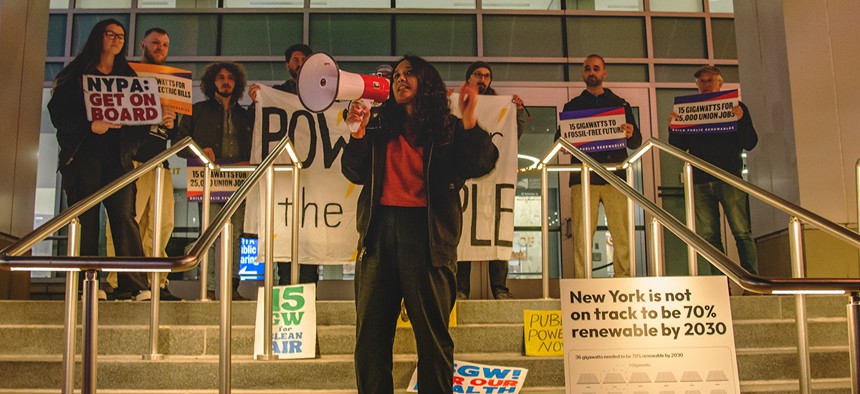
Assembly Member Sarahana Shrestha speaks outside a New York Power Authority public hearing. Brittany Barnard


In 1931, when Wall Street was eager to own the state’s hydropower, and speculative holding companies were profiteering off energy, then-Gov. Franklin D. Roosevelt had the foresight to create the New York Power Authority as a counterweight to private companies like Con Edison. Not only did this immediately lower electricity rates, but NYPA continues to provide some of the cheapest electricity today. Now, as a historic affordability crisis plagues New Yorkers, the state must once more recognize two things: the cost of energy is at the core of the affordability agenda, and public power is the key to energy affordability. NYPA’s power must once again be unleashed – and to do that, we need the right people at its helm.
The dire circumstances New Yorkers find themselves in cannot be overstated. One-in-four residents experience a high energy burden, an unprecedented number of utility bills remain unpaid and families have to choose between keeping the lights on and and putting food on the table.
To date, the new authority and mandate granted to NYPA through the Build Public Renewables Act of 2023 has already given us a preview on what NYPA can do: it has funded over $25 million for green jobs training, created a program to administer automatic bill discounts and built a portfolio of planned projects that will create thousands of green union jobs as they move us toward climate resiliency.
However, considering the undeniable science on the speed of climate change, the scope of the affordability crisis and the absolute failure of the private sector to address either, NYPA has not demonstrated a willingness to act with the ambition that is necessary. On the contrary, NYPA cut 1.5 gigawatts of public renewables from its planned portfolio just last month, when what it should be doing is committing to building at least 15 gigawatts by 2030.
It’s worth remembering that when FDR was facing historic challenges as president, he embraced public authorities to bring the nation out of the Great Depression and keep it resilient through World War II. it was precisely the scale and the speed at which public authorities could tackle enormous undertakings, often without costing taxpayers, that led him to embrace that model. This history is extensively covered in the book Democracy in Power: A History of Electrification in the United States, which shows that it’s not enough for these institutions to be publicly-owned; they must also be models of democracy, accountability and transparency. We already have the basic ingredients of all three in NYPA, but to unlock its full potential as we navigate a crisis of democracy, we must go further.
Our new bill, the Public Power Democracy Act, takes a step in that direction by expanding NYPA’s board from seven to 17 members and giving the state Legislature the ten new appointments to bring necessary areas of expertise to the board: public finance, energy planning, union labor, environmental justice, renewable energy siting, building electrification and consumer advocacy. With a mandate to build New York’s renewable energy and a board that can rise to this task, we believe NYPA will deliver reliable, affordable and local energy that will power our homes and keep them healthy.
Sarahana Shrestha is an Assembly member representing Assembly District 103, which includes Kingston. Kristen Gonzalez is a state senator representing the 59th Senate District, which includes parts of Queens, Brooklyn and Manhattan.
NEXT STORY: Editor’s note: Campaign donors are power for Letitia James