

Opinion
Opinion: Lowering energy bills starts with getting New York off fossil fuels
Energy costs are on the rise due to the state’s reliance on volatile global oil and gas markets, not its landmark climate law.
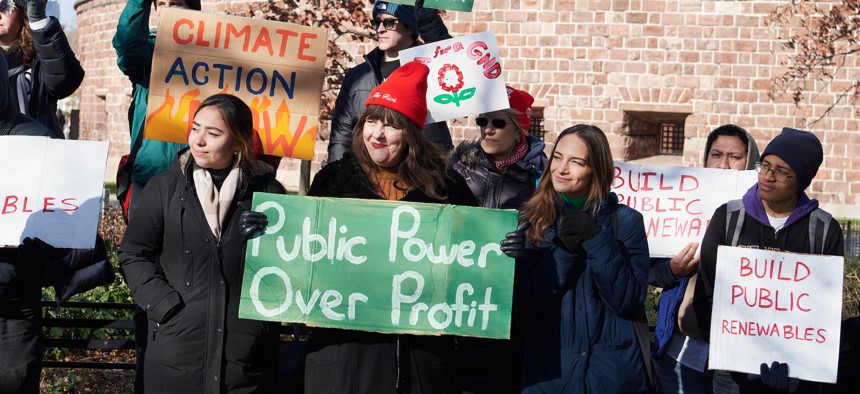
Assembly Member Emily Gallagher, center, and state Sens. Kristen Gonzalez, left, and Julia Salazar, right, attend a rally in support of public power in Battery Park in November 2023. Michael Paulson


New Yorkers are feeling the energy affordability crisis from every direction. A brutal cold freeze in January drove up gas demand and costs. Now, the United States and Israel’s war in Iran is pushing global oil and gas markets into further volatility.
Because New York imports nearly $50 billion in gas and oil annually, households are exposed to price spikes they cannot control. The cost of gas is driving up both gas and electric bills, with gas bills rising four times faster than inflation. Meanwhile utilities are profiting by expanding gas infrastructure that locks families into decades of expenses.
This is what fossil fuel dependence looks like: unstable, globally exposed and rigged to protect corporate profits.
New York’s Climate Leadership and Community Protection Act, the state’s landmark climate law, breaks the cycle of ever-increasing rate hikes that are driving working families and local businesses to the breaking point. Passed in 2019, the CLCPA is one of the most ambitious energy modernization laws in the nation. It aims to transition our current gas and fossil fuel-reliant grid to a fairer energy system that is efficient, clean and affordable.
And yet, Gov. Kathy Hochul is threatening to weaken the CLCPA and is embracing new fossil fuel development, despite the fact that the current status quo of relying on natural gas has created today’s affordability crisis. Today, 3 out of 5 households use gas for heating and/or cooking. The result? Over a million New Yorkers are two or more months behind on their utility payments with $1.8 billion in unpaid bills.
While families and businesses struggle to pay their gas bills, New York utilities are spending over $1 billion each year to build and repair the antiquated, leak-prone gas system. Because utilities profit off the infrastructure, they have a vested interest in maintaining and growing the gas system. During the last ten years, New York utilities more than doubled their gas assets from $17 billion to over $37 billion.
Meanwhile, residents pay for gas infrastructure spending in the form of gas delivery charges on their monthly bills, over which they have no control. Even as New Yorkers use less gas, they are paying more thanks to growing delivery charges: households are using 18% less gas in 2024 compared to 2018, but the average gas bill has risen 6% annually.
New York’s energy affordability crisis is directly linked to the state’s overreliance on gas. And yet, the oil and gas industry is peddling the lie that rising utility costs are the result of a climate law that has yet to be implemented. Despite the CLCPA passing seven years ago, our state has done almost nothing to put it into action and help our communities transition off costly fossil fuels.
Numerous studies have shown that actually implementing the CLCPA will lower energy bills, create tens of thousands of jobs and secure a cleaner and healthier New York. If done right, the CLCPA would save households over $1,000 per year while creating over 300,000 new jobs by 2035. The CLCPA also spurs further policies that rein in utility spending on leaky gas pipes, construct modern, electric new buildings, and increase funding to programs that help low and moderate-income households upgrade their homes to become energy-efficient.
New York’s climate law offers a vision of locally-generated clean energy, efficient and modern homes and an energy system that puts people over corporate profits. There is only one path that protects New Yorkers: Hochul must implement the CLCPA.
Emily Gallagher is an Assembly member representing Assembly District 50 in Brooklyn. Kristen Gonzalez is a state senator representing Senate District 59 in Queens, Brooklyn and Manhattan.
NEXT STORY: Editor’s note: When is super PAC money welcome?