

Opinion
Opinion: When media giants control the remote, New Yorkers pay the bill
The Television Subscriber Choice Act would prohibit forced channel bundling, giving cable, satellite or streaming providers the flexibility to design packages based on what viewers actually want.
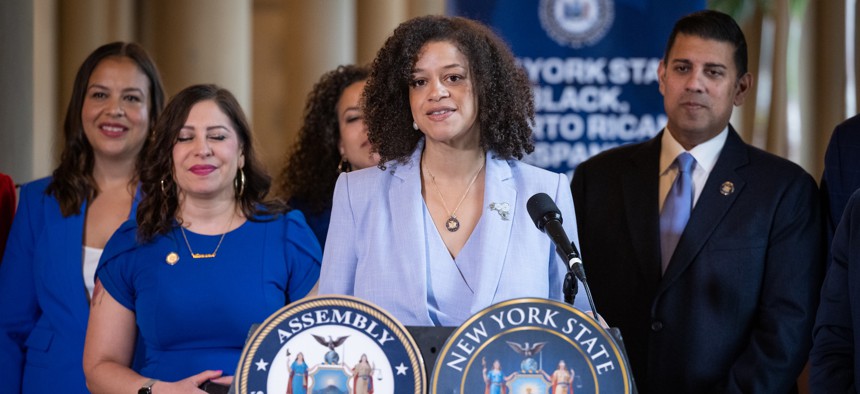
Assembly Member Michaelle Solages is a lead sponsor of the Television Subscriber Choice Act. Office of Assembly Member Michaelle Solages


The suspension of Jimmy Kimmel Live in September grabbed headlines for its political drama, but the real story is about something closer to home: who controls what we watch and how much we pay for it.
Here’s what happened. After Jimmy Kimmel made controversial remarks about conservative activist Charlie Kirk, Brendan Carr, the chair of the Federal Communications Commission, publicly pressured broadcasters to take action.
Sinclair and Nexstar, two of the nation’s largest owners of local TV affiliates, obliged. Why? Because both companies are seeking approval for multi-billion dollar deals, including Nexstar’s proposed $6.2 billion takeover of Tegna. If approved, Nexstar would control nearly 60% of U.S. television households, wielding immense leverage over cable, satellite and streaming TV distributors alike.
Now, that deal is facing a major legal challenge. This week, state Attorney General Letitia James joined a multistate coalition to sue to block the Nexstar–Tegna merger, arguing it would illegally reduce competition in local TV markets, raise costs for consumers and weaken the quality of local news. In markets like Buffalo, where both companies own competing stations, the proposed consolidation would eliminate competition entirely.
This consolidation trend isn’t happening in a vacuum. The FCC is now considering eliminating the national broadcast ownership cap, which currently limits any single broadcast group’s reach to 39% of U.S. television households. Scrapping that cap would open the door to even more consolidation, shrinking local media independence and driving up costs for consumers.
That’s the piece too often left out of the conversation. These mergers don’t just reshape the media landscape; they dramatically increase the negotiating power of giant programmers against distributors of all kinds, whether it’s traditional cable systems or virtual multichannel video programming distributors (vMVPDs) like Hulu + Live TV, YouTube TV, and Sling, or satellite providers such as Dish and DirecTV. When programmers gain more leverage, consumer prices inevitably rise. The conglomerates force distributors to accept bundles of little-watched channels in order to get access to must-have ones. Consumers then foot the bill for the excess, paying more each month for channels they never watch.
The attorneys general make this exact point in their lawsuit: when station ownership is consolidated, broadcasters gain the power to demand higher retransmission fees from cable and streaming providers – costs that are passed directly on to consumers. In some cases, they can threaten to black out multiple major network affiliates at once if distributors refuse to pay their demands.
This is exactly why I introduced the Television Subscriber Choice Act (A5870 / S4653). The bill tackles the “all or nothing” bundling practice head on. Right now, if a distributor wants a popular channel, they’re forced to take the entire suite of lesser watched channels; driving up costs for everyone. My legislation would prohibit forced bundling, giving cable, satellite or streaming providers the flexibility to design packages based on what viewers actually want. It would also ban restrictive packaging requirements that give programmers control on how distributors sell video products – opening the door to more flexible, affordable options for consumers.
Cable and satellite providers still play a unique role in our communities. They pay franchise fees that support towns and cities across New York. They fund public, educational and government access (PEG) channels that deliver hyperlocal coverage of school board meetings, cultural programming and community news you can’t find anywhere else. But if rates continue rising under this broken model, subscriber losses will accelerate across every platform, shrinking revenues, threatening PEG resources and forcing even greater dependence on the very conglomerates driving these increases.
When programmers consolidate, friction in negotiations intensifies. Distributors are forced into all-or-nothing deals, and when talks break down, consumers pay the price, literally and figuratively, through channel blackouts and higher bills. We’ve seen this play out repeatedly, with recent high-profile disputes involving Fubo and NBC, YouTube TV and Disney, and others. Each standoff leaves millions of viewers in the dark and drives costs even higher.
According to the American Television Alliance, big broadcasters are already charging consumers over 2,000% more for broadcast TV than in 2010, even as viewership among the Big Four broadcast networks has dropped by more than 50%. If nothing changes, the cost of video content will keep climbing across every platform – cable, satellite and streaming. As prices rise, more subscribers will cut services, leaving fewer customers to shoulder even higher costs. That downward spiral will shrink choice and threaten the availability of video products altogether.
The lesson from the Jimmy Kimmel episode is clear: when corporate consolidation and political pressure collide, consumers lose. New Yorkers shouldn’t have to pay the price. The Television Subscriber Choice Act is a commonsense step toward restoring balance, protecting choice and ensuring that – whether you get your TV through a cable wire, a satellite dish or an app – you’re only paying for what you actually want, not for what the media giants demand.
Michaelle Solages is an Assembly member representing Assembly District 22 in Long Island. She is the chair of the Assembly Committee on Local Governments and the chair of the Black, Puerto Rican, Hispanic and Asian Legislative Caucus.
NEXT STORY: Opinion: Why NYC needs a Department of Community Safety