

Opinion
Opinion: Legalize bodega cats
Keeping cats in bodegas and other retailers is technically prohibited by city and state law, but our legislation would fix that.
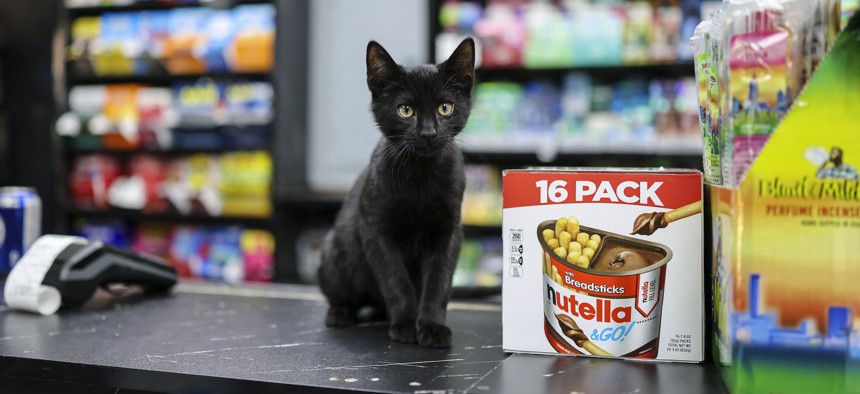
A cat named Shadow sits on a bodega counter, in flagrant violation of current city and state law. Angela Weiss/AFP via Getty Images

Editor’s note: After this article was initially published, City & State learned that this op-ed was partially written with the use of generative artificial intelligence, which violates our guidelines.
Walk into almost any corner store in New York City, and you’ll see something familiar: a cat perched near the register, lounging on a stack of boxes or quietly keeping watch from behind the counter.
For generations, these “bodega cats” have been part of the fabric of New York life. They are as recognizable as the bodegas themselves, a uniquely local tradition that blends practicality with personality. They greet customers, charm neighborhoods and, perhaps most importantly, help deter rodents in a city that continues to grapple with a persistent rat problem.
There’s just one issue: under current law, they are technically not supposed to be there.
To the surprise of many New Yorkers, city and state law prohibit live animals in retail food stores. That means the very cats that have become fixtures of neighborhood life are, on paper, violations subject to enforcement. These rules are inconsistently applied and widely ignored, leaving small business owners in a confusing and sometimes unfair position.
This disconnect between law and lived experience is exactly the kind of problem the government should solve.
That’s why we are working together, at both the city and state levels, to bring common sense, clarity and compassion to this issue.
At the city level, legislation is being reintroduced in the New York City Council that would remove the city’s prohibition on cats in retail food stores. It would also establish voluntary programs to provide free vaccinations and spay and neuter services for cats living in these establishments, in partnership with the Office of Animal Welfare and the Department of Small Business Services. These programs would ensure that the animals are healthy, properly cared for and supported with real resources, not just left in a legal gray area.
But as important as that step is, it is only part of the solution. Action is also needed in Albany to change state regulations for food establishments.
New York state is currently considering legislation that would authorize the presence of "bodega cats" in retail food stores by directing the Department of Agriculture and Markets to establish formal health and safety standards. The bill would mandate the creation of dedicated, sanitary spaces separate from food preparation and storage areas where cats can rest and retreat. By aligning city and state regulations, this legislation would end the long-standing legal limbo surrounding these local staples, ensuring they are humanely cared for while finally providing a clear path to legalization.
The existing system we have is neither realistic nor protective. It does not eliminate the presence of cats in stores, but it does discourage transparency and limits the ability of the government to ensure proper care. A better approach would be to regulate them openly by setting clear standards for care and sanitation that protect both the animals and the public.
It is also about fairness for small business owners.
Bodegas are among the hardest-working small businesses in New York City. Owners operate for long hours, serve as neighborhood anchors and often go far beyond simply selling goods. Yet under current rules, they can be penalized for maintaining something that is both culturally accepted and functionally beneficial.
We should not have a system where enforcement depends on discretion or inconsistency. Clear, modernized rules benefit everyone: store owners, customers and the animals themselves.
And yes, it is also about preserving a small but meaningful piece of what makes New York, New York.
In a city of constant change, there is something reassuring about the familiar: the corner store you’ve visited for years, the person behind the counter who knows your order and yes, the cat who seems to have claimed the place as their own. These are not just quirks; they are part of the lived experience that gives neighborhoods their character.
Good policy doesn’t ignore that reality. It works with it.
This is a practical, incremental effort that brings together public health, animal welfare and small business support in a way that is both thoughtful and achievable. It is also, notably, the kind of issue that cuts across traditional political lines. Regardless of party or ideology, most New Yorkers can agree on a few things: we want fewer rats, healthier cats and fair rules.
New York has always been a city that adapts – a place that evolves not by clinging to outdated rules, but by updating them to reflect how people actually live. Legalizing and regulating bodega cats, in a responsible and structured way, is a small but meaningful example of that principle in action.
It’s time for the law to catch up with reality.
Frank Morano is a New York City Council member representing Council District 51 in Staten Island. Keith Powers is an Assembly member representing Assembly District 74 in Manhattan.
NEXT STORY: Opinion: The Climate Law puts dollars into Black and Latino communities