

Opinion
Opinion: That day at departure
A childhood tragedy shaped my fight for affordable healthcare. The account I told myself about it was true, but incomplete.
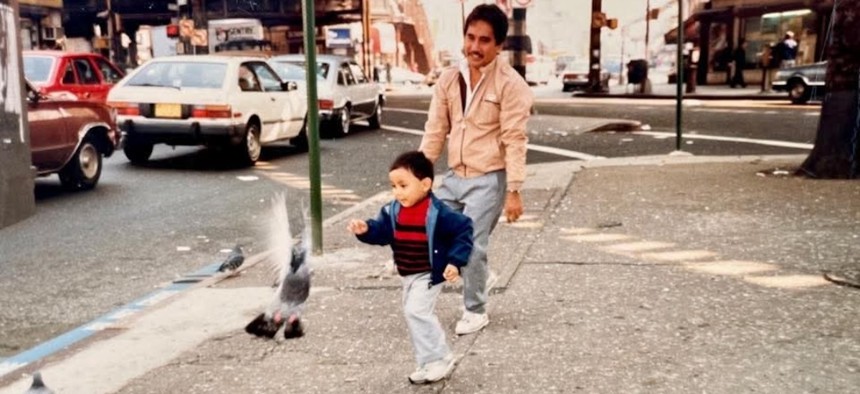
Steven Raga, age 6, with his father Andres Raga in Woodside, Queens, in 1990. Courtesy of Steven Raga


In her 1969 memoir “I Know Why the Caged Bird Sings,” Maya Angelou captured the weight of unspoken trauma when she wrote, “There is no greater agony than bearing an untold story inside you.”
Losing my father, Andres, when I was 7 years old – to a rare but treatable disease, because we couldn’t pay for his care – is my untold story.
For most of my life, the tragedy has remained a private source of grief. After I entered public service, I confided it sparingly: in a closed-door meeting with healthcare advocates, to a longtime ally in western Queens advocacy or a close Assembly colleague. Even then, because childhood trauma rarely endures as a coherent narrative, I could only offer a scaffolding of memory.
In late 1990, when I was a second grader in Woodside, Dad was diagnosed with amyloidosis, a disease caused by the buildup of an abnormal, organ-ravaging protein. My family could not afford life-extending treatment or palliative care. My father passed away within a few months. He was only 44 years old. His death imprinted a hard truth: In the nation’s wealthiest city, my Dad was gone not because care didn’t exist, but because it wasn’t accessible.
This personal loss forged my worldview about income inequality and healthcare as a human right. It charted my legislative order of battle toward healthcare justice and affordable care pathways for everyday New Yorkers, particularly in fighting tooth and nail for the single-payer New York Health Act (NYHA), the most critical and comprehensive healthcare law in our state’s history.
For 34 years, this was the story I had told myself. This past year, however, as I met a growing number of constituents devastated by H.R. 1, the Trump administration’s unraveling of our systems of care, and as I began to hear them unpack their trauma, the contours of my own began to resurface.
Waylaid by the colossal force of recollection, as the writer Mary Karr said, I began to grasp how incomplete that story was. I began to remember.
January 1991: I am awakened in pre-dawn Woodside by my mother, Adela. It was time to get dressed for the airport. She was hurrying me. It was an early flight at JFK and we didn’t want to mess around with traffic. Dad was already having breakfast, or trying his best to, in his weakened state. We were living with my Aunt, or Tita, my mother’s sister. Tita and I were going with my folks to send them off. My grandfather had passed away that week in the Philippines, and they were going home for the funeral while I stayed with my Aunt until they returned in a couple of weeks.
I recall feeling vaguely unsettled that morning, but that had been my constant emotional state since returning to New York as a 6-year-old that year.
Though I was born in Queens to my immigrant parents in 1984, I’d only lived in the U.S. since 1990. Shortly before my first birthday, my parents decided that Dad and I would live in the Philippines until his permanent residency petition was granted in one to two years. Mom would remain in New York and continue working at her two retail clerk jobs.
Dad and I lived in his boyhood home in Laguna province, south of Manila. He traveled two hours each way to his postal clerk job in Manila while both sets of grandparents cared for me. A few days each month, he would bring me to his sprawling post office in the big city, where I’d trundle after him and chat with his coworkers, my first experience with public servants.
One year bled into the next until the promised one- or two-year family separation had become six. In 1990, when I was turning 7 years old, Dad’s green card was finally approved. We arrived in the U.S. in time for me to enroll in second grade. We’d been made whole as a family for barely half a year when Dad got sick and received his diagnosis. And then came that day of departure.
I’d understood that Dad was ill. Our near-daily jaunts through Woodside on the way to the playground had tapered off as he swiftly deteriorated. But in my child’s cognitive framing, this separation was temporary: His father, my Lolo, had died. He was going with Mom to bury him. They would both soon be back.
It was during the livery car ride that I began to sense that something was amiss. My father was clutching me tightly in his arms. Mom was facing out the window, covering her mouth, trying to mask her tears.
Inside the terminal, I remember my bewilderment as Dad pulled me into a long embrace, sobbing, before walking away with Mom to board the flight. And my Tita is leaning down and whispering, “He’s crying because this is the last time he’ll see you.”
Absent the means to pay for treatment, my father had been given a few months to live. Our family insurance wouldn’t cover the specialized care that might have extended his life. Unwilling to burden the family’s strained finances for his hospice and funeral costs, he was flying to the Philippines to bury his father, before spending his own final days in his childhood home.
These were all revealed to me later, because in the moments after Tita’s whisper, all I remember were rising waves of indignation – that was our last hug?? – along with panic and, finally, desperation, as I tried to scoot under the metal barriers to run after my Dad, Tita restraining me as I screamed at my parents to wait, so I could go with them, and wailing as they receded from view.
He had been my entire world, and now he was swept away in a current of strangers.
My father, Andres H. Raga, passed away at the age of 44 a few weeks later on Feb. 28, 1991. He died in his childhood bedroom, with Mom by his side, and was buried in his hometown next to my Lolo.
I am recounting this personal narrative – and the chimerical path I took to reclaiming it fully – to honor my Dad and pay tribute to my Mom, Adela Cabildo Raga. She raised me as a single mother and we struggled financially for years, getting evicted several times from various apartments in Queens. Eventually, through her membership in the Teamsters and sheer force of will, she brought us to a place of economic stability. She passed away in 2019, at age 70, three years before I was elected to the Assembly, as the first Filipino American to hold statewide office and the first person of color to represent the district.
As the H.R. 1 emergency enters one of its direst phases, with half a million New Yorkers soon to lose their health insurance from President Donald Trump’s cuts to the state’s Essential Plan – I am impelled to share it as an account of what a health care catastrophe looks like, from the perspective of one family and its most vulnerable member, a young child.
I am bearing witness, in the foundational belief that no young New Yorker should ever have to endure a moment like the one I experienced on that day at departure.
Steven Raga is an Assembly member representing Assembly District 30, which includes sections of Woodside, including its Little Manila district where he grew up; Elmhurst, East Elmhurst, Jackson Heights and Maspeth. He is a candidate for state Senate District 12.
NEXT STORY: Opinion: New York must set the standard for responsible data center development