

New York City
Opinion: Dems and GOP agree, we need an AI moratorium
The school year ends this week. Let’s start the next year without it.
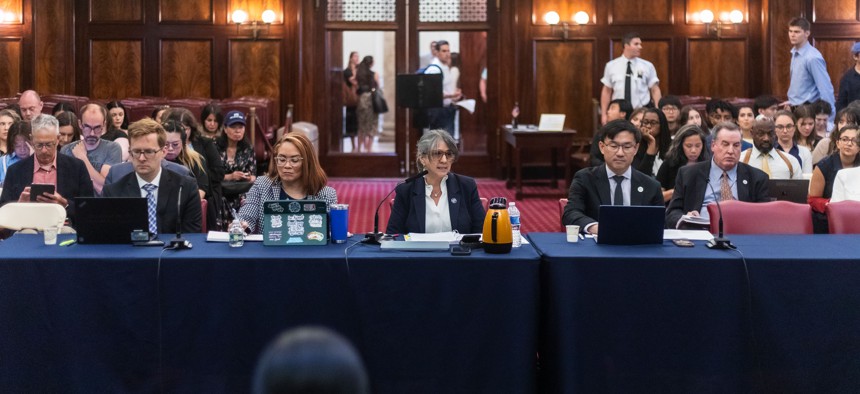
The New York City Council Committees on Technology and Education held a hearing about AI use in schools on Wed. June 24. Emil Cohen/NYC Council Media Unit


Twenty-nine members of the New York City Council released a letter this month supporting a two-year moratorium on artificial intelligence in New York City public schools. The letter called for a pause on the introduction of new AI ed-tech spending in our public schools, over concerns for student privacy and roadblocks to cognitive development. This demand isn’t just coming from one side of the political spectrum: Republicans to members of the Democratic Socialists of America signed onto the letter.
The broad council support reflects a deep community concern. Community Education Councils and local school boards across the city have been channeling the tidal wave of parental anger over AI into resolutions calling for a moratorium. In the districts we represent on City Council and the CEC, we heard concerns about the lack of information and consent on what AI platforms are being used in classrooms, lack of safety and privacy guardrails, lack of robust public engagement and, most importantly, the negative cognitive effects of AI on children.
At a time when student data privacy concerns are at an all-time high, under threat of federal immigration enforcement surveillance, we cannot gamble with unstable tech contracts. The New York state comptroller’s office issued a report on the technical failings of AI ed-tech programs, and how susceptible to data breaches they are. The report found at least 141 breaches of student data between 2023 and 2025. This creates a threatening learning environment, where students cannot feel secure participating in collective learning activities, for fear that it may put themselves or their families on the radar of unlawful immigration enforcement.
At April’s Panel on Educational Policy (PEP) meeting, where parents, teachers, and students came out in droves to voice their outrage about AI in city schools. Nearly 100 community members berated the Department of Education’s handling of this technology, in what Chalkbeat called “The AI Rebellion.” The meeting didn’t finish until 12:45 a.m., nearly seven hours after it started.
As more families have learned about how much AI is in their children’s classrooms, a movement has exploded across the city. More than 4,000 New Yorkers have signed a petition calling for a two-year moratorium. Seven CECs have issued resolutions demanding a two-year moratorium. Over a dozen organizations have joined the AIM coalition calling for a moratorium. And this isn’t just in NYC. Fairplay, a national organization dedicated to protecting kids from the harmful impacts of big tech, is calling for a five-year moratorium nationwide, and there’s a campaign in Los Angeles for a moratorium as well.
There’s been outrage in response to Schools Chancellor Kamar Samuels announcing he would beta test AI products on our children. In a viral video on Instagram, comedian and parent Ilana Glazer, who also spoke at the City Council rally, said that her heart would be broken if Mayor Zohran Mamdani did not stop the flood of AI into schools.
The DOE promised to listen to parents, providing a 45-day comment period for its “Guidance on AI.” This comment period began with a quiet announcement shortly before spring break. Although the DOE claimed it would seek meaningful input from families during those 45 days, it held zero public meetings, and most families remain unaware of the DOE’s new policy. The comment period ended not with a bang but a whimper: no results of the survey were released. Right now the year ends as it started. New York City schools are the wild forefront of AI – act-first policy without any understanding of the deep ramifications of this spending.
On Wednesday, at a joint hearing for the City Council’s Committees on Education and Technology, Council Members continued to ring the alarm. Several members echoed concerns about rushing to implement guidelines while AI is already in use in the classroom. To understand such a behemoth technology and its pervasive usage, DOE should take more time and consideration so we can prevent harm to our students.
Most importantly, AI ed tech fails at the one task it was designed for: educating our children. Students’ use of generative AI in 3K to 12 classrooms produces a net-negative impact on cognitive development, creativity, and critical thinking, according to research from the Brookings Institution’s Center for Universal Education. While the DOE pretends this is about equity, the children and families who will be most harmed by the racial bias, privacy violations and environmental pollution are the city’s Black and brown students.
Some school leaders claim that because AI is already out in the world, we must teach children how to use it responsibly. But we don’t need tech spending to teach the safety impacts to students. Many technologies that exist in the world are banned from schools, and the DOE has already developed clear protocols for other outside-of-school problems, like substance misuse, social media and inappropriate sexual behavior. New York City can and must do the same with AI.
We believe in standing up to the billionaires that have called the shots for our public institutions for far too long. We cannot continue to allow the Department of Education to fork over tens of millions of taxpayer dollars to big tech while ignoring the community's pleas to press pause on generative AI in New York City classrooms. Our children, our schools, and our climate need us to do better.
Alexa Avilés is a New York City Council Member representing District 38 in Brooklyn and former PTA president. Kelly Clancy is the parent of three children in NYC public schools, a member of the District 20 Community Education Council and the founder of Parents for AI Caution in Educational Spaces, which is part of the Coalition for an AI Moratorium in NYC Schools.
NEXT STORY: Editor’s note: The view from the top of ‘The Dink’