

Opinion
Opinion: Universal childcare means expanding after school programming too
New York City should double funding for new seats in the budget.
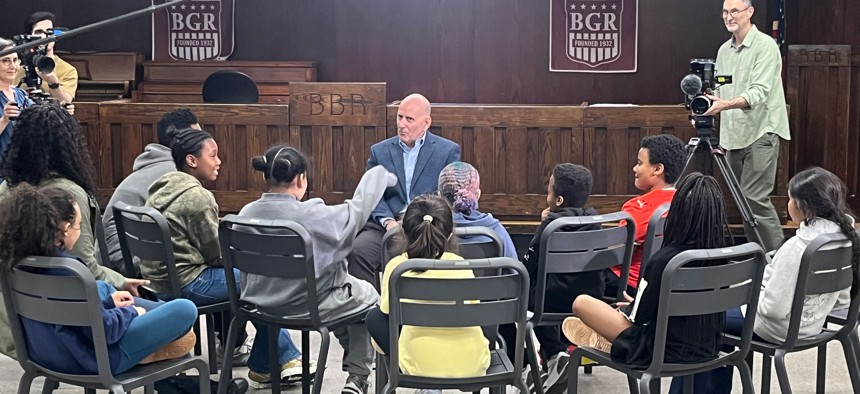
New York City Council Member Harvey Epstein talks to students Courtesy Henry Street Settlement


Earlier this year, New York City Mayor Zohran Mamdani and Gov. Kathy Hochul announced Universal 2K, a transformative investment aimed at confronting New York City’s affordability crisis and expanding access to early childhood education. But for working families, the childcare crisis does not end when the school day begins, or when it ends.
New York City parents, especially low-income minority families, are still struggling to piece together reliable, affordable care during the hours before and after school, often at enormous financial and professional cost.
Universal afterschool programming for K-8 students is the next essential step in building a city where families can truly afford to live and work. By treating afterschool programs as core public infrastructure, New York City can support working parents and caregivers, strengthen educational and developmental outcomes for children, and close the persistent access gap between affluent and low-income families.
Mayor Michael Bloomberg created the Out-of-School Time (OST) initiative in 2005, the first watershed moment for after school programming. Originally designed as a $200 million, three-year program, it grew into the nation's largest municipally-funded afterschool system, eventually reaching over 80,000 New York City youth. Mayor Bill de Blasio expanded funding for after school programs, particularly in middle schools, and established programming on NYCHA campuses and community centers, as well as the Summer Rising Program. Mayor Eric Adams invested $331 million into the COMPASS System, adding 20,000 more seats for students by 2028.
Today, New York City has an opportunity to move beyond piecemeal expansion and finally treat afterschool as the essential public infrastructure it is, especially as families citywide face a deepening affordability crisis. All elementary school families who qualify for Title I support should have access to free afterschool programming. An estimated 250,000 K-5 students qualify for free or reduced-price lunch (one status determining need), yet the current plan funds only 184,000 seats, leaving a gap of roughly 66,000 students even if every seat goes to high-need families.
To close this gap, the city should fund 20,000 additional seats in fiscal year 2027, instead of the proposed 10,000, and add 20,000 more seats over the following three years to ensure universal access for all Title I elementary school students by 2030.
The problem goes beyond a shortage of seats. Many families choose schools not based on educational fit, but on access to free or low-cost afterschool care through Title I programs, creating an illusion of choice while forcing impossible tradeoffs between childcare costs, limited program availability, and work decisions shaped by strict income eligibility rules. Families in the Bronx and Brooklyn face the highest childcare burdens in the city, with some spending up to 63% of their income on care, and many are effectively penalized for earning slightly more while still unable to afford private alternatives, causing significant socioeconomic stratification.
In practice, this system reinforces racial and socioeconomic segregation by concentrating low-income families in Title I schools. Schools and community organizations are then forced to ration access due to insufficient funding, leaving care dependent on arbitrary eligibility rules and limited seats rather than family need. Treating afterschool programming as a means-tested benefit instead of a universal public good deepens the inequities and segregation the city claims to oppose.
Moving toward universal afterschool cannot succeed without first addressing the foundational challenges that have long plagued the afterschool community. Providers have spent years raising concerns about late payments delays that can stretch into years placing serious financial strain on their operations. Many have been forced to take out loans simply to keep their doors open. The city must invest in modernizing its procurement infrastructure to ensure that providers receive timely, reliable payments. A system that depends on providers absorbing financial risk is not a sustainable one.
Staffing challenges are not new to the afterschool field or the broader human services sector, but the COVID-19 pandemic has significantly worsened recruitment and retention. Providers continue to report persistent shortages that compromise their ability to meet contractual obligations and, more importantly, to effectively serve the youth and families in their communities.
To address this, the city must take proactive steps, including building a talent pipeline by prioritizing pathways for young people to enter and grow within the afterschool workforce nS partnering with CUNY to provide support, training, and professional development that elevates and professionalizes the sector.
Universal afterschool is an achievable and worthy goal but it must be built on a foundation strong enough to hold it. This is not only a matter of convenience for working families, but a necessary step toward educational equity, economic stability, and child well-being. With targeted expansion now and a clear commitment to full coverage by 2030, New York can finally treat afterschool care as the essential public good it should be.
Harvey Epstein is a New York City Council Member representing District 2 in Manhattan. Althea Stevens is a City Council Member representing District 16 in the Bronx. And Jessica González-Rojas is an Assembly member representing District 34 in Queens.
NEXT STORY: Opinion: Dems and GOP agree, we need an AI moratorium