

Opinion
Opinion: It's time to end horse-drawn carriages in New York City
After crashes, deaths and chaos, the City Council must pass Romanch’s Law.
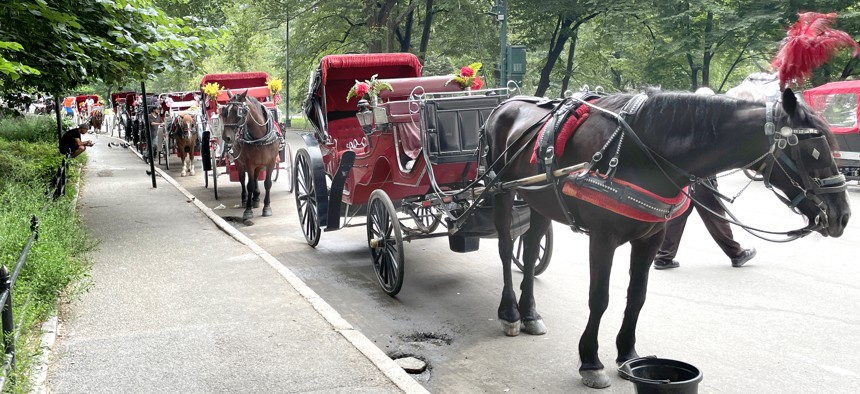
Horse-drawn carriages line an entrance to Central Park. Deb Cohn-Orbach/UCG/Universal Images Group via Getty Images


Editor’s note: After this article was initially published, City & State learned that this op-ed was partially written with the use of generative artificial intelligence, which violates our guidelines.
For years, animal welfare advocates, public safety experts and elected officials have warned that New York City's horse-drawn carriage industry was a tragedy waiting to happen. Last month, that warning became a heartbreaking reality.
On June 17, 18-year-old Romanch Mahajan was killed after a carriage horse bolted through Central Park, crashed into traffic at the 59th Street intersection and struck multiple vehicles. What should have been a family vacation celebrating his graduation ended in unimaginable loss. Our hearts remain with Romanch's loved ones, whose lives have been forever changed by a preventable tragedy.
His death was not an isolated accident. It was the foreseeable consequence of forcing animals with powerful flight instincts to pull carriages through one of the busiest, loudest and most congested cities in the world.
This latest tragedy follows years of dangerous incidents that have repeatedly put New Yorkers, tourists, carriage passengers, drivers and horses at risk. In the last year alone, eight carriage horse emergencies unfolded in Central Park as horses spooked, broke loose and crashed, causing injuries and widespread panic.
Over Labor Day weekend last year, chaos erupted when a frightened horse threw its driver to the ground and sped through the park with two tourists trapped inside the carriage. The horse slammed into a metal pole, forcing the passengers to jump from the moving carriage to save themselves. One was injured. They later said they feared they were going to die. The horse then barreled onto a crowded lawn where families scrambled for safety, including a pregnant woman celebrating her baby shower who narrowly avoided being struck. The terrifying footage spread across the country, underscoring how easily that incident, too, could have ended in tragedy.
Now it has.
The cruelty extends beyond these public crashes. Too many horses have collapsed and died on our streets, their suffering unfolding in full view of New Yorkers and visitors alike. Others endure lives confined to cramped stables without the open pasture, grazing, movement and social companionship that horses need to thrive.
This suffering is entirely preventable.
Romanch’s Law, formerly Ryder’s Law, would responsibly phase out horse-drawn carriages, relocate horses to accredited sanctuaries and rescue homes where they can finally live as horses should and provide a just transition for workers. Council members have already been in conversations with the administration about how to connect carriage drivers, who are not unionized, with good union jobs that offer stable pay, benefits and real workplace protections. We have also been in communication with several horse sanctuaries that are prepared to take in the horses and generously compensate owners for them. This is not about leaving workers behind or creating uncertainty for the horses. It is about ending a dangerous industry in a responsible way that protects the public, supports workers and gives the horses a safe and dignified future.
We should not have needed another tragedy to prove the point.
Romanch Mahajan should still be alive. His death is a devastating reminder that this issue has never been solely about animal welfare. It is also about public safety. Every day this industry continues, New Yorkers, tourists, workers and horses remain at risk.
New Yorkers are ready to turn the page. Recent polling shows that an overwhelming majority of residents support ending horse-drawn carriages. Cities across the United States – including Chicago, Philadelphia, Las Vegas, Salt Lake City, Key West and San Antonio – have already done so, as have major cities around the world like Toronto, Montreal, Paris, Barcelona, Brussels, Shanghai and Mumbai.
Momentum is now building inside City Hall as well. Speaker Julie Menin just announced her support for Romanch’s Law, the bill continues to gain additional cosponsors and the City Council will hold a hearing later today on how to move forward. After decades of delay, the council now has the chance and the responsibility to act.
The question is no longer whether tragedy could strike again. It already has. The City Council must pass Romanch’s Law before another family pays the price.
Christopher Marte is a New York City Council member representing District 1 in Manhattan and the prime sponsor of Romanch’s Law. Harvey Epstein is a City Council member representing District 2 in Manhattan and the co-chair of the Animal Welfare Caucus.
NEXT STORY: Editor’s note: De Blasio talks to the Irish, Italians and Mamdani