

Opinion
Commentary: The political arrival of Muslim New York
Historian Asad Dandia writes about how the Muslim community has come full circle, from being surveilled by the NYPD to now leading the city.
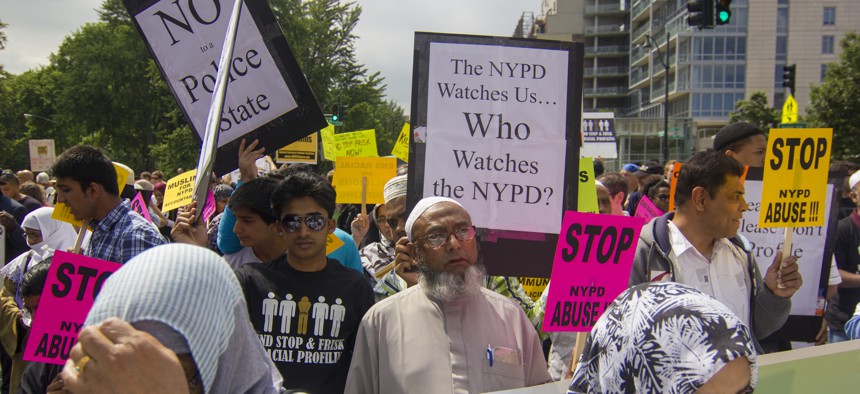
In the aftermath of 9/11, stop-and-frisk policing and the surveillance of Muslim communities created a lot of harm across New York City. Tony Savino/Corbis via Getty Images

In the lead-up to the 2021 New York City Democratic mayoral primary, candidate Eric Adams showed up to a late-night religious service at a Muslim community center under the Brooklyn-Queens Expressway in Sunset Park, Brooklyn. It was the 27th night of Ramadan, a night that most Muslims often hold to be “Laylatul Qadr” – the Night of Destiny – marking the night when the Quran was first revealed to the Prophet Muhammad. For most Muslims the world over, it is the most sacred night of the year, spent entirely in prayer and reflection. Up until that point, no candidate for mayor had campaigned on the Night of Destiny, let alone knew of its significance to Muslims. Adams became the first in the city’s history to do so, and that night, he spoke pointedly but warmly about having the community’s back when they were targeted by police surveillance, religious discrimination, and Islamophobia. He would win the election later that year, carrying the votes of the outer borough ethnic enclaves, labor unions and the business community, while losing with college-educated progressives. For many Muslim New Yorkers, it felt as though they had finally made it as a political force.
This was an unusual experience for a community that isn’t considered part of the city’s traditional or legacy “ethnic blocs.” Islam, of course, is not an ethnic group, and unlike Jews, Muslims are not an ethnoreligious community. Thus, to categorize the community as a singular bloc poses challenges: The diaspora comprises people from dozens of Muslim-majority countries, converts of countless nationalities (the fastest growing are Latino), and of course Black American Muslims, who were the first Muslims on this continent. But if there was a precipitating moment that galvanized them all to cohere as one, it was the aftermath of the Sept. 11, 2001, terrorist attacks.
Scholars who write about Islamophobia in the United States will often say that Islam and Muslims are racialized. This means that even if they come from various ethnic or racial backgrounds, state policy and mainstream pop culture understood them as one. Of course, Muslims have their own internal unifying discourses (Muslims think of themselves as part of an “ummah” in the same way that Jews think of themselves as part of an “am”) but nothing united them politically like the shared experience of being targeted by the state for their religion. After 9/11, one could say that a Bangladeshi from Ozone Park, a Yemeni from Bay Ridge, a Gambian from Fordham Heights, an African American from Bedford-Stuyvesant and an Albanian from Tompkinsville might be part of the same organized community – Muslim New Yorkers.
As a late millennial, I came of age in a city where these social and political realities were the norm, and it completely altered the course of my life. In late 2011, when I was a college student, my friends and I started a faith-based charity organization, Muslims Giving Back, aimed at delivering food and groceries to poor families. In March 2012, a young South Asian man my age – 19 at the time – based in Queens messaged me on Facebook asking if he could participate in our work. I received these requests often from young Muslims wanting to get involved in service work that was grounded in faith, so I introduced him to my organization and friends’ group.
About a month later, an older brother figure in my neighborhood wanted to share something with me in confidence. This person was a police officer, and one evening while he was off duty, we met at our mosque and he took me into his car (but not without shutting both our phones off and throwing them into the trunk) to tell me that the NYPD was watching me, and that his precinct had a file with my name and photos in it. He asked me to be careful in my work, knowing full well how police can target our communities. Later that month, I had heard from another source that we were being surveilled. We decided we’d shut down the organization after a major summer event we had planned. But the organization continued to grow, and we were on cloud nine, so we decided to continue working.
In October 2012, as I returned home from delivering food, I received a text inviting me to check Facebook. When I did, I saw a Facebook status confession from the young man from Queens admitting to being an informant sent by the NYPD to investigate terrorism. My entire community was shattered. Shortly thereafter, I received an email from some civil rights attorneys at the CUNY School of Law who wanted to speak with me, and when we met, they had told me that they were working on a lawsuit to challenge the NYPD for targeting Muslims, and that they wanted me as a plaintiff. One of those lawyers was Ramzi Kassem.
Few New Yorkers were cognizant at the time – and perhaps not many know today – that the New York City government under the leadership of Mayor Mike Bloomberg implemented a widespread surveillance program targeting Muslim New Yorkers. Our mosques, restaurants, student groups and nonprofit organizations were all infiltrated by plainclothes informants. Not a single terror lead was found, but relationships and communities were completely torn apart.
It was personal for me. Imagine coming home one night to find out that a person whom you invited into your home, introduced to your family, broke bread with, shared intimate conversations with, and had sleepovers with was a government agent reporting on your activity to a police handler as if you were part of a sleeper cell.
I decided to join the class-action lawsuit, which was also being led by the American Civil Liberties Union along with CUNY, and the next few years – the entirety of my early 20s – were spent fighting back against these civil rights violations, which were a threat not just to Muslims but to all New Yorkers. After years of a protracted battle, we secured a settlement containing several policy changes in 2017, bringing an end to the discriminatory surveillance of Muslims and completely changing the course of the city’s history. It marked a turning point in the history of Muslim New York and paved the way for what was to come nearly a decade later.
In the summer of 2024, another South Asian millennial had reached out to me to seek my advice for an idea he had. This one wasn’t a spy. His idea was to run for mayor of New York City, and he wanted my help. Adams – who was the first to recognize that Muslims were essential to the city’s fabric – had been embroiled in federal indictments and corruption charges, and much of the community felt betrayed by him by what they felt was his one-sided approach to the war in Gaza. For Zohran Mamdani, a bona fide pro-Palestinian activist, this was an opportunity to offer a more humane approach.
The Assembly member wanted to chat about the possibilities of his mayoral campaign, his path to victory and an important question that few in New York politics have ever had to consider: how to galvanize the Muslim vote. We were initially going to meet at Qahwah House in Greenwich Village, but changed to Caffé Reggio, because a Yemeni coffee shop would’ve been the worst place for two Muslims to hold a secret meeting. We spoke at length, and a week or two later, he called to recruit me to his “kitchen cabinet,” a political campaign term referring to one’s informal advisers.
The press makes a mistake when it assumes that the Muslim vote was guaranteed for Mamdani. It was not. He happens to be a Shia, a democratic socialist and a theological progressive. Most Muslims are not all those things. But most Muslims also do not have views that are fixed. The great thing about politics is people can be moved and change.
Over the course of his campaign, Mamdani spoke at over 50 mosques (citing me by name as his friend through one of my tweets in every stump speech he gave), and on the last Friday before the Democratic primary, had 300 volunteers at roughly 136 mosques in the city, marking the largest Friday prayer canvas in American history. He went on to win about 90% of the Muslim vote, according to The Associated Press, leading to jokes that he won democratically in the overwhelming way Arab dictators win undemocratically by putting up “Assad numbers” in these communities.
For Muslim New Yorkers, 9/11 was a precipitating event. Now, 25 years later, and nearly 10 years after the success of our lawsuit, we have a Muslim mayor of New York City. Kassem, who is his chief counsel, was also my attorney when we sued the NYPD. In a classic New York story, Muslims have progressed from suing the government to leading the government. On the Night of Destiny, Adams understood that Muslims are essential to New York City. But destiny would have it that Mamdani would be the one to raise the profile of Muslim New Yorkers more than any other mayor before him. We finally made it.
Asad Dandia is the founder of New York Narratives. He also leads guided tours at the Museum of the City of New York, teaches NYC history at CUNY, and serves as the official Brooklyn Borough Historian. Like a true Native New Yorker, he still does not have a driver’s license.
NEXT STORY: Editor’s note: Spotting Samuelsen’s strategy