

Opinion
Opinion: Netanyahu is coming to NYC. How should our elected officials respond?
Local officials can’t arrest Netanyahu, but there’s still so much we can do to cut off U.S. funding for Israel.
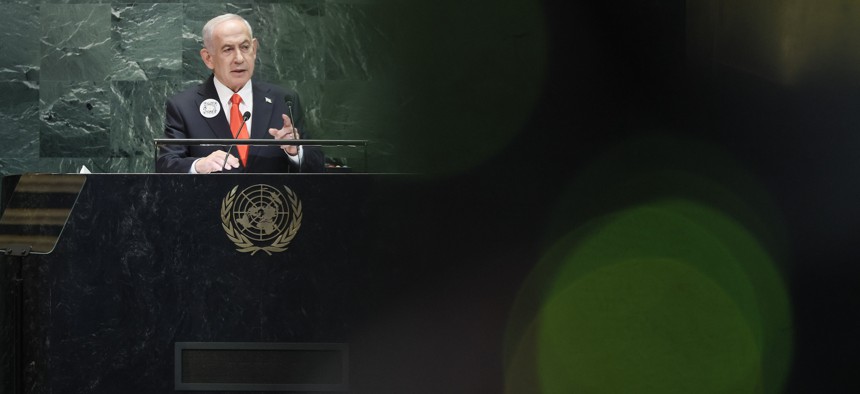
Israeli Prime Minister Benjamin Netanyahu speaks at the U.N. General Assembly on Sept. 26, 2025. Michael M. Santiago/Getty Images


This week, New York City is welcoming world leaders for the 81st session of the United Nations General Assembly. One of them is Israeli Prime Minister Benjamin Netanyahu, who is wanted for arrest by the International Criminal Court for war crimes and crimes against humanity in Gaza.
Mass public pressure has forced Netanyahu to change his travel plans for this year's visit, shortening his trip to just 24 hours to deliver a speech where he plans to defend Israel's horrific crimes in Gaza and Iran. The pressure comes from protests planned by activist groups across the city and opposition from New York City Mayor Zohran Mamdani, who has called on federal authorities to arrest Netanyahu under the ICC warrant, since the city itself lacks the legal authority to do so.
Even though local officials don’t have the jurisdiction to execute the warrant, there is still so much we can do to cut off the U.S. funding to Israel that has bolstered Netanyahu and his regime’s ongoing genocide against Palestinians. That’s why I decided to run for office myself: to challenge the status quo and transform politics as usual.
This past June, I was elected to be the Democratic nominee for state Senate representing Western Queens, and could become the first Palestinian American to win elected office in New York this November. I’ve spent my life advocating for Palestinian rights by organizing protests, lobbying elected officials, and most recently, co-authoring the Not On Our Dime bill introduced by then-Assembly Member Zohran Mamdani and state Sen. Jabari Brisport to stop New York state from subsidizing Israeli settlements and war crimes.
While it’s been disheartening to see so many of my future colleagues in Albany remain silent on Netanyahu’s visit and our state’s complicity in genocide against my people, I also know it’s nothing new. Before Oct. 7, 2023, few politicians I’d met with were willing to speak up for Palestinians, and even fewer were willing to co-sponsor the Not On Our Dime legislation when it was first introduced in 2023, the bill faced immense backlash from Democratic leaders in the state legislature.
In the three years since then, there’s been a sea change in public opinion, with more Americans than ever turning against the brutality of the Israeli apartheid regime funded with our tax dollars. Mamdani’s outspokenness against the genocide in Gaza and his focus on affordability and fighting for dignified lives for New Yorkers is what propelled him to his historic victory last year. However, many of our leaders are still greatly out-of-step with the constituents they represent. With midterm elections quickly approaching, they would be wise to take note, particularly if they want to mobilize the masses needed to defeat fascism at the ballot box.
As the chief architect of the ongoing genocide in Gaza that has killed more than 74,000 Palestinians in the last three years, Netanyahu must be arrested and held accountable for his actions. It should be an easy demand for elected officials to make. At the same time, however, it won’t stop the war crimes and violence committed against Palestinians. Netanyahu is one man – a leader of a country full of officials and a military who are seizing people’s homes, abusing prisoners and bombing hospitals. Israel’s apartheid regime didn’t start when it invaded Gaza after Oct. 7; it has existed for more than 78 years. And just like leaders of the past, Netanyahu can be easily replaced, and bombs would resume dropping the next day.
In addition to accountability, we need systemic change and to utilize all of the tools at our disposal to cut off U.S. support for the state of Israel. New York legislators are far from powerless, and any who claim to have no influence over Israel’s actions are either speaking in bad faith or just simply ignorant of where our tax dollars go to.
Passing the Not On Our Dime Act is one way elected officials can take action and support Palestinians. In May, Brisport and newly elected Assembly Member Diana Moreno reintroduced the bill, picking up stronger momentum that reflects how the tides are changing in the halls of power with regard to Palestine. However, nine Assembly cosponsors and three in the state Senate are not enough. We need more legislators to back policies like Not On Our Dime to divest our taxpayer dollars from Israeli war crimes and invest them in our communities and in our city.
Beyond divestment, elected officials must also act to stop weapons transfers happening right here in our own city. Organizers with NYC-DSA’s Break the Chain are sounding the alarm over military cargo that is being shipped out of John F. Kennedy Airport to weapons manufacturers in Tel Aviv. According to reports from The Intercept, explosive material like grade A nitrocellulose is sharing the same runways as passengers and workers, putting countless lives at risk. As state legislators, we owe it to our constituents who are funding the airport with their taxpayer dollars to demand accountability from the Port Authority and all complicit airlines, and to halt all shipments that are being used to aid Israel’s ongoing genocide.
We can learn a lot of lessons from the international solidarity movement that organized against apartheid in South Africa. In the 1970s and ’80s, our government was resistant to backing comprehensive sanctions on the brutal apartheid regime, with most legislators happy to continue our economic relationship while offering meaningless platitudes about the evils of racism. There were of course representatives who saw the moral necessity of action before the rest of the country, including the Congressional Black Caucus who introduced anti-apartheid legislation in 1972 and Assembly Member Herman Farrell who pushed for divestment on the state level.
Due to pressure from people mobilizing in the streets, lawmakers were forced to take action, and in 1986 the Comprehensive Anti-Apartheid Act was passed over Reagan’s veto, finally implementing robust economic sanctions that cut off the financial enabling of apartheid. As anti-apartheid activist Nelson Mandela once said, it is often a long walk towards freedom. In response to pressure campaigns targeting corporations, cultural institutions, banks and other countries around the world, the apartheid government finally gave in and the apartheid system was formally dismantled in the 1990s.
Today, the fall of South African apartheid is celebrated as part of a movement towards a more just society, and it reminds us of how organizers on the street can push lawmakers to take action. The fight for lawmakers to act in divesting from Israel and supporting Palestinian human rights is similarly a moral calling. Like South Africa, the collapse of Israel’s own apartheid regime is inevitable, and we have the power to make it happen.
Aber Kawas is the Democratic nominee for state Senate District 12.
NEXT STORY: Publisher’s note: Groundbreaking journalists drove City & State’s past 20 years