

Opinion
Opinion: The best response to measles is action before crisis
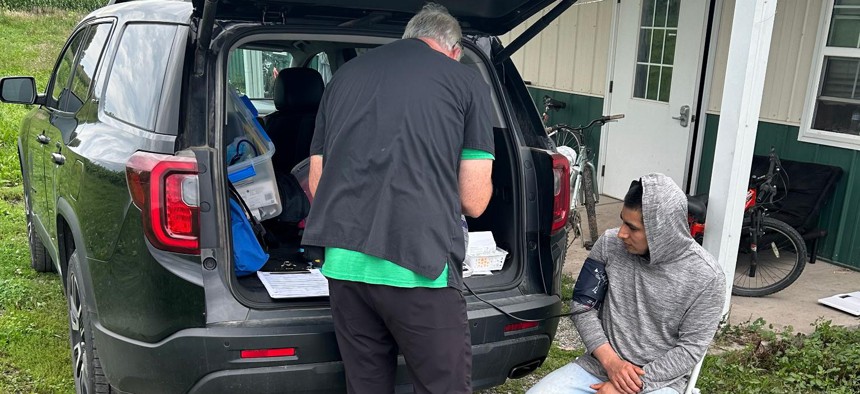
An Oak Orchard Health staffer takes a farmworker’s blood pressure. Courtesy of Oak Orchard Health

Twenty-six years ago, measles was declared eliminated in the United States. It was one of the great public health achievements of a generation.
Today, measles is back.
Across the country, communities are confronting outbreaks of a disease that many Americans assumed belonged to another era. More than 3,000 confirmed cases have been reported nationally this year, and here in New York, cases are rising, including in rural communities.
That should concern all of us. But it should also force us to ask an important question: When we know a public health threat is coming, do we wait for vulnerable people to find their way into our healthcare system, or do we bring healthcare to them?
At Oak Orchard Health, we recently had to answer that question.
When measles cases emerged in Allegany County, our team immediately began thinking about the people who might be most at risk. In the rural communities we serve, agriculture is a critical part of the economy. That means thousands of seasonal and migrant agricultural workers live and work throughout our region.
These individuals are essential to our communities and our economy, but they can also face significant barriers to accessing healthcare. Some have moved between states or countries and may not have ready access to immunization records. Many live and work in close proximity to one another. Transportation, language, work schedules and the transient nature of seasonal employment can all make traditional healthcare delivery more difficult.
Waiting for those patients to come to us was not good enough.
Our medical, nursing and patient engagement teams, including staff who regularly work directly with seasonal agricultural workers, came together to determine what we could do. Within roughly 10 days, they developed protocols, identified resources, coordinated through existing state vaccine programs, mobilized our staff and deployed a mobile vaccination effort near the affected area.
The first deployment vaccinated 80 people. Another 40 are scheduled to receive vaccinations over the following 10 days. In total, the effort is reaching workers across four farms in Allegany, Steuben and Wyoming counties.
Those numbers matter. They represent healthcare meeting people where they are.
Measles is among the most contagious diseases we know of. According to the CDC, as many as nine out of 10 people who are not immune can become infected when exposed to someone with measles. It can also cause serious complications, particularly among young children and other vulnerable populations.
In an environment where public health information can quickly become entangled with politics, misinformation and distrust, healthcare providers have a duty to stay focused on patients.
We do not need to win a political argument before protecting a community. We need to provide credible information, make care accessible, answer questions honestly and give people the opportunity to protect themselves and their families.
That sometimes requires a shift in how we think about healthcare.
Our system is often extraordinarily good at responding once someone becomes sick. But community health cannot simply be reactive. Sometimes the most important patient is the person who has not yet walked through our doors.
Federally Qualified Health Centers understand this particularly well. We care for people who can too easily become invisible within a traditional healthcare system including agricultural workers, rural families, people without reliable transportation, people facing language barriers and people who may delay care because accessing it is simply too difficult. Serving those communities means being willing to leave the walls of the health center behind.
I am incredibly proud of the Oak Orchard team for recognizing a potential danger and acting quickly. Nobody waited for the situation to become a crisis or asked whether responding would be convenient. Our team saw people who could be at risk, developed a plan, loaded the necessary equipment and supplies and went to them.
That is what public health looks like at its best.
The return of measles is a reminder that progress in public health cannot be taken for granted. But it is also a reminder of what is possible when local healthcare providers know their communities, earn their trust and have the resources and flexibility to respond.
Sometimes protecting a community means seeing a problem, deciding that someone needs to act and choosing to be the one who does.
Marco Altieri is the CEO of Oak Orchard Health, a Federally Qualified Health Center serving over 50,000 patients.
NEXT STORY: Goo-goos press Mamdani to take action on corruption