

Opinion
Opinion: Don’t let the Hunts Point Market deal die in transition
It took years to develop the institutional knowledge and trust necessary to reach a $650 million deal to modernize the Hunts Point Produce Market – and only a few months of transition to lose it.
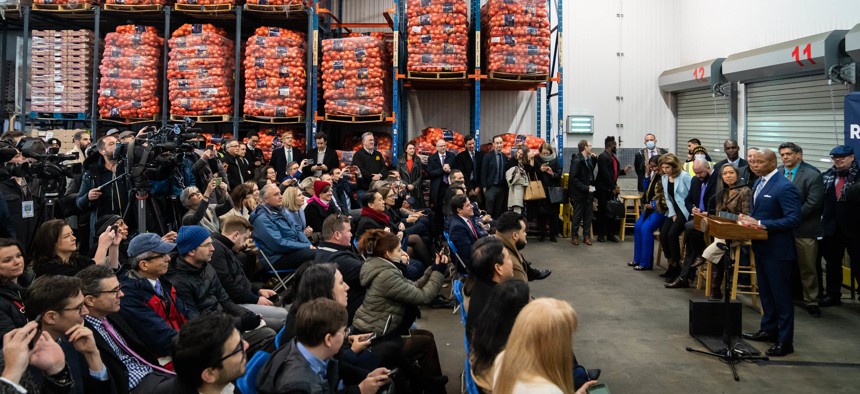
Former Mayor Eric Adams holds a press conference at the Hunts Point Produce Market on March 10, 2022. Ed Reed/Mayoral Photography Office


If you’ve bought a banana in a bodega, an apple from a greengrocer or fresh salad from your favorite lunch spot, chances are that produce traveled through a 100-acre campus in the South Bronx – the Hunts Point Produce Market, which handles an estimated 25% of all fresh produce entering the city.
This indispensable piece of New York’s food supply chain operates from archaic buildings constructed nearly 60 years ago. The facility is inefficient and inadequate for a market serving one of the largest and most complicated food systems in the world. Its operations also contribute to the truck traffic and diesel pollution that residents of Hunts Point have long endured.
For many decades, city leaders, market businesses, community advocates, labor unions and elected officials have agreed that the Produce Market must be modernized. The most recent redevelopment effort came closer than any before it.
Over the last four years, the city, state and federal governments committed more than $400 million alongside an additional $225 million federal loan, the first of its kind, premised on a new long-term lease with the Market. A design-build team was selected to create a modern, all-electric facility, renderings of which were unveiled in December. The project promised to create more than 2,000 union construction jobs, improve the resilience of the city’s food supply and reduce harmful emissions in the South Bronx.
After years of technical work and difficult negotiations, the city and the Market together announced an agreement at the end of 2025 intended to move the redevelopment forward.
On Tuesday, Gothamist reported that the Market voted down the roughly $650 million project over the summer, putting the redevelopment and public funding in jeopardy. Later that morning, Mayor Zohran Mamdani said on WNYC that “this iteration is not one that’s moving forward,” while emphasizing that meetings with the cooperative continue and the city has not given up on electrifying and modernizing the market.
I helped negotiate with the Market on behalf of former Mayor Eric Adams’ administration. I understand why the Market matters and how difficult it was to get this far.
This is not a moment to assign blame or relitigate every decision that brought us here. Large public projects are complex and dynamic. Negotiations reach impasses. The longtime businesses at the Market are faced with the daunting task of balancing their futures with maintaining their day-to-day operations.
A new mayoral administration also has the right – and the responsibility – to review major commitments made by their predecessors. Fresh scrutiny can uncover better approaches, protect public dollars and ensure that projects reflect the current priorities.
But there is a difference between reassessing a project and starting from scratch.
Complex public projects accumulate value long before a shovel is put in the ground. That value is not just in dollars appropriated, but also in hard-fought consensus achieved, alternatives evaluated, compromises negotiated, regulatory hurdles resolved and relationships built among parties. At Hunts Point, it meant years around the boardroom table at 772 Edgewater Road, working through questions of cost, design, financing and how businesses could keep operating during construction. It takes years to develop that institutional knowledge and trust – and only a few months of transition to lose it.
New York cannot afford to repeatedly discard this accumulated momentum whenever leadership changes. Our largest and most complex infrastructure, housing and economic development projects routinely take longer than the tenure of any mayor, deputy mayor, council member or agency president. If each transition sends complicated projects back to the drawing board, the city will struggle to complete anything that requires sustained cooperation.
Hunts Point illustrates why continuity is essential. The underlying need has not changed at all: New Yorkers still depend on the Market. Its businesses and workers still need a facility capable of serving the region into the future. Hunts Point residents still deserve relief from diesel pollution and congestion. And the city still has an extraordinary opportunity (although now a narrow window) to leverage substantial state and federal resources to modernize its own infrastructure.
To be clear, I am not saying that the prior plan must be accepted without modification. If elements of the prior deal no longer work, the parties should say so candidly and determine what can be changed. If the project must be phased, redesigned or restructured to accommodate the concerns of the Market businesses, those options should be evaluated. City leaders should establish a focused and time-bound process for resolving remaining differences.
What cannot happen is for the project to quietly lose momentum while deadlines pass, funding becomes vulnerable and the knowledge built over years disperses.
Mamdani and New York City Economic Development Corporation should promptly bring the parties back to the table, with seats for the Produce Market, labor (especially the Teamsters, whose support was critical), community representatives, local elected officials and state and federal funding partners. The objective should not be to resuscitate the previous agreement, but to identify what is needed to preserve a path forward.
New York has invested too much and come too close to allow this opportunity to slip away. The task now is not to preserve any individual official’s plan or legacy. It is to preserve an essential public asset and finally deliver the modern market that Hunts Point and the entire city need.
Nate Bliss served as executive director for economic development in the Adams administration and held economic development roles under mayors Michael Bloomberg and Bill de Blasio. He is the founder of Latent Urban Ventures.
NEXT STORY: Opinion: Meeting the moment for New York’s homeless youth