

Opinion
Opinion: The quiet whitewashing of history at Bowling Green
Why New York must defend the Museum of the American Indian
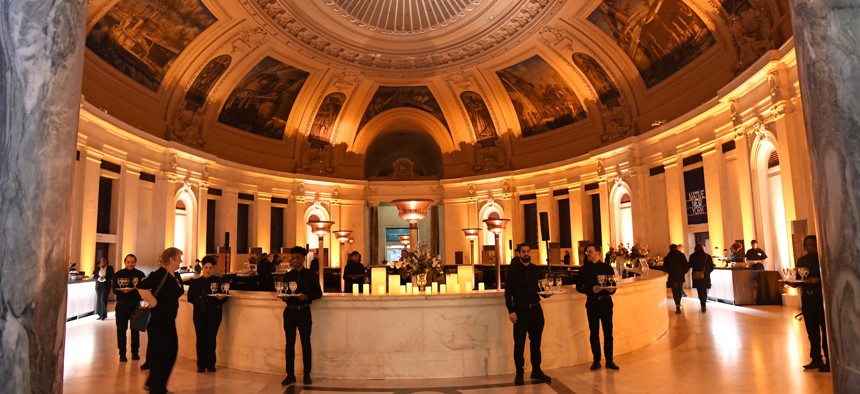
A view of the rotunda of the Museum of the American Indian in Manhattan on March 6, 2025. Noam Galai/Getty Images for AMC Networks


Over the past month, New York City has publicly celebrated the enduring cultures of North America’s First Peoples. In September, a herd of life-size buffalo puppets marched from Bowling Green through lower Manhattan – a massive public art spectacle created with Lakota and Lenape elders to symbolize Indigenous resilience. Days ago, the Museum of the City of New York opened a major exhibition, timed with a Prospect Park Pow Wow, designed to remind New Yorkers that the Lenape are a living contemporary presence, not a historical relic.
But inside the U.S. Custom House at Bowling Green, the New York branch of the Smithsonian’s National Museum of the American Indian is being quietly whitewashed.
For over twenty years, I climbed those steps to find sanctuary. It also became a classroom. Bringing my ten-year-old son through the museum's halls, I watched him learn that the ground beneath our feet held thousands of years of memory long before it was paved in asphalt.
Lately, however, the museum appears less like an open forum for cultural scholarship and more like an institution in political retreat. It reflects the chilling effect of the Trump administration’s persistent campaign against the Smithsonian and other federal cultural institutions, which treats honest historical reckoning as subversive and pressures museums to trade complex truths for an uncritical, sanitized patriotism.
That shift is clearest in the rotunda. This central space historically showcased prominent Indigenous artworks and exhibitions that presented First Peoples on their own terms. For much of this year, however, those works were supplanted by a timeline dedicated to Native American military service. Indigenous communities hold a distinguished record of armed valor. But eclipsing foundational art and sovereign history with an exhibition on wartime loyalty carries a cynical subtext, suggesting that Native heritage is most welcome in federal halls when measured by devotion to the state that dispossessed them.
Beyond the rotunda, galleries that once offered unvarnished histories and complex exhibitions are cordoned off behind “Closed for Renovation” placards. Curators and retail managers across federal trusts know that under current policy, having titles that explore “stolen land,” two-spirit gender traditions or colonial violence can trigger congressional hearings, budget threats and public boycotts.
When my son asks why those rooms are blocked, it is hard to explain that the closures seem less about structural repairs than intellectual containment.
One of the few candid historical accounts still standing details the 1779 Sullivan Expedition. It plainly documents George Washington’s orders to execute the “total destruction and devastation” of Haudenosaunee settlements – a scorched-earth campaign that burned 40 Iroquois towns and earned Washington the Haudenosaunee title Conotocaurious, or “Town Destroyer.”
Even this panel faces mounting pressure. It recently drew an alarmed Fox News headline: “Smithsonian’s dark take on America exposed.” Such rhetoric aims to manufacture outrage and pressure the Smithsonian to purge exhibits deemed insufficiently celebratory.
Defending this museum is about defending the intellectual sovereignty of First Peoples. Native societies created farming innovations that reshaped global food systems and practiced sophisticated ecological management. The Haudenosaunee Great Law of Peace established a framework of participatory democracy that directly informed the American Constitution. Flattening Native history into either a recruitment campaign or a catalog of victimhood erases this genius.
What makes this capitulation so alarming is New York's silence. Our civic, academic and philanthropic leaders have largely looked the other way, even as the museum is dismantled. Yet both of New York’s top elected executives have recently positioned themselves as champions of Indigenous recognition.
Gov. Kathy Hochul traveled to the Seneca Nation to formally apologize for the state’s role in the Thomas Indian School, while ordering a review of Indigenous representation in the State Capitol and completing a historic land agreement with the Saint Regis Mohawk Tribe.
Mayor Zohran Mamdani has likewise made the recovery of marginalized histories part of his civic language. In marking America’s 250th anniversary, he began New York’s story not with European settlement but with the Lenape people who inhabited these lands long before the city bore its present name.
For both the governor and the mayor, intervening to defend the museum would be a powerful way to back up those words and actions. The institution is an integral part of New York’s cultural composition. Commanding two of the most potent political bully pulpits in the country, they must exert public pressure on Smithsonian leadership, demand clear answers about these exhibit closures and make clear that New York will not quietly accommodate federal censorship.
When I walk up those steps with my son, I want him to confront America’s history honestly. But I also want him to marvel at the wisdom, art and complexity of North America’s First Peoples. If Albany and City Hall refuse to protect the truth at the foot of Broadway, they are signaling that every cultural institution in this city is open to political compromise.
Andrew Holt is the former publisher of City & State.
NEXT STORY: Opinion: We need transformative responses to sexual violence