

Editor's Note
Editor’s note: 333 pages down, in ‘Power Broker’ marathon reading
New York City’s arts culture is strong, as long as people keep doing weird things.
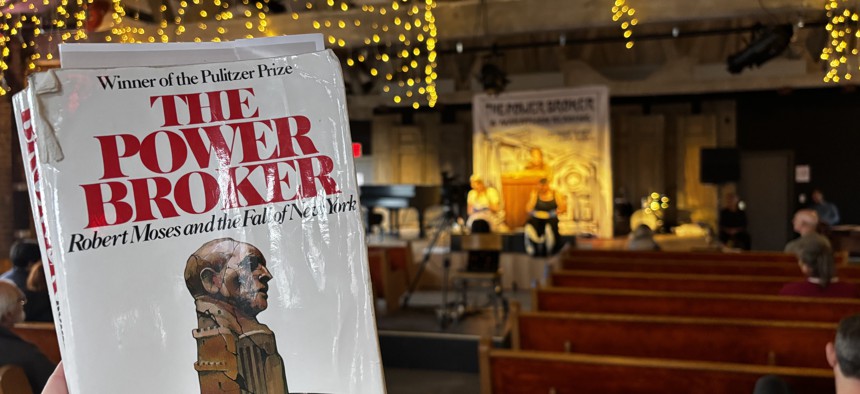
You didn't have to bring your own copy, but I did just in case. Jeff Coltin



Joining the ranks of “Fiorello!” and “Rent” in performances broadly inspired by New York politics is a new entry: the 3 1/2-day nonstop marathon reading of “The Power Broker.”
I filled a 10-minute slot Friday afternoon, reading an evocative passage detailing just how decrepit New York City’s parks were in 1932, before Robert Moses took over. “Scabs on the face of the city,” as the author Robert Caro put it, on page 331 (of 1,162).
The marathon reading is a labor of love by Brad Vogel, director of special projects at Judgy Baby, the church-like Gowanus arts space, yet to formally open, that hosted the event.
“It is the epic that tells you so much about the place. Where are the fault lines? Who are the players and interests that just keep recurring?” Vogel said. “That’s why it was worth uncorking the bottle of wine, so to speak, swishing it around the glass and smelling it anew.”
Reviewing the names of the 400-odd readers, in minuscule font on the playbill, was a game of New York politics word search. I found state Sen. Andrew Gounardes, and New York City Council Members Alexa Avilés and Shahana Hanif, but also Gov. Kathy Hochul’s campaign spokesperson Ryan Radulovacki, reporter turned MTA hand Nolan Hicks and former Council Speaker Melissa Mark-Viverito – who's scheduled for a 2:10 a.m. slot Sunday morning.
Backstage, I ran into former Eric Adams aide Anthony Alaimo talking with Jami Floyd, the longtime WNYC news anchor who briefly ran for retiring Rep. Jerry Nadler’s seat earlier this year. Floyd was recalling the previous night’s conversation with her 24-year-old son, a defender of the nominal power broker’s legacy.
“He said ‘Mama, I can’t believe you’re going to participate in this calumny against Robert Moses. Hindsight is always twenty-twenty,’” Floyd said. “We had a big debate over dinner about the relative good and evil Moses did.”
Needless to say, Caro’s Pulitzer Prize-winning work, published in 1974, is still a cultural obsession for a certain segment of New Yorkers. My two-page segment included mentions of deferred maintenance in city parks (still an issue), the dearth of public bathrooms (still an issue) and the controversial presence of horses in Central Park (still, somehow, an issue).
This marathon reading was well-timed, as our magazine next week is all about the mixing of arts, culture and New York politics. We ran down 100 Empire State power players in the sector, and reporter Bob Hennelly sat down with the Metropolitan Opera’s Peter Gelb. And our own Sahalie Donaldson pulled together the city’s cultural affairs commissioner and two legislative chairs for some art therapy, while talking about the state of art in New York City.
My take? As long as New Yorkers keep creating, and showing up to support cultural events like a marathon reading of a 52-year-old doorstop, we’re going to be OK.