

Opinion
Opinion: Cutting out the middleman
The case for the New York Health Act
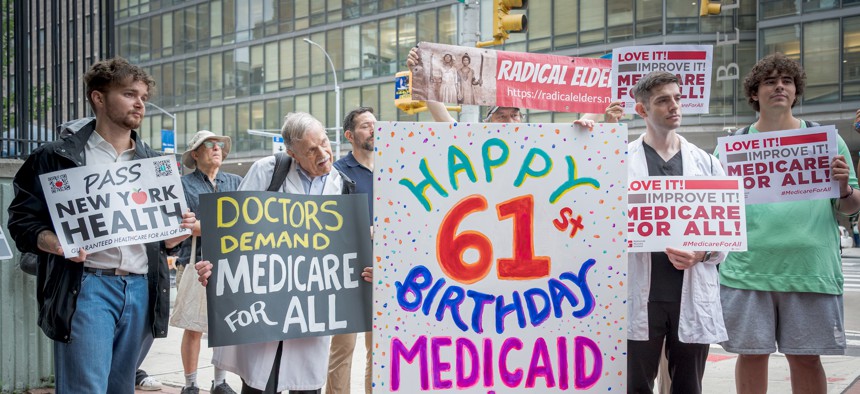
Demonstrators in Manhattan call for passage of the New York Health Act and Medicare for All on July 30, 2026 – the 61st anniversary of Medicare and Medicaid. Erik McGregor/LightRocket via Getty Images


I only learned about the New York Health Act, which first passed the Assembly in 1992, when I ran for Congress this year. In short, it’s a local version of Medicare for All – a universal healthcare system for New Yorkers and people who work full-time in the state. Instead of paying insurance companies, we pay premiums to the state from our taxes. The amount of tax we pay is based on our income, and for those who are employed, employers kick in the majority of the tax.
Currently, with our Affordable Care Act plan, my family pays more than $16,000 each year in premiums for my two boys and me. The plan covers only doctors in the five boroughs. While it's cheaper than the $80,000/year COBRA plan offered when my partner retired, it has an $8,250 family deductible. Until we hit it, we pay for most of our care ourselves, even generic prescriptions. There’s no out-of-network coverage, and co-pays for almost everything: $75 to see a specialist, $500 for the emergency room, $1,500 for a hospital stay, and only if the insurer approves it first. On top of our premiums, we could owe another $20,300 before we hit the out-of-pocket maximum.
Under the New York Health Act, my family would pay the state instead, and the state would negotiate with doctors and hospitals on payment and with drug companies on prices. Our only job is to get care when we need it, with no co-pays and no deductibles.
Yes, some of us may pay more. The bill doesn’t set tax rates, but an independent 2018 RAND study estimated that roughly the top 10% of households would pay more in taxes than they now pay in premiums. But there are no add-ons or surprises; we get vision, dental, hearing and long-term care, and our coverage isn’t tied to a job.
Already on Medicare or Medicaid? New York would ask Washington to fold those programs into New York Health. If Washington agrees, you join everyone else; if not, those programs keep paying and New York fills the gaps. Medicare enrollees would get dental, vision, hearing and long-term care, with their first $50,000 of income exempt from the new health tax. (For everyone else, the first $25,000 would be exempt). Medicaid enrollees would no longer depend on federal work requirements, and doctors would no longer be paid less to see them, which means they’d have an easier time accessing care.
The bigger picture is just as striking. A May 2026 white paper by health policy experts Cheryl Cashin and Judith Esterquest looked at what our towns, counties and school districts spend on health insurance for public workers, plus the counties’ share of Medicaid – all paid from our property taxes. Suffolk County spent $560 million on employee health insurance, plus $253 million as its Medicaid share. Under the New York Health Act, it would pay about $67 million in payroll taxes instead – for a projected savings of $745 million, which is roughly equal to the $741 million the county collects in property taxes each year. Across the state, local governments would save 12-14% of their budgets on average. New York City alone would save $13.6 billion. Statewide, according to the RAND study, New York would save about $80 billion in total health spending over ten years.
This isn’t pie-in-the-sky socialism. Your doctor stays your doctor, and the government doesn’t take over hospitals. All that changes is who pays the bill: one public plan instead of dozens of insurance companies.
The Assembly has passed the New York Health Act five times, but it has never reached the floor of the state Senate, and the governor has stayed silent largely because the profit-driven insurance lobby and some powerful unions and business groups oppose it. This session can be different: voters elected a majority of Day 1 cosponsors to the state Legislature, and Democrats now hold veto-proof majorities in both houses. That leaves no more excuses.
In Washington, Democrats seem to be coalescing around “Medicare for More,” which would lower the Medicare age to 50 and include routine dental, vision and hearing care. But that isn’t good enough. The plan omits most working-age people and long-term care. It relies on private insurers to fill the gaps with drug plans and supplements, and it leaves the insurance industry right where it is, collecting premiums.
New York doesn’t need to wait for Washington’s half-measures. Canada’s single-payer system started in one province, and then the rest of the country followed. New York has led before: we were the first state to outlaw hiring discrimination in 1945, nearly 20 years before the federal Civil Rights Act, and we legalized abortion in 1970, three years before Roe v. Wade.
Critics point to the billions in new taxes but leave out the premiums, deductibles, and co-pays those taxes replace. The payer changes; total spending goes down.
There are still details to work out, and it won’t happen overnight. But the bottom line is that the New York Health Act saves us money by cutting out the middlemen and gives us all the care we need. It’s a win-win for New Yorkers and a chance for New York to lead the country in improving healthcare while driving down costs.
Nina Schwalbe, MPH, PhD, is a former congressional candidate. She is the founder and CEO of think tank Spark Street Advisors and a public health expert who has held leadership positions at USAID, UNICEF, and Gavi, the Vaccine Alliance.
NEXT STORY: Editor’s Note: That soccer game didn’t go well