

Opinion
Opinion: The NYPD’s force review must go deeper – and the SRG must go
I spent a decade in Internal Affairs investigating excessive force cases. Here’s what needs to change.
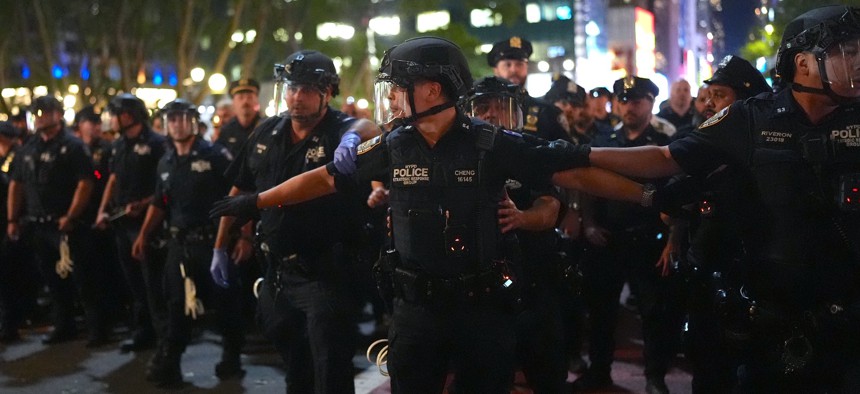
Members of the NYPD’s Strategic Response Group push back a crowd outside a Knicks watch party on June 8, 2026. Anadolu via Getty Images


New York City Mayor Zohran Mamdani has called for a review of the NYPD’s use-of-force policies, and Police Commissioner Jessica Tisch has begun the process. It is a welcome step, but the real test will be whether the department is willing to look beyond existing policies, examine past incidents and make meaningful changes that could prevent future tragedies.
While I support disbanding the Strategic Response Group over its handling of protests, the upcoming review must go further. It must rigorously examine encounters that end in shootings, serious injuries or deaths.
I spent 21 years in the NYPD, including ten years overseeing excessive-force investigations. As a lieutenant commander in the Internal Affairs Bureau’s Force Group, I oversaw thousands of excessive-force investigations, including cases where officers discharged firearms. I also led hundreds of investigations involving protests and civil disobedience following George Floyd’s killing in 2020. Those cases taught me that evaluating individual incidents in isolation is not enough. We must also examine the decisions and tactics that contributed to what happened.
I know the department takes its policies seriously and is capable of enforcing them. However, good policies must also reflect what officers face on the street and what past incidents have taught us.
In an Oct. 12 email, Tisch said the Chief of Department Michael LiPetri would lead the review with the Deputy Commissioner of Legal Matters Michael Gerber. Both have important roles to play. But the committee should also include force investigators, Training Bureau instructors, department attorneys, crisis-response practitioners and outside experts in policing, behavioral science and data analysis. We need people who understand these situations from many different angles.
SRG’s role at protests needs particular attention. The unit handles disorder-control duties while also preparing for terrorism and active-shooter incidents. Yet responding to an armed attack is very different from managing a demonstration. The city’s Department of Investigation found that some NYPD tactics used during the 2020 protests may have escalated confrontations rather than reduced tensions.
The NYPD should bring back its former Disorder Control Unit, with officers trained in communication, de-escalation, crowd management and protecting constitutional rights. They should be able to prevent violence and make lawful arrests without turning an entire demonstration into a confrontation. The Emergency Service Unit and specialized counterterrorism units should handle active-shooter incidents and terrorist attacks. The committee should review protest footage, investigative findings and accounts from officers, supervisors, legal observers and protesters. Those lessons should shape training and deployment. Simply changing the name of a unit will not solve the problem.
The same principle applies when police encounters end in gunfire: We need to understand not only what officers did, but also whether other options were available.
During my career, I never met an officer who went on patrol saying, “I want to kill somebody.” Yet people do die in encounters with police, often when officers have only seconds to make life-or-death decisions. We owe it to the officers, families and the public to understand why these tragedies happen.
The review must look beyond whether individual officers followed policy or used unnecessary or excessive force. It should also examine whether better tactics, training or equipment could have changed the outcome. Following policy doesn’t mean there was no better way to protect a life.
I remember an encounter while serving as a patrol supervisor in the 44th Precinct. Two officers responded to a call about a man in an emotional crisis carrying two kitchen knives in a hallway. I responded as their supervisor. While looking for him, we suddenly saw him running toward us with both knives. We stepped back to create distance and firmly ordered him to drop them. He complied. We took him into custody and sent him to the hospital.
Nobody was shot.
Another encounter ended tragically. On March 27, 2024, Win Rozario, a 19-year-old Bangladeshi American experiencing a mental health crisis, called 911 from his home in Ozone Park, Queens. Responding officers used Tasers after he picked up scissors. His mother tried to restrain and disarm him while pleading with officers not to shoot. When he picked up the scissors again and moved toward the officers, they fatally shot him in front of his mother and younger brother. I did not investigate or supervise that case.
The circumstances were different. The man we confronted followed our commands. Rozario picked up the scissors again. His family believes the officers could have avoided shooting him by creating distance or using a protective shield. I am not suggesting the officers faced identical situations. But we should examine whether different tactics or equipment could help prevent similar deaths.
Body-worn cameras now allow us to compare these encounters in detail. The committee should look at shootings alongside similar incidents that ended without gunfire. By reviewing footage, interviews and other evidence, we can understand what happened before shots were fired and whether officers could safely have created distance, taken cover or called for help.
Equipment also matters. A polycarbonate shield, for example, may offer protection against a stabbing threat and give officers more options. The department should consider making it mandatory equipment when responding to incidents involving knives or sharp objects.
Some situations require officers to fire immediately to protect a life. I understand that reality. But a shooting can be within department guidelines and still reveal something we should change.
The commissioner has an opportunity to make real changes. Give the committee access to evidence, enough time to do its work and a chance to hear from affected families and communities. Release the findings without compromising confidential information. Then make sure the recommendations are actually carried out, including disbanding SRG.
The success of this review should not be measured by how many policies are rewritten. It should be measured by whether officers make better decisions, protesters can exercise their rights without unnecessary confrontation and fewer people are injured or killed.
Good leadership means recognizing when something is not working and having the courage to change it. Another Band-Aid will not fix the problem.
NEXT STORY: Editor’s note: ‘Governing on easy mode’