

Interviews & Profiles
Diana Ayala was once homeless. Now she’s deputy speaker of the New York City Council.
An exit interview with the council member who for the past eight years represented Council District 8.
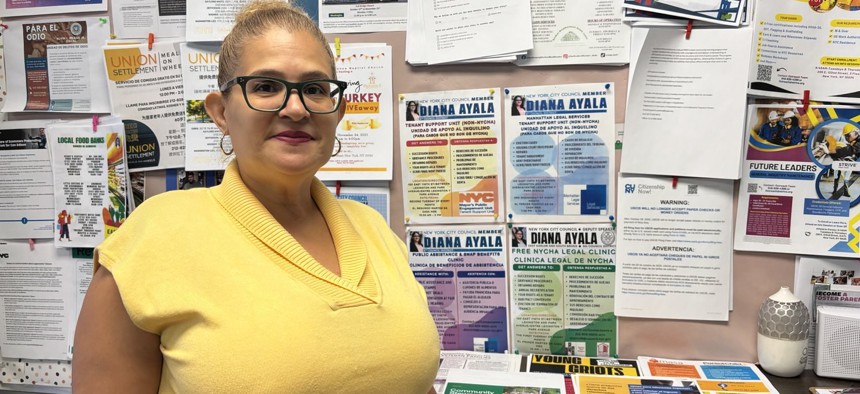
Deputy Speaker Diana Ayala represents a district that spans East Harlem, Roosevelt Island and parts of the South Bronx. Holly Pretsky


New York City Council Deputy Speaker Diana Ayala has spent her time in office supporting New Yorkers with mental illness, chairing both the Mental Health, Disabilities and Addictions Committee as well as the General Welfare Committee. Her brother, who died last year, had bipolar disorder and had been hospitalized and incarcerated, she told City & State. He also used heroin. “I wasn’t able to help him the way I wanted to because the system is so broken,” she said. “I’m happy that I was in the position that I have been because I felt like I could not only advocate for him, but for people like him.” Ayala also passed legislation to create a syringe buyback program. “It’s an example of how my own personal life intertwines with the work that I do,” she said. The outgoing council member, who represents parts of Manhattan and the Bronx, spoke with City & State about her only-in-New-York path to the City Council – and her legacy. This interview has been edited for length and clarity.
This is one of those seats that has a succession story where you worked for former New York City Council Member Melissa Mark-Viverito for a long time and then she passed the seat to you. Same with Elsie Encarnacion, who has worked for you for a long time, and you’re passing the seat to her. What do you think is accomplished when you have that continuity?
I think people undervalue the importance of that. They just assume that we feel like we’re entitled to the seat and we just want to hold on to it. But there’s a lot of benefit to the community in this type of succession planning, because Elsie, for instance, has been sitting in on meetings for years. She knows all of the issues. She’s going to be ready to go on Day One. … For instance, I have Metropolitan Hospital, which is my pet project. We've infused over $70 million into Metropolitan Hospital. We still need another $115 million to do a new emergency room.
This council is the most diverse council ever, and the first woman-majority council ever. I feel like you embody that, coming from this background of being low-income and having experienced homelessness. Tell me about your biography.
I was born in Puerto Rico. My mom moved us here when I was about 5 years old to the Lower East Side. … While we were living in the Lower East Side, we were forced into a shelter because … the building went up in flames, and so we ended up in a Tier II shelter, literally, like three, four blocks from where we were originally living … and then we moved across the street to Lillian Wald Houses. It’s a NYCHA development. And then when I was 15, and the night before my 16th birthday, my boyfriend was shot and killed. I was three months pregnant. Now I was a single teenage parent, went through my own share of emotional turmoil, suffered from postpartum depression … and I needed to kind of do my own thing. And so I emancipated myself, and then I went into shelter with my son, who, at the time, was 1. And then I moved on to a relationship that was very abusive, and ended up having another child, moved to the Bronx by then. And then, when that relationship ended, I was left in an apartment. I remember my first apartment was $430 a month for a one-bedroom apartment, and I couldn’t afford it because I was on public assistance, and I had my two babies with me, and I didn’t have any other means of making any income and so we struggled a lot.
One day, I had, like, an epiphany. I was like, “I need to figure life out, so I’m going to go back to school.” … And within a few months, I was able to get my GED. But it was the first time I had ever been exposed to college, you know, nobody in my circles ever spoke about college as a possibility. … It was a part of a program that was for mothers that were on public assistance. … And that was lifesaving for me, because I didn’t have to worry about having to go to work and, you know, take care of the kids and drop them off in school, which would have been really impossible for me at that time, so I was able to concentrate and really throw myself into my studies. And so I owe a debt of gratitude to Bronx Community College for having that type of program available to me at that time, because it really did help alleviate a lot of the stress that I was going through.
It seems like you’re a success story of a lot of these government and public programs that actually worked like they were supposed to work – the homeless shelter that was close to the house that you lived in, public housing that was affordable and then these resources to get your GED and the child care – all these public systems that actually really supported you.
I always say I had a little guardian angel that kind of guided me. … You end up where you’re supposed to be eventually, whether you want it or not. And I think that that’s kind of like the way that I’ve looked at it throughout the trajectory of my life. I got my associate degree in liberal arts and then went to Lehman College. … I was very fortunate. I thank God that I’ve had a lot of really good opportunities that come my way because of a lot of really wonderful people that have gotten to know me and my family, and have been very helpful. I’ve also been very good at self-advocacy, I’ve always been very resourceful. When I was in Bronx Community College, I had to do an internship and they placed me in an older adult program because I wanted to do human services. So I’ve always been kind of like a social worker at heart.
Through a long career in older adult services in the district, you came to know the staff of then-Council Member Mark-Viverito. She hired you to do constituent services.
I really loved it. But the reality was that the majority of the people that came in here, like 97% of the people that came here, came here with issues that I had experienced. I remember having this woman called Lucy come in here one day, and she was like, “I need help. I’m about to become homeless.” And after I reviewed the case, I realized there was no saving her. There was already an eviction order – there was no way of keeping her house. And so I had to sit with her and I said, “We’re going to have a frank conversation. You’re going to be homeless. You’re going to end up going into the shelter. But when you get into the shelter, you need to mentally prepare. … So you’re going to make the best of it for a few days, and then once you’re in the system, you’re going to come back to me, and then I’m going to make sure that they move you back to your community, to a shelter nearby.” And that woman, years later, she came back to thank me, because she was like, “You helped me face that very difficult time in a way that made me more comfortable.” Sometimes you can’t give somebody what they want, but you can help walk them through the experience, and because I knew the system, and because I had those experiences as well, I could help her visualize the good, the bad and the ugly, but it also gave her a light at the end of the tunnel that she could look forward to.
And I guess that Melissa saw that I didn’t have any intention of ever running. … She was like, “I really do think that you will make a great representative, because you have something that a lot of people lack, which is you actually love the work that you do.”
NEXT STORY: This week's biggest Winners & Losers