

New York State
Exit Interview: Albany Mayor Kathy Sheehan became the voice for all New York mayors
The experienced elected official used her post to influence the state Legislature on matters important to local executives.
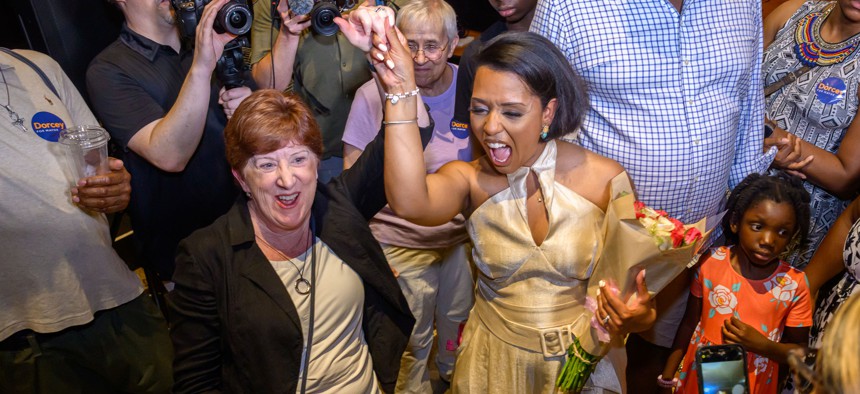
Albany Mayor Kathy Sheehan, left, celebrates with her successor Dorcey Applyrs. Jim Franco/Albany Times Union via Getty Images


Albany Mayor Kathy Sheehan plans to end her time in City Hall at the close of 2025 after weathering the COVID-19 pandemic, defending the city’s pride amid a viral moment and being a point of contact for state lawmakers looking for the perspective of a New York mayor.
Sheehan’s office is in the shadow of the state Capitol and from public safety to infrastructure, she can point to her streets to explain how state policies are or aren’t working. She hadn’t meant to serve this long in the first place, but the pandemic and the resulting recovery the city needed to undertake had a part to play in that decision.
Sheehan invited City & State to her office for a chat as she prepares to leave office, but she made it clear that she won’t disappear completely. This interview has been edited for length and clarity.
There’s only a little time left in your tenure. What’s high on your to-do list?
Finishing a number of initiatives that are underway. So I really want to make sure that I’m leaving behind not a huge pile of to-do’s that I’ve started. We’ve got the Albany West Hill Community Center that’s under construction, supposed to be mostly completed in December. It’s going to have a pool, but that obviously won’t open in December, as well as the Hoffman Community Center. That’s not going to be done until next year. There are a number of things that will be completed next year, but that are underway and paid for. So getting those things aligned and making sure that they’re on budget and on schedule is really important to me. Also working with the incoming administration, which we will be certain of by the middle of next week, is also really important. Having a transition, giving the new mayor the opportunity to kind of understand what the status is of various initiatives and where we’re tracking with our budget is going to be important as well.
When you started your tenure as mayor, did you envision it would go the way it has?
When I became mayor, I thought I would serve two terms. In Albany, we have this history of mayors serving for very, very long terms. You know, Erastus Corning, 42 years. Tom Whalen was a short termer, comparatively … and then Jerry Jennings for 20 years. And while I think that all of those mayors accomplished really incredible things, I also think that, particularly in a city the size of Albany, it’s important to have fresh ideas and new people and an opportunity for new leadership to rise up. In the middle of my second term, we had this little pandemic, and so I decided to run again for a couple of reasons. One, because we had all of this momentum and all of these great things that were happening, and everything went on pause, and so I really wanted to finish a number of things that I had started, and the other piece of it was that there was so much uncertainty, because at the time, the Trump administration only bailed out, and by bailout, I mean gave some aid to cities with more than 750,000 people. Well, that left most of America’s cities behind, and we were fighting for the American Rescue Plan, and under the Trump administration, that was not going to happen, and so it was uncertain. Were we going to be seeing incredible fiscal constraint, where we were going to have to tighten our belts and make really difficult decisions, which is what I had to do at the beginning of my term, or were we going to have a lot of money because the Biden administration would come in and pass the American Rescue Plan Act. Then it’s also important to have, I think, experience at the table. Because good news is you have a lot of money, but the challenging news is, it’s never enough, and the way that money was allocated, it had to be spent in a very short period of time, and so I had the experience of knowing the capacity of our community-based organizations and the various providers, those who were in the housing space, because we knew we wanted to build housing, and to know who could actually get this money out the door and do the work that we wanted it to do. I decided to run for a third term, and I knew that that was going to be it, and so these last four years, it’s been kind of liberating to be focused on getting the job done, as opposed to sort of thinking about the electoral piece of it and the politics piece of it.
Have you felt a degree of extra responsibility as Albany mayor, since all the state lawmakers come in every year and they observe the city around them, so anything you do in theory, it’s reverberating throughout the rest of the state?
Well, I think I’ve used it as an opportunity to be a voice for my fellow mayors, because oftentimes there are very well-intentioned legislators who are looking to address an issue, and that solution may or may not actually be something that we as mayors feel confident in being able to implement, and we really can see what the potential impacts of it might be. We have the opportunity to lobby, and we have a New York Conference of Mayors, so we have a lobbying arm, but I’m able to develop relationships with the legislators because I’m here, and I often get invited to welcome people to various lobbying days or other events that are happening that my fellow mayors can’t always get to. Being able to develop those relationships and really humanize what the impacts are, I think, has helped. I think that’s a role that the Albany mayor has often played, of having those relationships and being able to make the phone call and say, “hey, I know you’re thinking about this particular piece of legislation,” or the iterations that we’ve had with things like bail reform, and sort of these unintended consequences, I have been able to use those relationships.
Albany is in this weird place where to some people, it’s not upstate enough, and to others, it’s in the middle of nowhere.
Well, I think that there were a lot of misconceptions. I know there were a lot of misconceptions about Albany, because when I first started to engage in our lobbying efforts for capital city funding, I would get responses from the legislators about, well, “don’t you have all that revenue from Crossgates Mall,” or, “you have all those restaurants out on Wolf Road?” So to get them to understand that, for them, that’s Albany, but of course, it’s not Albany. It’s not part of our tax base. Being able to tell the story of Albany, and I think also connect, particularly with a lot of the New York City legislators, that the challenges in Arbor Hill and West Hill and the South End are just microcosms of what you see in New York City. Being able to make it clear to those who are coming here what the needs of the city of Albany proper really are was really important, because there were a lot of misconceptions that Loudonville is Albany and Guilderland is Albany, and it’s not. There was a lot of poo-pooing of what our needs were, because they would say, “well, you have all these jobs,” meaning all the jobs that are in and around the Empire State Plaza and the state jobs that are here. And I would have to explain, yes, and many, many, many, as a matter of fact, the majority of the people who have those jobs don’t live in the city of Albany. They’re commuting into the city, and then they’re leaving and they’re going into buildings that are paying me no property taxes. Most cities are places that net gain population during the day, but you know, in Atlanta, that’s workers coming in and going to work for Coca-Cola, which is paying property taxes. Being able to tell that story was important and I have to retell it, because there are new members that come in, and so I try to make sure that I’m working with our delegation to say, all right, well, who do I need to meet now and who do I need to talk to to tell Albany’s story?
Speaking of Atlanta, their spaghetti junction is just a larger version of I-787. Does part of you wish you could have made more progress on making that something else?
I admire the activists and the folks in our community who are pushing and pushing and pushing. We need them, but I’m also a pragmatist, because I know how long it takes to undo what was poor urban planning that has left its mark across this country and I talked to mayors all over the country, and almost every mayor has a 787, something that they wish that they could undo. I look at how long the process took in Syracuse, and now they’re just finally rebuilding I-81 and trying to reverse the impacts of decades and decades of that city being divided. In Albany, it’s a little different, because it’s not that it went through a neighborhood, it’s that it cut us off from the river. I saw my role as advancing the ball. So when I became mayor, there was a study of 787, and it was really more the conditions of it that had been undertaken by (the Department of Transportation), and it was completed relatively early on in my first term as mayor. One of the things that it identified near-term, long-term and longer-term opportunities, but it basically was saying we’re going to stick with the status quo. I mean, when you read the report, 787 is staying, and it’s going to stay for a long time. So there was a ramp that was identified as underutilized, and so I lobbied very hard for them to take that out of the midterm, which was something we could do within the next 10 years, to the near term, something that we were going to do something within one to five years, and they grudgingly agreed. I’m sure that the next mayor will advance the ball even further so, but these things take time.
Can you take me back to the night when ESPN basketball analyst Rebecca Lobo dissed Albany? What was it like as both mayor and someone who lives here?
Her quote was, “Good luck finding something to do in Albany.” And I will say, backing up right, pre-COVID, we had already started the residential conversions. They were completed during COVID, and COVID fundamentally changed downtown Albany, and it fundamentally changed lots of places like downtown Albany. I have a friend who’s an attorney in Boston, and three of the delis in and around her office have still not reopened. But I think when you look at a place like Albany, we’re small enough that impact is really felt, and so the combination of people not coming back to their offices, struggling to find a workforce and all of those things do make it challenging downtown. Do I think that we could have done a better job with everything around that tournament? Yes, I wasn’t part of the team, right? This was Albany County’s Convention Center and Visitors Bureau. It’s an Albany County MVP Arena. The participation that we had as a city was around public safety, so my police department was involved around whether roads were going to need to be shut down and how we were going to manage traffic flow. I would have liked to have seen a bigger investment in afterparties, in bands. But what I loved was that, totally organically, people came to our defense. I think what I’ve observed in Albany is that, and I’ve been here my entire adult life, that there tends to be this knee-jerk reaction of focusing on the negative and to see people flip that around and poke fun at it, but then also punch back was great to see. It really brought a smile to my face.
For future mayors of Albany, how do you recommend they address public opinion around housing and public safety when the numbers and data are saying one thing, but people feel another way?
You communicate, communicate, communicate. I bring people into this office who disagree with me or who I disagree with all the time, and they sit in those chairs, and we have civil conversations, and sometimes I’m able to get the outcome that I think is the right outcome based on the data and based on what I’m seeing, and sometimes I’m not. They’re just passionate about their issue, and they believe that their way is the only way, and they’re going to proceed. But I always opt for trying to take the temperature down. Because there’s this idea that if temperatures are too high, everybody’s screaming and nothing gets done, and if temperatures are too low, people get apathetic and nothing gets done. So there’s this point at which a certain level of “hey, I’m upset about this,” and “hey, I am too, and we need to find a solution,” can be really, really productive. I’m seeing it now with inclusionary zoning. I tried very hard to say, this is just math. It’s math. If you go to any bank and you want to borrow money to build housing, you have to show a return of X, a minimum return of X, and what you’re proposing yields a minimum return of X minus five. So no bank is going to loan money to a developer to build market-rate housing. I was told, well, the bank should be willing to make less money. I don’t live in that world. We’re not New York City. We do not have that type of market power. And I was truly concerned about the future of the city of Albany, and I don’t like the fact that I was right. It pains me every day, two years, two years, we have not built a single new unit of market-rate housing for people who make $55,000 and $60,000 a year. We haven’t. We haven’t built it because there were people who were adamant that they were pro-housing. They call themselves pro-housing. They call themselves housing advocates, and yet they single-handedly killed the market-rate apartment and housing market in the city of Albany. Killed it. So all we’ve done is continue to build low-income housing that concentrates poverty in formerly red-lined neighborhoods. If we want a grocery store downtown, if we want more retail, if we want more life, if we want more vibrancy, we need to have a mixed-income city. We cannot have a city that is solely made up of individuals who are struggling.
Are you leaving Dorcey Applyrs a list of projects you hope she can complete when she takes office?
I would be doing it with any mayor, but Dorcey is a friend. I’m going to have a whole stack, and, you know what, it’s really good ideas. But (the Office of Court Administration) wants a new courthouse. We want to take down 787. I would love to see how we can better embed the county Department of Health. We’ve started it, but the county Department of Health and (the Department of) Mental Health is moving into our new community centers. I think that’s going to be a real opportunity. So, yeah, there’s a lot that still needs to be done. There always will be.
What are you going to miss the most?
Solving problems for my community, big or small. I’ve really looked at every challenge as an opportunity. And really being able to show up for people and to show that we can do things. I look at the investments that we’ve made in our formerly redlined neighborhoods. When I became mayor, half the sidewalks on West Hill were asphalt, like the city had come in and ripped up the sidewalk for whatever reason. Maybe it was National Grid. Maybe it was a water main break, and they had replaced them with asphalt. Now you know, I’m a mom, and the first thing I said when I saw these asphalt sidewalks, I turned to a mother who had young ones, and I said, what does this do to your stroller? And she’s like, “Oh, yeah, I have to get a new stroller, like, every six months, because asphalt rips up the wheels of a stroller when it gets hot.” I mean, it was horrifying to me, but that’s as much as we thought about that neighborhood. And then you wonder why you have vacant buildings, and you wonder why you have graffiti, and you wonder why people throw garbage on the street. Well, we’re telling them that they’re not a priority neighborhood.