

New York City
Exit Interview: Francisco Moya achieved his dream of a soccer stadium in Queens
He has also written legislation to help immigrant students and strengthened New York City’s sanctuary protections.
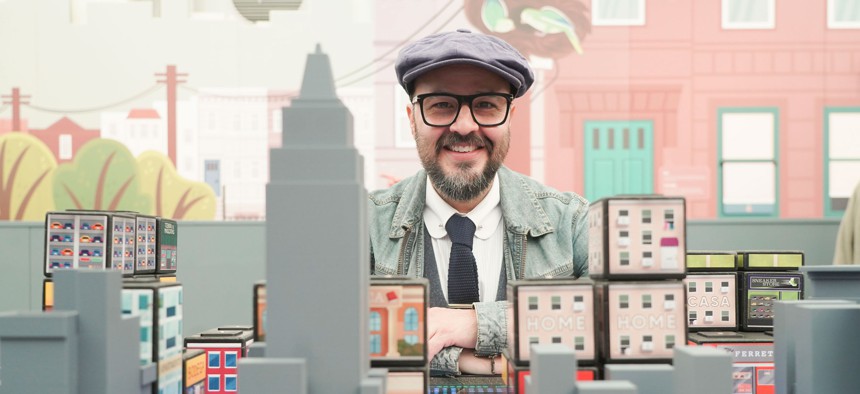
New York City Council Member Francisco Moya achieved his goal of landing a soccer stadium for Queens. Gerardo Romo/NYC Council Media Unit



After years of pushing for it, Francisco Moya is leaving the New York City Council with his own version of the World Cup: A professional soccer stadium coming soon to Willets Point, Queens.
The stadium, a long-awaited permanent home for the New York City Football Club, is the focal point of a sprawling mixed-use development project complete with 2,500 affordable housing units, a school, a hotel, an array of businesses and community space. It’s the city’s biggest development of entirely affordable housing in 40 years – a project expected to revitalize an area long defined by wetlands, an ash dumping ground, and most recently, a conglomeration of auto body shops.
For Moya, who’d grown up imagining himself scoring goals in a professional stadium while playing soccer at Flushing Meadows Corona Park, the project has been a lifelong dream.
He started chasing it back in 2011 as an Assembly member, when he became the first Ecuadorian American elected to public office in the country, his efforts continuing into his City Council tenure upon taking office in 2018. Bringing the project to the diverse, heavily immigrant district, has been a highlight of Moya’s time in elected office – as have his other efforts to help the community, like writing legislation to give undocumented students access to state financial aid and scholarships as well as measures strengthening the city’s sanctuary city protections. As he prepares to leave the City Council with no immediate plans to run for another elected office, City & State caught up with Moya to reflect on his tenure. This interview has been edited for length and clarity.
What has it been like to play out these final months of your tenure? What have you prioritized getting done?
It’s just kind of last-minute things that we have going on here. This is the neighborhood I was born and raised in, so there's a lot of different things that we have to get done, like street renamings and the housing lottery for Willets Point going online Dec. 1. I’m holding seminars with the community and many different groups to let them know how to apply. That project is really my legacy here. It’s always keeping busy, but you know, it’s really been positive. As elected officials, you have to have thick skin, but it’s always nice when you’re approached by the folks that live here and say that they’re going to miss you, and you’ve done a good job. That’s very satisfying for someone who’s been in this for like 20 years. It’s also a little emotional as well.
You’ve been pushing the Willets Points project for years. It’s got to be satisfying to leave office as that’s really starting to finally come to fruition.
My chief of staff, Meghan Tadio Benham, she’s been with me for 15 years. It’s hard to have that kind of working relationship with someone that lasts so long. I don’t think I would have been able to accomplish the things that I’ve been able to accomplish as an elected official if I didn’t have her. When I first got elected in 2010 in the Assembly, we sat down and wrote two lists. One list was on what we were going to do in Albany, and the other list, which was broader, had 10 items on it. I’d said that if we could check those 10 things off the list, we could call it a day and say damn, we did everything we set out to do. The last thing on that list was the soccer stadium.
It’s with great pride. It’s rare that you get to use your passion to shape public policy, right? I’ve been able to do that with soccer. It never was just about a soccer stadium, it was, “How do we create something that is going to leave a long lasting impression and impact on the very community that I was born and raised in?” It really helped me put together the whole combination of the housing, a school and soccer to create a brand-new neighborhood in New York City. My legacy isn’t the stadium – my legacy will be the 2,500 families who will call Willets Point home the same way I’ve called Corona home.
As a kid, I used to dream about playing professional soccer in a stadium here at (Flushing Meadows) Corona Park. I never gave up on that. I never stopped believing that I would bring a stadium to Queens. I said I’m going to write the book that no one will read because no one will know the level of intricacies and the amount of people that were involved to get to the point where we are right now. It was all well worth it though. In the end, I don’t think that many people in my position get to leave on their own terms and also get to leave behind the work that I’ve been able to do here. And look, I’m not moving. I bought the house I grew up in. This is still my neighborhood and I care deeply for it.
You endorsed Yanna Henriquez in the competitive Democratic primary to succeed you. How is your relationship with the candidate who won, Shanel Thomas-Henry?
I think it’s fine, we’ve always had a relationship, and we’ve met several times, and I have given her advice. She’s extraordinarily capable of doing really great things for this community, which I am 100% supportive of. I want her to succeed and as a constituent of hers now, I want to see the continuation of progress in the neighborhood. I think she’s going to do great and if she needs me, I am there for her.
What’s been the highest and lowest points of your time in the City Council?
Look, I’ve enjoyed my time as a council member. I think the lowest point of my time was the COVID-19 pandemic. My district was the epicenter of it. I was born in Elmhurst Hospital, I worked at Elmhurst Hospital and I represented Elmhurst Hospital as an elected official. To see what was going on, to be the first one on the ground there trying to get PPEs delivered and then to see the community experience real food insecurities, the long lines that lasted three to four hours at First Baptist Church – that had to be the lowest point. Seeing the sheer volume of neighbors who died and the many people in desperate need of basic nutrients was really difficult. It was one of the most challenging periods for me as a human being – not just as an elected official.
You were the first Ecuadorian American elected to public office in the U.S., and you’ve been a trailblazer for Latino representation in New York politics for some time. What does that mean to you?
If you look at my track record of endorsements, I’ve always always been there for Latinos. I’ve always said I may be the first, but I won’t be the last. Going and talking to young Ecuadorians about public service, encouraging them to get involved has always been something that I really enjoyed. I’ve mentored a lot of folks that have run for public office or gone on to work for other elected officials, not just here, but also outside of New York. That’s been very humbling as an Ecuadorian because my community is one that is on the rise here.
I’ve felt it was my responsibility to, one, hold myself to a higher standard and, two, to open doors for others. This year was the first time in New York City where we celebrated Ecuadorian Heritage Month at Gracie Mansion. Many other ethnic groups have been celebrated in a similar fashion, but for some reason, Ecuador never had. It’s been great being able to give back to my community and where I’m from, but also on a larger level as a Latino in politics. When I was first elected, there really wasn’t any elected officials from South America. Being able to share my culture with colleagues, many of whom now have large Ecuadorian communities in their districts, has been very meaningful. Seeing another Ecuadorian elected to the City Council or any other elected position one day would make me really proud.
You were a leading candidate in the previous City Council speaker race. Mayor Eric Adams backed you pretty strongly, which angered some members. What did you learn from the experience?
That’s in the past. I've enjoyed my time with my colleagues here in the City Council. My relationship with Adrienne has always been great and it’s been a real pleasure and honor to serve with her and have her as our speaker. I don’t look back on these things and ask, “What can I change here? What can I change there?” To me, (in) the totality of my career, that’s a small little blip. The real thing is that I have been able to accomplish the vast majority of things I set out to do as an elected official. And Willets Point has been the one thing I can say I am most proud of. That would not have happened if I was not at the City Council. Whether I was speaker or not, I was able to do that.
Beyond attending FIFA soccer games when the World Cup comes to New Jersey next year, have you figured out what you want to do next?
I have, but I’m not ready to say now.
Can you elaborate at all?
I can’t really say anything right now, but I’m happy where I’m going.
Are you going to run for public office again, or is it in the private sector?
I’m never saying I’m not coming back to public office, that’s for sure. … I love serving my community and I’m not ruling out a return, but for now I’m going to be doing something different.