

Policy
Gounardes wants moratorium on sale of AI chatbot-enabled kids’ toys
After passing the RAISE Act, state Sen. Andrew Gounardes is drafting regulation aimed at keeping ChatGPT out of teddy bears.
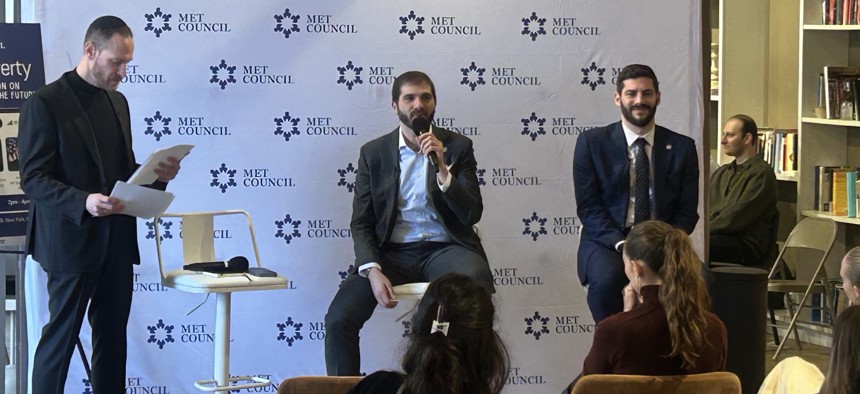
State Sen. Andrew Gounardes, center and Assembly Member Alex Bores, right, speak at a Met Council panel on artificial intelligence on March 8, 2026. Annie McDonough

Not in my Barbie.
State Sen. Andrew Gounardes is drafting legislation that would ban the sale of artificial intelligence-enabled toys for kids – a real thing that currently exists, despite the southern Brooklyn legislator likening it to an episode of “The Twilight Zone.”
“I have three little kids. There is no way in hell I think a teddy bear or Barbie doll should have a chatbot in it,” Gounardes said Sunday, speaking at a Met Council event on AI. A spokesperson for Gounardes said they are still finalizing details of the legislation and could not share draft text ahead of publication, but Gounardes said Sunday that the bill would “put a moratorium on the sale of those toys once they come to market.”
Gounardes told City & State he is not yet sure who would co-sponsor the bill in the Assembly. It’s also unclear whether Gov. Kathy Hochul would support the bill.
“Governor Hochul has implemented nation-leading regulations to ensure safe and responsible AI use in New York State,” a spokesperson for Hochul said in a statement, adding that she “remains committed to keeping kids safe online” and would review any bill that passes both houses of the state Legislature.
AI-enabled toys – for example, a teddy bear capable of conversing with kids via WiFi, a microphone and a large language model – are booming in China and have also been growing in popularity in the United States. Major AI companies have not released toys themselves but have still come under scrutiny for the advertised use of their chatbots in kids’ toys. A report by the consumer advocacy organization Public Interest Research Group found that despite major companies’ attempts to ban kids from using their chatbots, a third-party developer could use their large language models to build AI-enabled toys made for kids.
Julie Samuels, executive director of the industry group Tech:NYC, suggested the state should first focus on data privacy. “Protecting kids online is critical. We should start by passing comprehensive data privacy legislation, creating a consistent foundation of rules for how our data is used – rules that New York currently lacks,” she said in a statement. “That way, more targeted proposals around things like games and toys can build on clear protections for families.”
Gounardes and Assembly Member Alex Bores – who joined him at the Met Council event on Sunday – together sponsored the RAISE Act, which includes some of the nation’s strongest regulations on major AI developers. Hochul signed a watered down version of the bill late last year.
Both legislators are in favor of additional regulations on AI – Bores, a computer scientist by trade, has made it a cornerstone of his bid for a congressional seat in Manhattan, attracting the ire and massive capital of an industry-backed PAC spending against him. But neither legislator is an AI doomer or Luddite: Both said Sunday that they use AI in their daily lives, and are concerned with educating kids on the technology and preparing New York’s workforce for AI-related job loss. “We’re absolutely late to the dance,” Bores said of technology education in schools.
Legislators don’t appear to have any plans to slow their pace on AI regulations this year. State Sen. Kristen Gonzalez, chair of her chamber’s Internet and Technology Committee, kicked off the new legislative session with a hearing to examine best practices for ensuring the safe use of artificial intelligence across industries as the technology continues its rapid expansion into nearly every facet of life.
One bill from Gonzalez, first introduced nearly a year ago, inexplicably drew the attention of the crypto-based prediction market Polymarket last week. The company’s X account declared that proposed legislation in New York would ban chatbots from “answering questions related to several licensed professions like medicine, law, dentistry, nursing, psychology, social work, engineering, and more.” The post has received over 12 millions views and sparked significant backlash.
It also prompted a response from Gonzalez, whose bill would not explicitly ban chatbots from answering questions related to those fields, but would instead create criminal penalties for companies if their AI impersonates a licensed professional while offering advice. “You should have the right to seek damages if a chatbot tells you it is a doctor, a lawyer, a veterinarian, or any other licensed professional and gives you bad advice,” she said in a statement a day after the Polymarket post.